2018-02-03
Backbone of Europe
Help is at hand at last with my new chart of northern France, Germany, northern Italy, Austria and Slovenia which picks out what you need to know about the part of the Tabula covering Europe's most prosperous areas today.
What is striking is that the ductus of the Tabula -- and an awareness of the geography on the ground -- points to our designer having chosen a main road leading all the way from Boulogne, France to Rimini, Italy as his centerpiece.
This backbone, colored wine-red in my analytical diagram, passes through Reims, Besançon, Lausanne, the Great St Bernard Pass and Cesena. It's not the same as the medieval Via Francigena which led from Canterbury via Florence to Rome, but both the high roads served the same traffic and had many stretches in common.
Another big takeaway: the Tabula Peutingeriana is not oriented north-south. "Up" is north-west. Use the interactive control "Landmass" to see the coasts which the late antique designer had in mind. Of course the match is not perfect: Boulogne ends up on top of London, Leiden in the North Sea and Milan perched on the bank of the Rhine. But it's remarkable that anything matches in something that initially appears so chaotic.
What we are seeing is a very different take on Europe from that we are familiar with in modern maps. This is Roman Europe, with a fortified border in the north along the valleys of the Rhine and Danube (the dark blue line at top). It's also a Europe where most long-distance travel is obstructed by the Alps. The interactive control "Passes" shows how these seal off northern Italy. You can't go round them (except by ship): you have to over them as the playground song tells us.
To prove I haven't cheated, use the interactive control "Manuscript Sections" to see how the places form columns. The vertical layout precisely matches that in the Tabula, a UNESCO Memory of the World treasure now kept in a vault in Vienna. Tell me if you spot any errors. And if you want to see a similar chart of southern Europe, check out my previous blog post, Two Frances.
2018-01-28
Exultet Roll
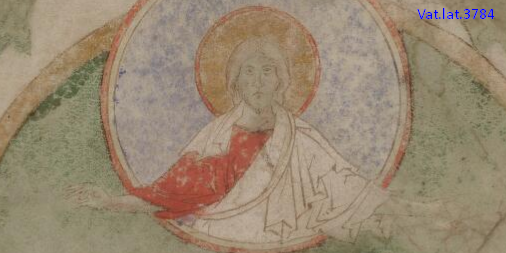
It's not the only one - half a dozen Cassinese rolls have survived - but it is celebrated for the magnificence of its text and its drawings of angels and the rising of Christ.
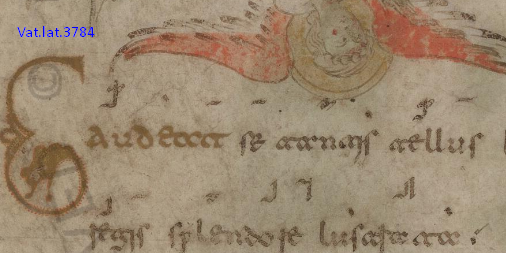
Digitization programs tend to pass over scrolls because they are difficult to scan, so I am pleased the Vatican librarians chose this one and hope they bring out more rolls for the digitizers in the next few months. You will notice that the text is inverted with respect to the pictures. The digitization shows the images right side up. I have inverted one image with "Gaudeat et tantis tellus irradiata fulgoribus..." where you can see an angel standing on his head:
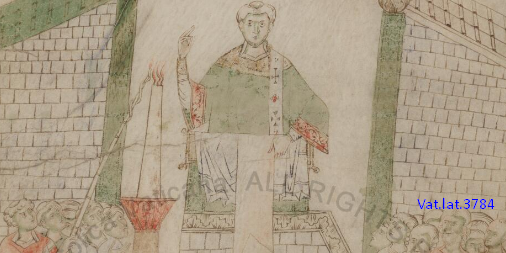
Examine the roll closely, and you'll find the explanation why. As the deacon reads from the roll, he slides its top end over the edge of the lectern to hang down for the congregation to see:
This blog post would not have been complete without heroic help from a reader, Aaron Macks (@gundormr on Twitter), who responded to my cry for help a week ago. I monitor the Vatican Library website with Distill, a simple scraper that is an extension to the Firefox ESR browser. The huge size of the Vat.lat index now defeats it, so @gundormr offered to write a script/program that would do the job.
This custom script not only works like a charm. It also picks up items that have been upgraded from low quality microfilm to high-quality (HQ) color scans. The report is generated as an HTML list. In good weeks, posts on this blog attract 1,000 readers and we all owe a big debt to @gundormr (an expert on books of hours) for keeping this service going.
- Reg.lat.37 (Upgraded to HQ),
- Reg.lat.43,
- Reg.lat.46,
- Reg.lat.47,
- Reg.lat.48,
- Reg.lat.56,
- Reg.lat.63,
- Reg.lat.102,
- Reg.lat.105,
- Reg.lat.108,
- Reg.lat.110,
- Reg.lat.143,
- Reg.lat.161,
- Reg.lat.164,
- Reg.lat.171,
- Reg.lat.176,
- Reg.lat.186,
- Reg.lat.195 (Upgraded to HQ), 9th century
- Reg.lat.666 (Upgraded to HQ),
- Reg.lat.1364 (Upgraded to HQ),
- Reg.lat.1481 (Upgraded to HQ),
- Reg.lat.1496 (Upgraded to HQ),
- Reg.lat.1573 (Upgraded to HQ),
- Reg.lat.1596,
- Reg.lat.1618,
- Reg.lat.1622,
- Reg.lat.1631,
- Reg.lat.1642 (Upgraded to HQ),
- Reg.lat.1653,
- Reg.lat.1666 (Upgraded to HQ),
- Reg.lat.1669 (Upgraded to HQ),
- Reg.lat.1685,
- Reg.lat.1689,
- Reg.lat.1692,
- Reg.lat.1695,
- Reg.lat.1699,
- Urb.lat.87,
- Urb.lat.105,
- Urb.lat.115,
- Urb.lat.146,
- Urb.lat.149,
- Vat.lat.427.pt.2,
- Vat.lat.585,
- Vat.lat.1984.pt.A,
- Vat.lat.2074 (Upgraded to HQ),
- Vat.lat.2104,
- Vat.lat.2150,
- Vat.lat.2183,
- Vat.lat.2370, Intentiones habemus in presenti conscriptione (13c-14c); see eTK
- Vat.lat.2412,
- Vat.lat.2448,
- Vat.lat.2453,
- Vat.lat.2456,
- Vat.lat.2459, Cura omnium egritudinum que accidunt a sumitate capitis; possibly by Pontius de S. Egidius; see eTK
- Vat.lat.2460, Cause difficultatis scientie pulsuum sunt; by Aegidius; see eTK
- Vat.lat.2507,
- Vat.lat.2520,
- Vat.lat.2583,
- Vat.lat.2618,
- Vat.lat.2663,
- Vat.lat.2690,
- Vat.lat.3784, Exultet Roll. See above.
2018-01-24
Cheery Again
Grateful, I decided to seek -- by hand -- the newly issued Vat.lat. items from the still-missing second week of January. It turns out there are 45, plus three codices newly upgraded from murky microfilm to high quality. They are listed below, only lightly commented.
- Vat.lat.168,
- Vat.lat.315,
- Vat.lat.427.pt.1,
- Vat.lat.636.pt.1,
- Vat.lat.636.pt.2,
- Vat.lat.788,
- Vat.lat.1316,
- Vat.lat.1503,
- Vat.lat.2057,
- Vat.lat.2086,
- Vat.lat.2087,
Aristotelian competitors from the 15th c. now back to back in the BAV.
— Pieter Beullens (@LatinAristotle) January 28, 2018
"De Anima" in the Latin versions by Argyropoulos & Trapezuntius. HT @JBPiggin https://t.co/jZQkPS31Kzhttps://t.co/1aogx3dQH3 pic.twitter.com/3S71tJiGe7 - Vat.lat.2091,
Thanks to @JBPiggin's list this MS with Aristotelian texts @DigitaVaticana. Here the end of the Parva naturalia and the beginning of the Physionomia.https://t.co/xACjs5lACP pic.twitter.com/o5Zo0cVIIg
— Pieter Beullens (@LatinAristotle) January 24, 2018 - Vat.lat.2187,
Commentary on Aristotle's "De anima" in @JBPiggin's list of MS @DigitaVaticana. Bought in 1444 in Padua for 4.5 ducats by friar Franciscus de Rovere de Saona, who later became Pope Sixtus IV. Autograph note.https://t.co/aXYRQYu1JI pic.twitter.com/YCiaLcHiCW
— Pieter Beullens (@LatinAristotle) January 25, 2018 - Vat.lat.2219,
- Vat.lat.2227,
- Vat.lat.2309,
- Vat.lat.2312,
- Vat.lat.2320,
- Vat.lat.2323,
- Vat.lat.2367, Hippocrates: Ad discipulum suum Actonem longis petitionibus (14th century copy); see eTK
- Vat.lat.2368,
- Vat.lat.2374, Cornelius Celsus: Ut alimenta sanis corporibus agricultura; see eTK
- Vat.lat.2386,
Thanks to @JBPiggin's list this MS with Aristotelian texts @DigitaVaticana. Here the end of the Parva naturalia and the beginning of the Physionomia.https://t.co/xACjs5lACP pic.twitter.com/o5Zo0cVIIg
— Pieter Beullens (@LatinAristotle) January 24, 2018 - Vat.lat.2397,
- Vat.lat.2401,
- Vat.lat.2419,
- Vat.lat.2420,
- Vat.lat.2423, Acatia est sucus alchati; .te Synonyms
- Vat.lat.2428, Liberet te deus fili amantissime a via errorum (14c-15c); see eTK
- Vat.lat.2432,
- Vat.lat.2446, Avicenna: Medicina est conservatio sanitatis et curatio egritudinis; see eTK
- Vat.lat.2450,
- Vat.lat.2472,
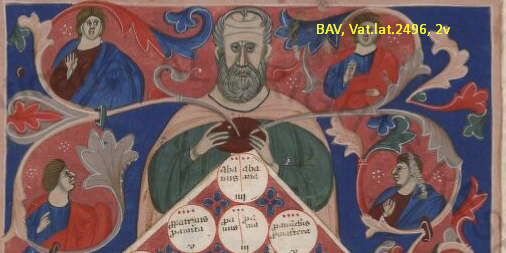
- Vat.lat.2496, the Liber Sextus Decretalium with Iohannis Andreae kinship diagrams. Magnificent!
- Vat.lat.2518,
- Vat.lat.2626,
- Vat.lat.2644,
- Vat.lat.2645,
- Vat.lat.2649,
- Vat.lat.2657,
- Vat.lat.2668,
- Vat.lat.2672,
- Vat.lat.2696,
- Vat.lat.2697,
- Vat.lat.2752,
- Vat.lat.2146, Walter Burley, Nota quod in homine sunt quinque sensus; see eTK
- Vat.lat.2186, Dominicus Gundissalinus, Cum omnes homines eque constent ex anima et corpore; see eTK
- Vat.lat.2426 , Urina alba in colore tenuis in substantia (14th century codex); see eTK
This is Piggin's Unofficial List number 146. If you have corrections or additions, please use the comments box below. Follow me on Twitter (@JBPiggin) for news of more additions to DigiVatLib.
2018-01-21
Grumbling
I have now reached the state where my fairly good computer and my high-speed internet connection can no longer reliably download and compare the Vat.lat. index page with its absurdly long list of 4,026 items, even when I block the images. Loading the index page takes up to a minute.
The solution ought not to be difficult. The series needs to be listed in 1000-manuscript chunks: 1-999, 1000-1999, 2000-2999 and so on. Until our technical friends at the Vatican realize that no one on the internet nowadays serves single pages with 4,026 images and reorganizes the indices in a more rational fashion, I am not going to be able to monitor for updates.
As a result, all that I have this week for you are 10 items from the other Vatican sub-collections:
- Reg.lat.101 contains keys to bible study, including Brito de vocabulis byblie secundum ordinem alphabeti
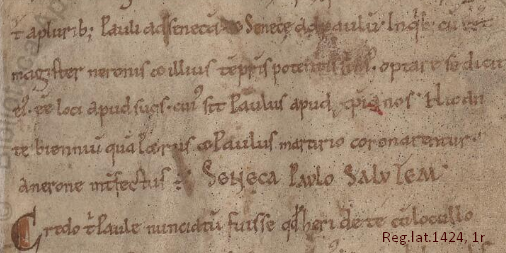
- Reg.lat.1424, an 8th or 9th century compilation of the classics starting with the famous forged exchange of letters between Seneca and St Paul, and including a poetic bit of the De Consolatione Philosophiae of Boethius Check out the tweet by @ParvaVox with more details.
- Reg.lat.1464, Cicero, De Officiis and other works
- Reg.lat.1643, Solinus, De mirabilibus mundi
- Reg.lat.1660, poetry, Italian
- Reg.lat.1662, begins with Caecus in limine, a whodunnit from Pseudo-Quintilian
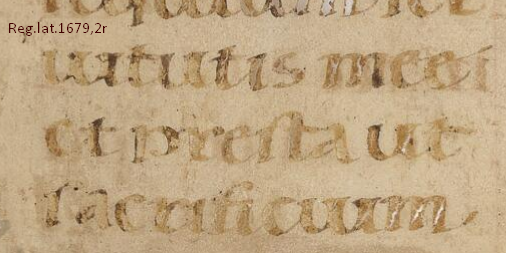
- Reg.lat.1679, Vergil, Eclogae, with a flyleaf reused from an old uncial missal, here the words "et presta ut sacrificium"
- Reg.lat.1680, Plautus, Comedies
- Sbath.34, an Arabic manuscript from the collection of the famed Father Paul Sbath
- Urb.lat.1101, letters, first date 1631, in Italian
2018-01-14
Felice Squares
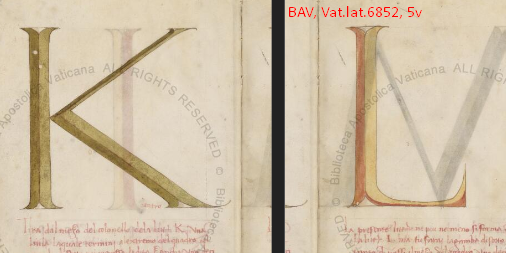
Vat.lat.6852 is the original copy of Alphabetum Romanum, his treatise on the geometrical construction of Roman capital letters using the square and circle. It was digitized and issued online a few days ago. It is part of the Renaissance movement that created Antiqua, the new lettering based on Roman models.
Of course we do not now like to see a square K as wide as it is high, but it is part of the slow process of experimentation that brought microtypography to where it is today. Enjoy.
Here is my full list of new releases. eTK refers you to the Thorndike and Kibre index. I must remain brief, as my left hand is still in a cast after surgery, and typing is difficult.
- S.Maria.in.Via.Lata.I.45, the Evangeliary of S. Maria in Via Lata, battered, mouldy and a thousand years old. The canon tables pages are classic in style. New uploads from @DigitaVaticana HT @JBPiggin and among them a true jewel: the 9thC evangeliary of Santa Maria in Via Lata is one of the very few manuscripts we can locate in early #medieval Rome and it's even more exceptional because we know it was used by a female community pic.twitter.com/Hc4s5lmhN5— GiorgiaV (@ParvaVox) January 15, 2018
- S.Maria.in.Via.Lata.I.45.pt.A, jewelled cover and bookmarks of above, some items seemingly even older
- Vat.lat.168
- Vat.lat.207 homilies of Origen in Latin translation; NB: error in Trismegistos: not TM 67902 = Lowe, CLA Suppl. 1769 = Rome, "Vatican, Biblioteca del Vaticano Lat. 207" which is in fact Pal.lat.207 (Lorsch; 750-825).
- Vat.lat.339
- Vat.lat.434.pt.1
- Vat.lat.434.pt.2
- Vat.lat.435.pt.1
- Vat.lat.454.pt.2
- Vat.lat.527.pt.1
- Vat.lat.527.pt.2
- Vat.lat.618
- Vat.lat.765
- Vat.lat.771 A less spectacular presentation of Aquinas' commentary on Aristotle's "De Anima". HT @JBPiggin as often.https://t.co/bYUv7uWUzb pic.twitter.com/KiCom7osLL— Pieter Beullens (@LatinAristotle) January 14, 2018
- Vat.lat.788 All out Thomas Aquinas in @JBPiggin latest release of MSS from @DigitaVaticana. Thread of various MSS containing the "Summa contra Gentiles"https://t.co/6LidAO73rj pic.twitter.com/CO0JzOP1ku— Pieter Beullens (@LatinAristotle) January 14, 2018
- Vat.lat.790
- Vat.lat.791
- Vat.lat.851
- Vat.lat.1008.pt.1
- Vat.lat.1008.pt.2
- Vat.lat.1101
- Vat.lat.1162.pt.1
- Vat.lat.1162.pt.2
- Vat.lat.1162.pt.3
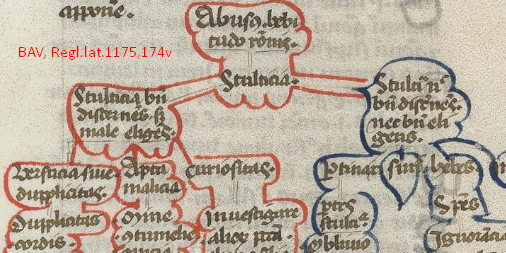
- Vat.lat.1175.pt.1, a great 12th-century work that uses stemmata to organize the teaching material: Radulfus Ardens, Speculum universale
- Vat.lat.1232
- Vat.lat.1250.pt.2
- Vat.lat.1304
- Vat.lat.1306
- Vat.lat.1314
- Vat.lat.1315
- Vat.lat.1568
- Vat.lat.1626
- Vat.lat.1898
- Vat.lat.1951.pt.1
- Vat.lat.1953
- Vat.lat.1961
- Vat.lat.1973
- Vat.lat.1985
- Vat.lat.1988
- Vat.lat.2009
- Vat.lat.2051
- Vat.lat.2053
- Vat.lat.2061
- Vat.lat.2076
- Vat.lat.2081
- Vat.lat.2116
- Vat.lat.2144
- Vat.lat.2156 Another popular medieval commentary on the same treatise "De Anima" was written in the early 14th c. by John of Jandun.https://t.co/ghr5MKzTGb pic.twitter.com/IfyDSK65X8— Pieter Beullens (@LatinAristotle) January 14, 2018
- Vat.lat.2157 HT to @LatinAristotle: second copy of the above commentary by John of Jandun
- Vat.lat.2161 eTK
- Vat.lat.2164 Also online @DigitaVaticana & in @JBPiggin's latest list. Anonymous commentary (ignore the caption in the top margin) on Aristotle's zoological books.https://t.co/MEOIhTFkHJ pic.twitter.com/68jj2ROh3n— Pieter Beullens (@LatinAristotle) January 14, 2018
- Vat.lat.2174 To conclude an afternoon on the playground of @JBPiggin's list of @DigitaVaticana MSS: Peter of Abano's commentary on the Aristotelian "Problemata".https://t.co/QejpexSgD2 pic.twitter.com/Qlf7A0Q7WM— Pieter Beullens (@LatinAristotle) January 14, 2018
- Vat.lat.2197
- Vat.lat.2200
- Vat.lat.2220
- Vat.lat.2223
- Vat.lat.2270
- Vat.lat.2301
- Vat.lat.2310
- Vat.lat.2327
- Vat.lat.2329
- Vat.lat.2371 eTK
- Vat.lat.2372 eTK
- Vat.lat.2373 eTK
- Vat.lat.2387
- Vat.lat.2391
- Vat.lat.2404
- Vat.lat.2457, Constantine the African: Pantegni Ah, this is a sight to behold: the earliest copy of @EgoConstantinus's #Pantegni in the @DigitaVaticana collection. (H/t @JBPiggin for notice: https://t.co/FZYNkMG8HM.) The #Pantegni is translation of 'Ali ibn al-'Abbas al-Majusi's 2-part encyclopedia of medicine. Here's incipit. pic.twitter.com/0EWewsYsls— Monica H Green (@monicaMedHist) January 14, 2018
- Vat.lat.5309
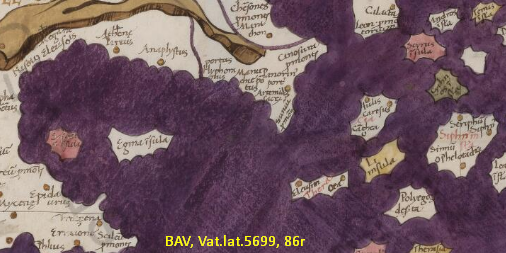
- Vat.lat.5699, a de luxe version of Ptolemy's Cosmography, dated 1469, translated from Greek to Latin by Iacobo Angelo. In the maps section, here is the Gulf of Athens. Note how each of the islands is a different colour, like confetti:
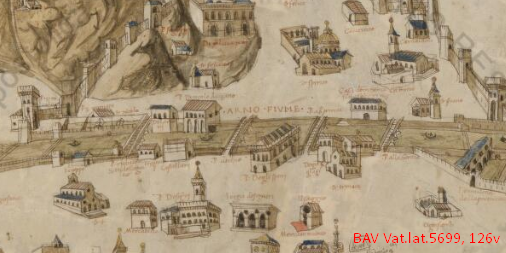
There are wonderful idealized town views, like this of Florence: pick out the Ponte Vecchio and try to find the Duomo: in fact it is marked in historicizing fashion as Santa Reparata:
Anthony Grafton noted for the Rome Reborn exhibition how the view on the next page showed Rome with the Castel Sant'Angelo, the Borgo and Saint Peter's at
bottom right, separated from the city by the Tiber: "Within the city
proper, the ancient monuments rise, without modern buildings and urban
sprawl. The Pantheon, the Forum, the Capitoline and Palatine hills, and
the Colosseum dominate the central space."
Fascinating! I was moved to see Ognisancti abbey, the church favored by the Vespucci family. Amerigo was 15 when this map was drawn, and probably still attended mass there from time to time. Thanks! pic.twitter.com/pYgtjGWgTq
— Historia y Mapas (@LRoblesMacias) January 25, 2018 - Vat.lat.5845, the late antique Collectio Dionysiana and Collection of Cresconius in an important 10th-century South Italian composite manuscript in a Beneventan hand
Another fascinating early #medieval #manuscript online thanks to @DigitaVaticana HT @JBPiggin: a canon law collection (Dionysiana&more) copied by Montecassino monks in exile (Capua 915-934) also integrating vestiges of a debate between the pope & #Carolingian missi (pic no. 4) pic.twitter.com/MVgLgCeLta
— GiorgiaV (@ParvaVox) January 16, 2018 - Vat.lat.6852, the original copy of the Alphabetum Romanum (above).
- Vat.lat.13152.pt.2
- Vat.lat.14936https://t.co/nvxFdwgGFC.14936 - Book of hours from 1561. Use of Rome and most likely Parisian calendar, it announces that it was made for Catherine de Medici on f.1v— AaronM (@gundormr) January 16, 2018
- Vat.lat.14937
- Vat.lat.15294.pt.2
2018-01-06
All the Palatine
This is a pretty big deal, because it means the former Latin section of the University of Heidelberg Library as of 1622 has been recreated as an online avatar at Bibliotheca Palatina. The prestigious library was hauled off to Rome as war booty and only the German and Greek books later returned.
The 2,030-book collection will also constitute the first complete large collection or sublibrary at the 80,000-codex Vatican Library to be available online. (Though not at the Vatican itself, where only half of the items are so far available in the Pal.lat. online collection.)
The collection is being digitized at the University in Germany with funding from the benefactor Manfred Lautenschläger. Presumably for contractual reasons the Vatican itself can only show the digital images online after a certain delay. Here are the last 11 items I have logged:
- Pal. lat. 1819 [Juristische Sammelhandschrift]
- Pal. lat. 2006 Schreibkalender, Tagebuch Pfalzgraf Johann Kasimirs; Abschussliste 1582 (1582)
- Pal. lat. 2020 Schreibkalender, Desiderata der Palatina
- Pal. lat. 2021 Indices zu Handschriften und Drucken der Palatina
- Pal. lat. 2022 Gebetbuch in deutscher Sprache, genealogische Notizen (16. Jh.)
- Pal. lat. 2023 Schreibkalender, Tagebuch Kf. Friedrichs III. von der Pfalz/Pfalzgraf Johann Casimirs (1569)
- Pal. lat. 2024 Schreibkalender, Tagebuch Kf. Ludwigs VI. von der Pfalz (1581)
- Pal. lat. 2027 Schreibkalender, Tagebuch Kf. Ludwigs VI. von der Pfalz (1579)
- Pal. lat. 2028 Mappe mit Einbandfragmenten (14./ 15. Jh.) (14./ 15. Jh.)
- Pal. lat. 2029 Inventarium manuscriptorum Latinorum Bibliothecae Palatinae (17. Jh.)
- Pal. lat. 2030 Codicum manuscriptorum Latinorum Vaticanae Palatinae Bibliothecae Index (Vatikanstadt, 1678)
- Reg.lat.1521: La Bugia, Rime del Marchese M. Palombara
- Reg.lat.1646: classics, signed by scribe William in 1270 on the last page
- Reg.lat.1648
- Reg.lat.1657, Cicero, Ad Familiares
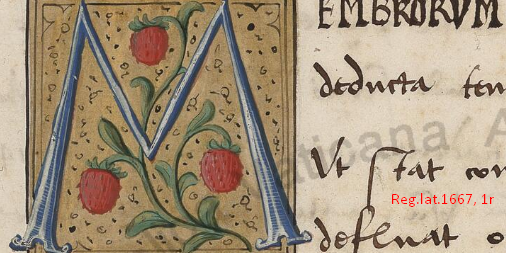
- Reg.lat.1667, Quintus Serenus Sammonicus (died 212): De medicina praecepta saluberrima, a didactic medical poem, with this lovely opening initial:
- Reg.lat.1690, genealogy in German
- Reg.lat.1694, Evrard de Bethune's Latin grammar, Graecismus
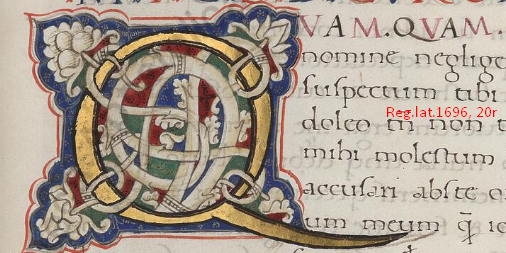
- Reg.lat.1696, Cicero, fine Renaissance initials like this:
- Urb.lat.371, Sebastiani Maccii Durantini ... Soteridos
- Urb.lat.1061, letters and reports of 1593
- Urb.lat.1108, letters and reports of 1639-40
2017-12-27
Quick Click
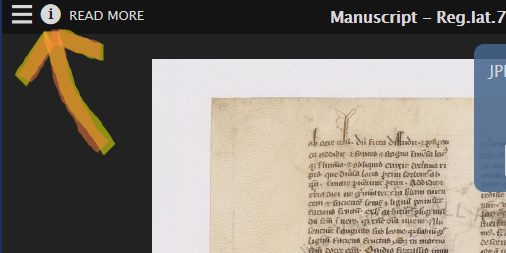
If you are looking at a codex page and need to quote it, click on the "i" in a white circle in the left navigation pane:
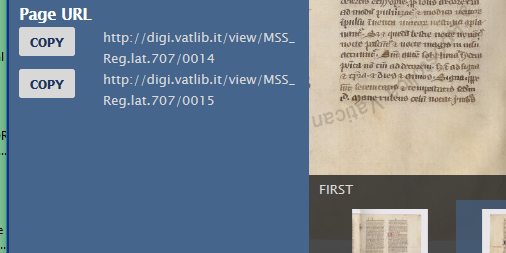
Scroll down to and down to "Page URL":
From here you only need to click the "COPY" button to get a usable link in your clipboard.
And now, the list of 26 new additions:
- Borg.copt.109.cass.XXV.fasc.123, page of a gospel?
- Borg.copt.109.cass.XXV.fasc.124,
- Borg.copt.109.cass.XXV.fasc.125,
- Borg.copt.109.cass.XXVI.fasc.126,
- Borg.copt.109.cass.XXVI.fasc.127,
- Borg.copt.109.cass.XXVI.fasc.128,
- Borg.copt.109.cass.XXVI.fasc.129,
- Reg.lat.203,
https://t.co/mSJy2B0TQo.203 is a Brevarium (Cistercian?), starting with the service for dedication of a churchhttps://t.co/mSJy2B0TQo.1647 seems to be Macrobius’ Saturnalia
— AaronM (@gundormr) December 28, 2017 - Reg.lat.1120, Justinian Code, glossed, 13th century
- Reg.lat.1271, commentary on Avicenna's canon (HT to @monicaMedHist)
- Reg.lat.1291, Renaissance commentary on Aristotelean mechanics
- Reg.lat.1410, 10th-century classics manuscript with Virgil, Horace, Juvenal
new manuscripts uploaded @DigitaVaticana among which this fascinating 10thC copy of classical poetry (Horace, Virgil, Persius & Juvenal) conceived and designed to accommodate a substantial corpus of interlinear and marginal annotations. HT @JBPiggin https://t.co/DE0if6bWV5 pic.twitter.com/JnYipjozDV
— GiorgiaV (@ParvaVox) December 28, 2017 - Reg.lat.1454, Seneca, Letters to Lucillium
- Reg.lat.1489, Lancelot du Lac, French
- Reg.lat.1559, early Renaissance compilation of Latin classics
- Reg.lat.1608,
- Reg.lat.1645.pt.1,
- Reg.lat.1645.pt.2,
- Reg.lat.1647,
- Reg.lat.1655, early Priscian, Institutiones grammaticae
- Reg.lat.1656,
- Reg.lat.1661,
- Reg.lat.1663,
- Reg.lat.1668,
- Reg.lat.1675, Horace, 11th-century?
- Urb.lat.1402, Fiore delle medicine, 15th-century Italian medical treatise (HT to @monicaMedHist)