2015-02-28

Portolan Charts of Pietro Vesconte

Among the finest things to be made available online this week from the Biblioteca Apostolica Vaticana (BAV) digitization programme in Rome is a codex, Vat. lat. 2972, which contains portolan charts which though unsigned can be reliably attributed to the remarkable mapmaker Pietro Vesconte and dated to about 1320.

Portolan charts are, for all intents and purposes, the first true western maps. Everything that precedes them, ought, in my view, to be classed as geographical diagrams.

A portolan chart was something novel and unprecedented, showing the world deskewed and to scale. Geographical diagrams like the BL's Psalter Map of 1265 (see this flash version) showed the human world as mentally represented. By contrast, portolan charts, with compass lines superimposed, show the physical world as one navigates it, with the entire coastline of a sea fully labelled without regard for the social standing of the places on the coast. When a vessel is trapped by a landward wind, any of the places here offers a potential haven on a lee shore. The Vat. lat. 2972 codex contains an atlas of five sheets and is part of Marino Sanudo's Liber secretorum, a book devoted to a mad plot to destroy the Muslim world. Here is the atlas version of the English Channel (folio 110v):
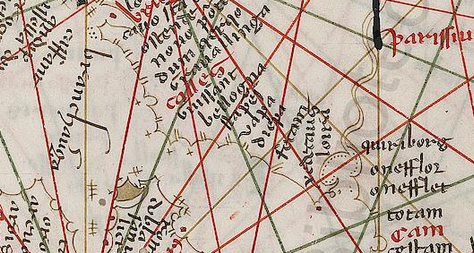
In the middle you see Dumqerqo (Dunkirk), Gravallinga (Gravelines), Calles (Calais) and Bellogna (Boulogne), and at right Parissius (Paris) and Cam (Caen).

Tony Campbell, former map librarian of the British Library, wrote a fine descriptive summary about portolan charts earlier in February on the Pelagios blog while presenting the portolan component of the Pelagios project. He tells us at least one portolan chart from the very end of the 13th century survives. The BAV's, from just two decades later in 1320, will likely become a prime reference on the internet. Yale has a later chart from 1403 online.

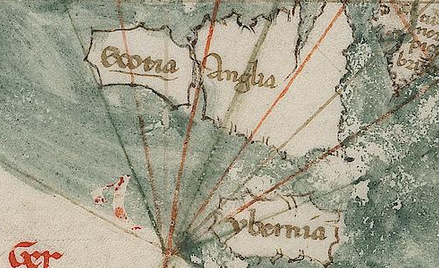
Curiously, Genoa-born Vesconte also did mappaemundi similar to that in the Psalter Map. He was on the cusp of the transition from old to new. Here are the British Isles in his Vat. lat. 2972 mappamundi. Since this map (112v) has east at its top, Ireland (Ybernia) is at the bottom of this grouping:
Update

I have tried to tag all the places on the continental coast in the portolan chart above, but some defeat me. Here is what I have resolved, after consulting Campbell's general toponymic listing:
#Bruges
? (Cavo Sta Catalina identified as Pointe de Zand by Campbell. Not clear what St Catherine's; the source document would have been Portuguese.)
#Oostende
#Nieuwpoort
#Dunkerque
#Gravelines
#Calais
#Wissant
#Boulogne
#Étaples
? (vapa identified by Campbell as Port St. Quentin or Eu.)
#Dieppe
#Fécamp
? (no port marked; Campbell proposes Chef de Caux)
? (no port marked, so "loira" may be an inland place)
#Quillebeuf
#Harfleur (on wrong side of Seine!)
#Honfleur
#Touques
#Caen
#Ouistreham

Some of these ports no longer exist, the rivers having later silted up and become unnavigable, leaving coastal areas that today are mainly a zone of holiday beaches.

Tony Campbell published a major new article on March 2, 2015 on the Carte Pisane, which is traditionally regarded as the oldest portolan chart, but is now the focus of controversy. He sets out arguments as to why it should be dated to the very end of the 13th century.

2015-02-25

Bumper book of medieval adventure in 549 full-colour frames

One of the treasures that popped out among the 64 items digitized so far this week by the BAV, the historic research library at the Vatican in Rome, is the Hungarian Angevin Legendary. It's an astonishing, comic-book style compilation of lives of saints full of gold and silver and technicolor gore. According to fellow blogger Zsombor Jékely, there are 549 known frames.

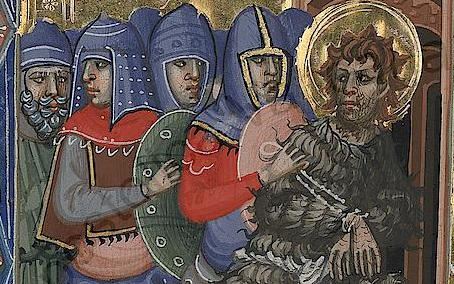
Here's my namesake John the Baptist being frogmarched by Herod's goons into the palace to have his head chopped off (folio 5r). Each of these pictures rewards many minutes of rapt attention. The Legendary was full of compelling visual storytelling techniques. Add a few speech bubbles and you would have a modern graphic novel. With some Ken Burns effects, many of the pages could easily be turned into some very impressive video.

The old story goes that this amazing book was commissioned to delight a spoiled 3-year-old Hungarian prince in about 1340, but that is probably a misconception. In all likelihood this was a strictly adult book, probably commissioned by or for the daddy king himself.

Like too many of the best codices, this one has been criminally dismembered. The BAV has the bulk of it, in the form of Vat. Lat. 8541, which you can now admire online (click the link at left). Quite a bit more is at the Morgan Library in New York (click the link and check out 22r which shows a headless body being dumped down a well). Jékely says there are also bits at New York's Metropolitan Museum of Art, MS 1994.516 (1 leaf),  Berkeley's Bancroft Library, BANC MS UCB 130:f1300:37 (1 leaf) and further leaves at the Hermitage and at the Louvre.

This is just one of the many good things to explore on the BAV website. Here is my tally of what is new: Arch. Cap. S. Pietro: 19; Barb. gr.: 2; Borgh.: 10; Chig.: 1; Ott. lat.: 2; Reg. lat.: 3; Sire.: 1; Urb. lat.: 1; Vat. ebr.: 10, Vat. estr. or.: 10; Vat. gr. 1; Vat. lat.: 3; Vat. turc.: 1. The total of manuscripts digitized now stands at 1,690. [This is Piggin's Unofficial List 2.]

2015-02-17

Is this the world's oldest bound book?

This was the week when the Vatican's library, the BAV, made available online digital images of what is perhaps the world's oldest intact, large, bound book, the Codex Vaticanus. It contains a handwritten text on 759 vellum leaves and is generally estimated to have been made in the second quarter of the fourth century (325–350 CE).

That it survives is amazing. That no one noticed what the Vatican was doing is almost more amazing. But more about that later.

During the 19th century, the BAV customarily only allowed visitors to touch this treasure under guard, so great was the fear that it would be stolen or damaged by a religious fanatic. Scholars grumbled at this, but the librarian's suspicions were not ill-founded. That anybody with web access can now read it without a couple of muscular young clergymen staring at the back of their neck as if they were a terrorist is a wonderful transformation.

The codex contains the Christian Old and New Testament in Greek and is comparable in age and significance with the Codex Sinaiticus, which got its own lush online presentation five years ago.

One can toss up as to whether the Vaticanus or the Sinaiticus is the oldest substantial bound book in existence, but the Vaticanus is the one in better shape, since it is still in one binding. The Sinaiticus got dismembered in the 19th century by the sort of scholar that the Vatican wisely never trusted (see above) and is now divided between four countries.

Neither book has a production date on it, so their ages can only be guessed from palaeographic evidence. Wikipedia's substantial description argues Vaticanus contains more antiquated features and is the older of the two, although one scholar, T.C. Skeat, propounded a theory that the two codices are contemporary and both come from the Late Antique scriptorium of Eusebius of Caesarea.

At the start of this post, I said the codex may be the oldest bound book. The qualification is important since books as we now know can come in three forms: scroll, codex and e-book.

I would have seen my first e-book at the Frankfurt Book Fair about 30 years ago and thought it a strange new thing, and the first owner of the Codex Vaticanus might have seen his first codex used for a scholarly purpose and thought it was a strange thing 30 years before he commissioned this very special codex for himself.

It is generally suggested that codices -- that is, books made of flat pages between two boards, bound at a spine -- began to outnumber the earlier technology, the scroll, in about 300 CE.

So "books" older than the Codex Vaticanus do survive: in scroll form, or as isolated pages torn from codices, among them the Chester Beatty papyri. But if you were to ask me where to find the world's oldest book -- meaning a thing between two covers, which is what most of us would mean -- I would point you to Rome, BAV, Vat. gr. 1209. Look at it and marvel.

On February 16, 2015, the BAV added 31 new items to its stock of online digitizations, raising the total volumes so far to 1,626. The collections added to were Arch. Cap. S. Pietro (10), Borgh. (5), Ott. lat. (1), Sbath. (1), Vat. ebr. (6), Vat. gr. (1, the Codex Vaticanus), Vat. lat. (4) and Vat. turc. (3).

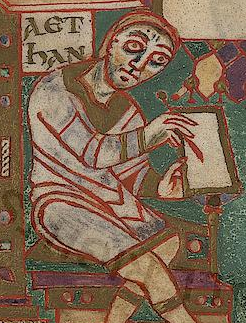
Items in the enormous Vat. lat. series which are newly available are Vat. lat. 83, which is a fine collation of hymns and psalms from the 11th century. It has a wonderful illumination in it of David with harp and the other supposed writers of the psalms, among them Ethan in a sailor suit (right), each with quill and ink-horn and a nifty little mobile desk of the sort that court writers must have used in the 11th century.

Tracking down the psalm authors had always been a matter of interest to Jewish and Christian scholars as we know from my edition of the fifth-century Liber Genealogus.

Also online for the first time are a book catalogue (Vat. lat. 3970) by Cardinal Sirleto (1514-85), a biography of Saint Gerard (Vat. lat. 7660), and a wonderful scrapbook of fragments (Vat. lat. 13501) presumably extracted from old bindings where we see a great variety of writing styles, a palimpsest or two, bits of sheet music and everything else that would have been hurled out in library spring cleanings and landed in this or that medieval book binder's recycling bin.

Sadly, the Vatican Library does not have the time or resources to promote this amazing release. To get in the news nowadays, you need a mass murder, a scandal or PR hype. The sole publicity for the release of the Codex Vaticanus was one modest tweet. Yes, a twiddling, tiny tweet. I suppose that all of the digital project's funds must go into actually scanning the books and getting the files into the servers.

I will keep a continuing watch on what they are digitizing in such honorable secrecy and present an occasional summary on this blog or on my Twitter feed. [This is Piggin's Unofficial List 1.] If you know of anyone else tracking the BAV digitization project, I would be happy to contact them.  Follow this blog, or follow me on Twitter @JBPiggin and I will keep you up to date.

This post originally ended with some debate on the "oldest bound book" hypothesis, but since that material grew so long, I have moved it to a separate blog post.

2015-01-23

Vatican Libary Making Progress

There are signs at last that the Vatican Library's manuscript digitization program is making good progress: there are now 1,549 manuscripts of the Biblioteca Apostolica Vaticana available online (up from 1,503 on January 1, a gain of 3 per cent in just 3 weeks).

The index page, which previously, listed every single digitization, has got so unwieldy that it has now been reduced to a compact, top-level, springboard page listing the collections the project has touched so far.

There's no sign yet of Vat. lat. 5729, the colorfully and richly illuminated Bible of Ripoll, which I want to see. So far only 78 of more than 15,000 medieval and modern items from that collection have been digitized. But the progress makes me optimistic.

UPDATE: After a couple more jumps (30 new items on February 4 alone), the total is 1,595. (And how do I know? Because I checked yesterday and today.)

2015-01-17

Persistence of Games

A curious example of the persistence of board games is mentioned by Irving Finkel of the British Museum in an entertaining New York lecture in 2012 which I watched a couple of years ago.

An article published in 1925 in Sudan Notes and Queries describes a "sedentary" game played on marks in the sand by Arabic speakers in Sudan. Finkel points out (from minute 35 of the video) that the game seems to be mehen, the "game of the snake," the spiral boards for which are found in tombs of Egypt's pharaonic period from around 2800 BCE.

"It seems to me that it is compelling to link the one to the other," says Finkel, overruling objections that a game could not have remained in continuous play for nearly 5,000 years.

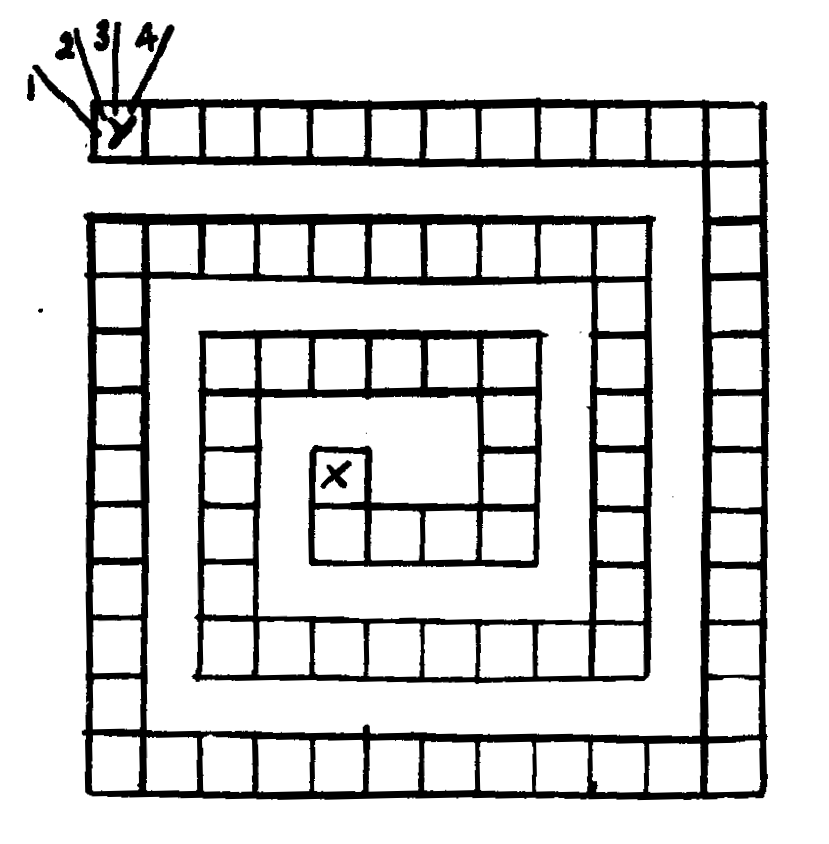
The article's description of the game terms it Li'b El Merafib and indicates it was principally played by men during Ramadan. The author provides the schematic drawing at right. A transcript can be found at the Waterloo Games Museum, while a digitization of the magazine is offered by AlFahl.net in a large PDF. The author, R. Davies, had no idea that the game was Egyptian. The game involves a chase from Y to X and back, with "hyena" pieces pursuing on the return leg, which makes the last phase of the game very exciting.

I was curious as to the identity of the author, who patronizingly says Li'b El Merafib is more exciting than games played by English children, which makes him appear rather blinkered, although to be fair, he did consult the scholarly literature available to him
A little research establishes that the author must have been Reginald Davies (1887-1971), who left a box of his manuscript papers to Edinburgh University Library (see Archives Hub with biographical details). A printed bibliographical reference to the same papers by Sharkey appears to be entirely unreliable.

Davies became the first British Resident in Darfur in 1922 and his policy of building up a local sultan may bear some responsibility for the appalling civil wars that have rent Darfur in recent decades. Finkel terms him a "British Army officer", which he most certainly was not: He was a civilian and university man, a group who were in fact intensely jealous of army officers who snatched their salaried jobs. For all the trouble Davies created as a colonialist, one must acknowledge that he faithfully recorded one of the remarkable clues we have to one of humanity's most intriguing practices: the board game.

Davies, Reginald. “Some Arab Games and Puzzles.” Sudan Notes and Records, no. 8 (1925): 137–52.

Finkel, Irving. Like Spilt Milk: How Ancient Board Games Were Disseminated, 2012. YouTube.

2014-12-06

Enemies of Hugh Capet

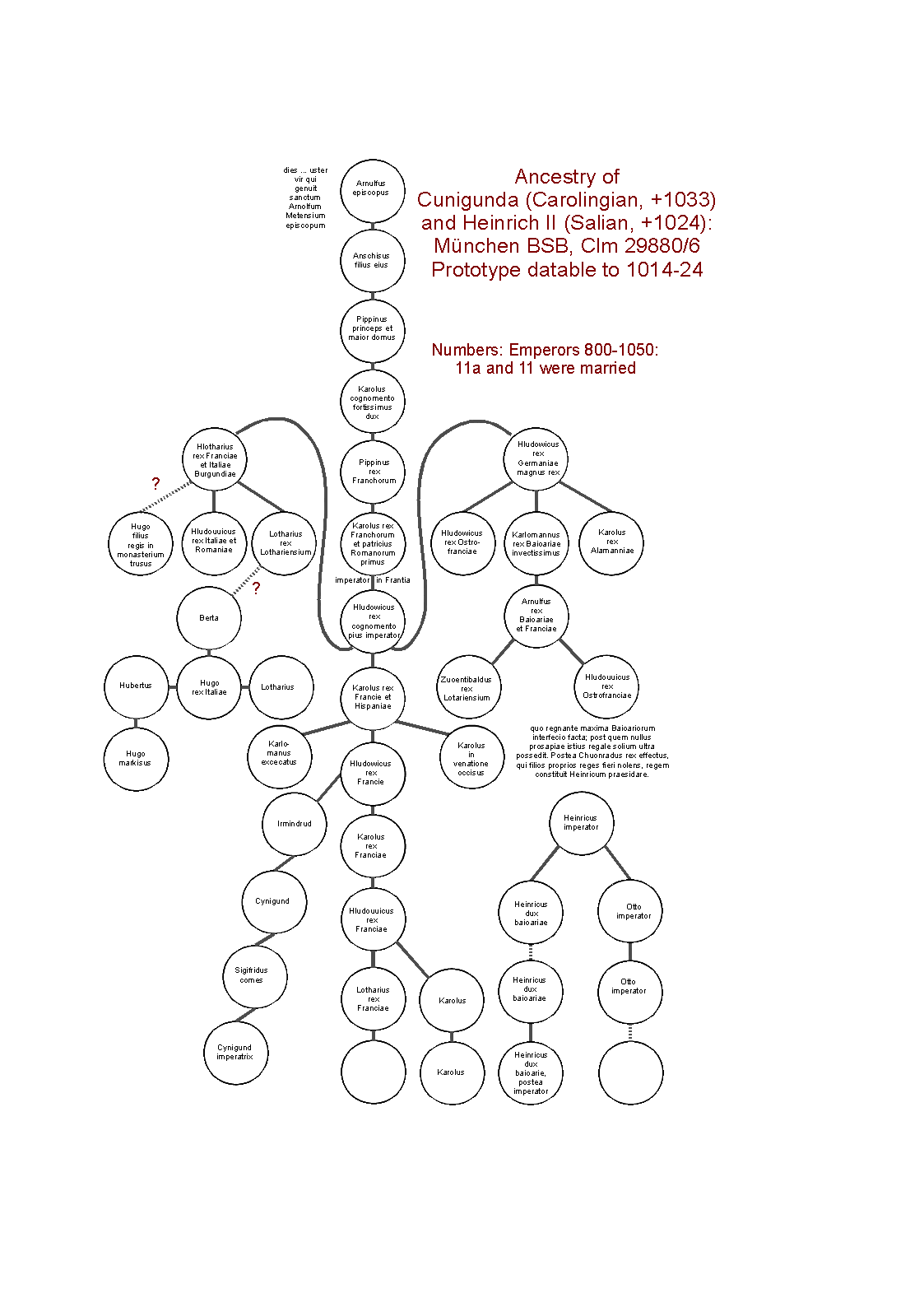
One of the difficulties of publishing a scholarly book is doubtless the fact that the time-span between research and hitting the market can be several years. This struck me when reading a couple of works from 20 years ago on the Stemma of Cunigunde. I mentioned this remarkable diagram some while back in a blog post.
A plot of it on my website allows you to see more detail. This diagram is the oldest visualization in existence of a genealogy that can be independently documented. The only older genealogical visualization is the Great Stemma, where many of the persons, ranging from David and Solomon to Jesus, are historical figures, but are documented by a single source only, the Jewish and Christian scriptures, and the diagram is not contemporaneous but based on that single source.

The great modern authority on medieval tree diagrams is Christiane Klapisch-Zuber, who published her study, L’Ombre des Ancêtres, in 2000. She rightly gave considerable attention to the Stemma of Cunigunde and its medieval evolution into various new formats.

What I now notice is that her investigation must have been conducted a good decade before her book's publication, because she does not cite the two key studies dating from 1992 and 1994, by Nora Gädeke and Karl Schmid, which advance our knowledge of the Stemma of Cunigunde.

Schmid's study of the Stemma was especially interesting. He instantly recognized that its subject and focus is Cunigunde (at the bottom left), not Charlemagne or any of the figures high up the diagram.

He proposed that the Munich manuscript is a copy, perhaps made decades later, of a document probably drawn up in Metz, where Cunigunde's villainous brother Dietrich II was bishop and no doubt had clerks and a library capable of drawing such a work. Schmid does not opt for a date, though tendentially he suggests this would have been after Cunigunde's coronation as empress in Rome in 1013.

The purpose of his article is to argue that the stemma's core content must go back to a 991 visualization that would have been drawn up by "Carolingian legitimists" in support of Karl, a child, as pretender to the kingship of West Francia in opposition to Hugh Capet (elected 987). Hugh won out and is now regarded as the first king of France, the legitimists lost, and little Karl (the last Carolus in the diagram) simply falls off the face of history. Whether he was killed or lived out a full life as a pitiable might-have-been is unknown. Instead he gains his place in history as the original inspiration for a very remarkable diagram.

The eye-catching festoons at the left and right of the drawing above would have been created to make room to add Cunigunde and the Ottonians to the anti-Capet diagram.

Schmid (Wikipedia entry) bases this ingenious lost-diagram hypothesis on an analysis of errors and non-sequiturs in the graphic arrangement that survives. His article is a most impressive feat of graphic reconstruction, and I think his point of view is convincing. As far as I know, this was the last scholarly thing he wrote. It was published following his 1993 death in a volume that contains his obituary.

From Forum Eeerste Wereldoorlog.nl
He even reaches back a little further, tentatively suggesting that the enemies of Hugh Capet may have found their model in a hypothetical document dating from the 978-984 war between Lothair of West Francia and the Ottonians. Schmid thinks that because the stemma often suppresses the title of "emperor" and because the final central roundel in the drawing above is empty, omitting the name of Louis le Fainéant which should obviously fill it, that ur-ur-diagram might have existed. He conjectures that this could have been a piece of proto-French political propaganda circulated during that conflict to ridicule the proto-Germans' pretensions to be upholding a (First) Reich. That is a sobering millennial thought in this year, when we often have in mind the sombre centenary of a war where elaborate French propaganda, like L'Impérial Semeur at right, so often mocked the Second Reich.

Gädeke, Nora. Zeugnisse bildlicher Darstellung der Nachkommenschaft Heinrichs I. Arbeiten zur Fruhmittelalterforschung 22. De Gruyter, 1992.
Klapisch-Zuber, Christiane. L’Ombre des Ancêtres. Paris: Fayard, 2000.
Schmid, Karl. “Ein verlorenes Stemma Regum Franciae. Zugleich ein Beitrag zur Entstehung und Funktion karolingischer (Bild-)Genealogien in salisch-staufischer Zeit.” Frühmittelalterliche Studien 28 (1994): 196–225. doi:10.1515/9783110242263.196.

2014-11-11

Why Greek diagrams are rude

How come it took until Latin Late Antiquity for a great infographic like the Great Stemma to explode on the scene? How come that the earlier Hellenistic culture of the West never evolved a graphic technology like this, with its flows of data that drag the eye down and onwards, with its callouts that divert your attention in the fashion of hyperlinks, and with its blending of multiple data classes - in this case chronography and genealogy?

Last year, the Israeli historian of mathematics Reviel Netz, who is professor of classics at Stanford University, spoke at the British Academy in London and offered an interesting new synthesis of his ideas on diagrams. As far as I know Netz has not paid any attention to the Great Stemma, but his thoughts on the Hellenistic intellectual world have a strong bearing on what followed on from it.

Netz is not only famous as the author of The Archimedes Codex, but also as the scholar who introduced in 1999 the idea that the geometrical diagrams in the works of Euclid, Archimedes and others should not be understood as after-the-fact explanations of geometrical discoveries or as mere ornaments to the text, but as integral to the logical proof, as snapshots of the discoveries themselves.

The geometers thought spatially, or diagrammatically, then honed the explanations in words afterwards.

Ideas evolve, and Netz seems to have moved onwards to a view that, in a sense, restores some of the primacy of text in that polarity. That would be my somewhat exaggerated take on what he was saying last year during Leaping out of the Page, a lecture in London that you can see on YouTube.

The question he explored in his 2013 March 14 presentation at the British Academy was: why are those Greek mathematical diagrams so bare, so sketchy, one might almost say, so rude?

Netz seeks to explain the fact that there is no evidence of anyone debating a better way to draw such diagrams (at 51.10 by elapsed time in the video) and he comes up with the following answer.  Literary texts on papyrus in the classical period lack any word-breaks, paragraphs or illustrations. The readers had to inject all of that. The text they held in their hands was what Netz calls "schematic": rude cues for the educated reader to unlock and "perform" the text in his mind.

The diagrams conform with this: they are schematic too (52.18). Nothing more than that was expected of them. This seems to come out of ideas in Netz's book, Ludic Proof, in which he explored the startling similarities between Hellenistic poetry and mathematical texts from the same era.

So what could this reveal to us about Late Antique diagrams?

Firstly, it highlights the way in which Greek mathematical figures are so very different from Late Antique flow diagrams like the Great Stemma, the arbor porphyriana and the 37 stemmata of Cassiodorus. We may use the English term "diagram" for both types, but they do not belong to the same genera of things at all. The Late Antique graphics are startlingly new and creative, with no identifiable roots in mathematical techniques or any existing literary practices.

The idea of devoting an entire papyrus roll to a graphic without any accompanying text must have seemed strange and new-fangled to people when they first saw it.

Secondly, these observations reinforce our understanding that flow diagrams are part of the haptic world of things that we manipulate. Netz argues (24.57) that geometrical figures are cerebral and differ utterly from touchy-feely arithmetic: "When Greeks do counting, what they do is to operate on an abacus. They have counters that are being moved around on an abacus... You have a flat surface, and on this flat surface you are moving stuff."

Something parallel would have happened when the designer of a flow diagram was laying it out. He had to use counters or ostraca to plan it. Later on, the reader of the flow diagram will inevitably handle it too, putting fingertips on its "icons" and tracing its flows. The flow diagram is something everybody has an urge to manipulate, a Late Antique precursor to the iPad: it's a physical thing, designed to be not only looked at, but touched, and aimed at the "manual" user, even the semi-literate, not the cerebral reader showing off his paideia.

Netz stresses how, in Euclid or Archimedes, text and geometrical figures marry together. Papyri are one of the main media of Antiquity and a "happy" literary papyrus, as Netz calls it, always contains the same thing: column after column of text to be read left to right. The figures are subsumed into these slabs of text (which is why I say, not entirely seriously, that Netz now sees the text having primacy).

So my third reflection is on the thorough-going difference between the unidirectional content of a papryus book and the jump-in-anywhere nature of the first great infographic. The Great Stemma does not have any accompanying text: all its words are build directly into the drawing. It has no mandatory start or finish: you can read it from the right, or the left, or even upside-down.

From the point of view of traditional literary culture, the Great Stemma would have seemed to break every rule in the canon.

Leaping out of the Page: The Use of Diagram in Greek Mathematics. London: British Academy, 2013. https://www.youtube.com/watch?v=7hzzdLsTb5E&feature=youtube_gdata_player.
Netz, Reviel. Ludic Proof: Greek Mathematics and the Alexandrian Aesthetic. 1st ed. Cambridge; New York: Cambridge University Press, 2009.
The Shaping of Deduction in Greek Mathematics: A Study in Cognitive History. Ideas in Context 51. Cambridge University Press, 1999.
Netz, Reviel, and William Noel. The Archimedes Codex. Revealing the Secrets of the World’s Greatest Palimpsest. London. Orion, 2007.