2013-06-02

Mistaken Improvements

The power of visual spatial displays often comes from their ability to simplify and abstract from reality, says Mary Hegarty in a 2011 paper.

Since figurative drawings are not so well adapted to the task of reasoning or explaining, the Late Antique inventors of node-link diagrams were careful to omit figurative elements from them.

Their successors since that time have repeatedly attempted to add figures, to regulate the distances between the nodes, to impose a standard orientation (for example, growing upwards like a tree) and to strictly align such diagrams. Those mistaken "improvements" indicate that later generations have not fully understood the genius of the original invention.

Hegarty quotes research suggesting why. We have a misplaced faith in fussily drawn diagrams,
with a strong preference for displays that emphasize high-fidelity spatio-temporal realism, even when these displays result in poor performance...  This may come from a folk fallacy that perception is simple, accurate and complete, whereas perception really is hard, flawed and sparse.

Markus Knauff's book (see my recent post) suggests an additional cause for the fallacy: if reasoning is largely spatial, and is taking place in a part of the mind that is not accessible by introspection, most of us are likely to be quite ignorant about what constitutes an effective explanatory method.

A similar point about why figurative art should be excluded from effective diagrams has been made by Manfredo Massironi in his theoretical account of Hypothetigraphy, the subject of a post on this blog in 2011. Massironi took the view that any diagram explaining abstract matters needs to be limited to what he called "precise marks" only: "Precise, clear lines contribute in conveying the impression that the depicted forms are mental constructs, not representations of natural objects."

Hegarty, Mary. ‘The Cognitive Science of Visuo-spatial Displays: Implications for Design’. Topics in Cognitive Science 3, no. 3 (2011): 446–474. doi:10.1111/j.1756-8765.2010.01113.x.
Massironi, Manfredo. The Psychology of Graphic Images: Seeing, Drawing, Communicating. Routledge, 2002.

2013-05-26

Stemma of Boethius

A new tabulation of online Boethius manuscripts which contain his famous stemma, or arbor porphyriana, has just appeared on my website. (Here.) I have not done serious work on Boethius for more than three years, so I spent a couple of days looking again at the sources.

I find it remarkable that so many of these documents can now be seen remotely via the internet: there are no fewer than eight manuscripts accessible, and three of them duplicate the stemma, so we have a total of eleven early medieval drawings to study.

A task remains for any eager reader. I have not heard that the Greek text of Porphyry, or the translations to Latin, Syriac and Arabic (list by Roger Pearse), contain such a diagram. One is reluctant to trust the critical editions, since text scholars generally leave out diagrams. If anyone would care to comb online versions of these, it would be good to have a clear yes-or-no answer about this.

2013-05-25

Our Secret Reasoning Device

A book published a couple of months ago by the German cognitive scientist Markus Knauff contains some remarkable new evidence and discussion about the seat of human reasoning. Summing up a couple of decades of experiments, he argues that a brain structure which can demonstrably be shown to analyse and reason is the so-called dorsal pathway.

This is the "where" stream which handles our awareness of space, our actions and, as a recent review article by Borst and others argues, our expectations. (All references below.) There has been some criticism in another review article by Schenk and others of the claims that this pathway is entirely distinct from the ventral or "what" pathway, but the dichotomy does seem to be holding up well.

In Space to Reason: A Spatial Theory of Human Thought, Knauff emphasizes that this dorsal pathway is not a self-aware channel, so it is easy to overlook its operations. It shows up in brain imaging, but we cannot examine it by introspection.
... people certainly have no clue about the mechanisms that work on a symbolic spatial array, and they are certainly not aware of a complexity measure that results in certain preferences. (190) [and quoting Goodale & Westwood:] ... the processing of spatial information in the dorsal stream is impenetrable to our conscious awareness. (191)
Knauff does not mention diagrams in his book at all. Most of his experiments involve reasoning about very simple problems such as:
The blue Porsche is parked to the left of the red Ferrari.
The red Ferrari is parked to the left of the green Beetle.
Is the blue Porsche parked to the left or to the right of the green Beetle? (2)

However he proposes that these yield valid data about problems such as:
If the teacher is in love, then he likes pizza.
The teacher is in love.
Does it follow that the teacher likes pizza? (95)
The cars problem is not difficult but it requires effortful thinking, whereas the if problem is instantly understandable. You will probably have guessed at the conclusion before you were conscious of reading the last line, which is said by some authors to be a characteristic of dorsal cognition.

Now there are two competing established accounts of what is going on: one is that we might pretend to see a real teacher whom we know and because we are so smart at understanding from sight, and teasing meaning from sight. we can deduce from visual indications that he is biting a slice of pizza that he must therefore be in love, just as we deduce from a distended belly that a woman is pregnant.

The rival account - propositional reasoning - maintains that we have a kind of machine language inside our brains, a computational logic. It does not use a language like English, but perhaps a language like JavaScript, and it tells us from the if what the only logical conclusion is.

Knauff argues for a third option: if I interpret this correctly, we have a black-box process in which we use the dorsal channel to simulate the problem as if we were perceiving something real. A mental model is constructed where the teacher, his state of romantic excitement and the pizza are encoded as spatial entities. Putting them in the only possible logical order allows us to grasp the conclusion.

The heart of his argument is that evidence shows the ventral stream need not be involved. One of the salient points about the spatial-thinking model is that the mental representation excludes all unnecessary information. The shape or colour of the cars or the exact distance between them does not need to be encoded, nor does the shape of the teacher's face or the flavour of the pizza.

As I have said, Knauff does not mention diagrams, let alone the Great Stemma or the Compendium of Petrus Pictaviensis. But the sense of excitement his book generates in the diagram researcher comes from the fact that the sparse, austere mental models he envisages as the bearers of human reasoning resemble the simpler sort of diagrams that are drawn on paper or on displays.

Reviel Netz suggests in The Archimedes Codex and his various articles that the Greek mathematician did not use diagrams to merely illustrate ideas that he had been thinking through in some propositional fashion. Archimedes was doing mathematics by manipulating spatial representations in his head. Since he was thinking about space, not propositions, the diagrams were the closest external representation to his raw thoughts. As far as I can guess, Netz's ideas are partly rooted in the ideas about external representations generated by externalists in philosophy of mind debates over the past 20 years.

Stemmata and diagrammatic chronicles are not direct reasoning tools in quite the way that geometrical drawings are. Geometry can yield mathematical proofs without numbers or words, whereas chronicles are not there to reason with, but usually serve to re-express histories or genealogies that have already been set down in textual form.

Their purpose is communication. I have always maintained that they are a form of direct author-to-reader communication which eschews the need to convert their content into language. An author massages his ideas into the most lucid spatial arrangement he can come up with, puts them on paper, and the reader's spatial reasoning abilities are sufficient to decode what is meant with a minimum of textual input.

The nearest that Knauff comes to this is when he suggests that there is a kind of diagrammatic substrate to reasoning, and compares this to subway or underground-rail diagrams:

I used the metaphor of a subway map to show that a qualitative representation does not display the shares and sizes of the stations or metrical distances between the stations but only represents the data that preserve spatial relations between stations and lines, for example, that one line connects with another. ... a visual image is completely different from a subway map. It is more like a topographical map ... that captures distances, streets, buildings, landform information, and so on. In contrast, spatial layout models are like schematic subway maps... (192)
His findings and his interpretation have some interesting implications for diagram studies. If the  mental model in our heads is somewhat like a diagram, it ought to be possible to devise diagrams that can inspire such mental models with a minimum of translation.

Since the precise distances between the elements, and their sizes, do not encode any information, both of the following work equally well.


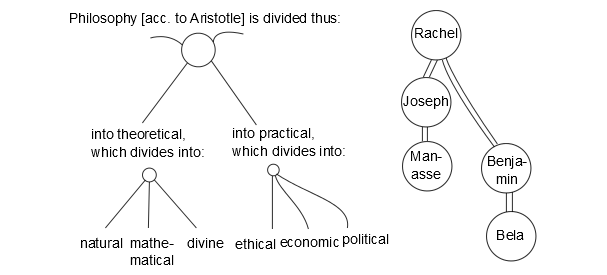
The left diagram is a 6th-century classification system drawn by Cassiodorus, while the right one comes from the 5th-century Great Stemma. I have translated the text from Latin to English. Whether the circles are large, small or non-existent, or whether the text is inside them or out, does not matter. Spatial reasoning merely needs apartness.

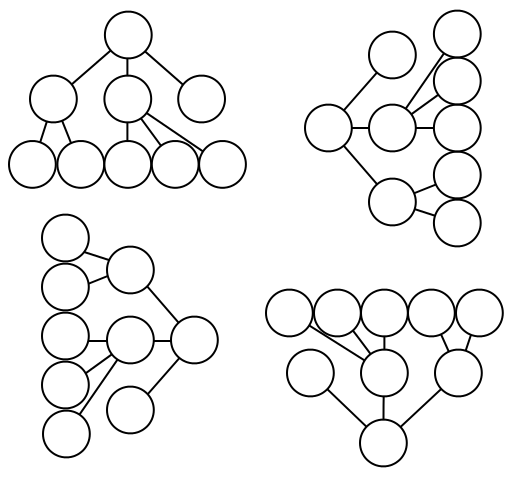
Overall orientation does not encode information, so all of the following directions of ramification are functionally equivalent.

Spatial reasoning is also likely to be highly tolerant of defective alignment, so that curved or crooked pathways in a diagram do not make them ineffective.

If this is correct, node-link diagrams which use a spatial encoding to express hierarchical relationships are likely to be a powerful means to manipulate a complex type of data while directly engaging with human intelligence. Working pragmatically and without any scientific evidence from cognitive research, the Late Antique inventors of node-link diagrams established an effective means of simplifying information without losing its essential structure.

Borst, Grégoire, William L. Thompson, and Stephen M. Kosslyn. ‘Understanding the Dorsal and Ventral Systems of the Human Cerebral Cortex: Beyond Dichotomies.’ American Psychologist 66, no. 7 (2011): 624–632. doi:10.1037/a0024038.

Goodale, Melvyn A., and David A. Westwood. ‘An Evolving View of Duplex Vision: Separate but Interacting Cortical Pathways for Perception and Action’. Current Opinion in Neurobiology 14, no. 2 (April 2004): 203–211. doi:10.1016/j.conb.2004.03.002.

Knauff, Markus. Space to Reason: A Spatial Theory of Human Thought. MIT Press, 2013.

Netz, Reviel, and William Noel. The Archimedes Codex. Revealing the Secrets of the World’s Greatest Palimpsest. London. Orion, 2007.

Schenk, Thomas, and Robert D. McIntosh. ‘Do We Have Independent Visual Streams for Perception and Action?’ Cognitive Neuroscience 1, no. 1 (26 February 2010): 52–62. doi:10.1080/17588920903388950.

2013-05-04

Incoherent?

Some years ago, the French cultural historian Christiane Klapisch-Zuber examined the Great Stemma. Because she was in Paris, the nearest manuscript at hand was a late recension, from Gascony, which is held by the French National Library or BNF. In colour and effect, the sumptuous polychrome diagram in the Saint-Sever Beatus is a beautiful thing, but in organization it is curiously incoherent.

Among its great oddities is a fishnet pattern among the descendants of Noah that largely obliterates the careful encoding of their relationships which was characteristic of the original model. That led Christiane Klapisch-Zuber, who is the greatest scholar to have surveyed the full history of such diagrams, to dismiss the whole class of Spanish Bible diagrams as an affront to the principles of ‘graphical semiology’. She argued in her 2000 book that no coherent biblical genealogical diagram had existed before a medieval work, the Compendium, was devised by Peter of Poitiers.

Her point of view was taken up and amplified soon after by Beate Kellner, who is now deputy principal of Munich's  Ludwig Maximilians University (LMU), in her Habilitationsschrift, which was published in 2004. Kellner also focussed this part of her research solely on the Saint-Sever manuscript in Paris.

She seemed to be even more troubled by the way the diagram strung out siblings like beads on a string instead of exhibiting them in hierarchical fashion as we do in "family trees", and spotted another oddity of the Saint-Sever manuscript, its curious folding together of the descendants of Leah:
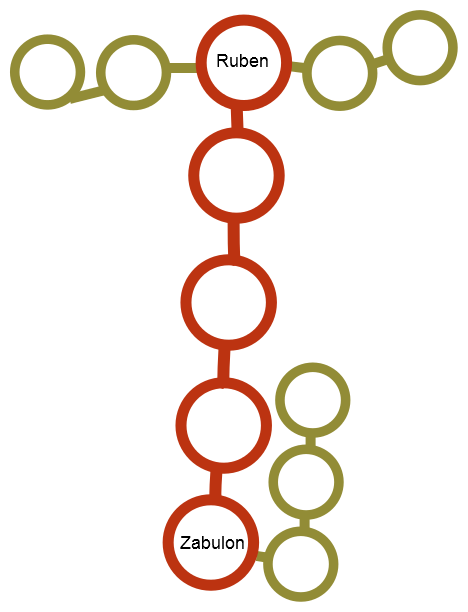
Here the organization of the panels avoids a coherent reading order as we would conceive it, from the top to bottom or from the bottom to top ... The genealogy below Jacob and Leah begins with their son Reuben ... His brothers Simeon, Levi, Issachar and Zebulun follow in a series of roundels which is open to interpretation as a genealogical line of descent since the line is graphically vertical, although in fact it links persons of a single generation. The sons of Zebulun are similarly connected by lines to one another in the vertical, and with their father, in such a way that the arrangement is effectively an ascending one. (JBP translation, hover for German original)
The sketch below shows the situation referred to, with the remainder of the environs omitted, and it must be agreed that the Saint-Sever artist took a very free attitude to his Vorlage when he arrayed Reuben's sons to both the left and right and ran Zebulon's sons up the page instead of downwards:


Now this is not the place to consider whether Kellner's overall characterization of medieval genealogy is correct or not. But the Saint-Sever treatment of the Great Stemma is so original and so untypical of its diagrammatic tradition (list of manuscripts here) that it can hardly be taken as representative of very much other than the artistic sensibility of Stephanus Garsia Placidus, the monk who seems to have been its creative director and principal artist. Yolanta Zaluska has pointed out odd inconsistencies in the diagram which suggest that something went wrong with the project and that someone other than the original director completed the diagram.

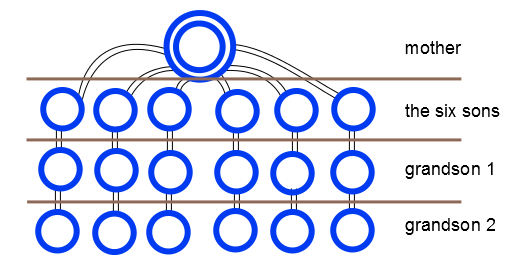
The classical arrangement of the sons of Leah in the Great Stemma is in fact severely regular, and it normally embraces all six sons, not five as in the Saint-Sever recension which omits Judah in this position. Here is a schematic of the same group from the Plutei manuscript, which contains pretty well the earliest format we can discover in the diagram's history:
Now it is true that the reading order of grandson 1, grandson 2 and so on is not the order that we in the 21st century could conceive as proper. But it does adhere to a broad logic in the Great Stemma where certain sibling groups which are only supplementary to the broad purpose of the document are always shown in space-saving fashion as vertical series. This is perhaps surprising to our eyes, but it is not chaos.

Following this generalization, Kellner then ventures the hypothesis that the crowded design of the Saint-Sever diagram deliberately establishes a stemmatic tangle, with extensions running every which way, in order to suggest that kinship by its very nature tends to be a network,
... that genealogy is being placed before us as a tapestry of relationships, as a complex structure oriented in multiple directions and not as a unitone line of descent... My hypothesis is that graphics, which are better able to exploit the two-dimensionality of the page, enable this particular form of discourse from the first glance, unlike a purely textual listing of genealogies, which certainly can employ linguistic features to link backwards or forwards and to that extend is capable of catering for genealogical cross-connections, but is ultimately bound by the continuity of script and creates an impression of linearity from the very character of text. (JBP translation, hover for German original)
One already hears an ominous creaking in this structure of ideas, built as it is on evidence that simply does not support it. Rather than building on the august traditions of German text-critical scholarship, on the detailed analysis of the full range of manuscripts, such an interpretation employs the semiotics approach of Jacques Derrida, Roland Barthes and Co. which was popular in the late 20th century, spinning creative meaning and significance around supposed "signs", while paying too little attention to verifiable data about what one might describe as the ecology of culture - the structures of the human mind, the evolution of artefacts and the phenomenal experience of human societies.

Kellner is undoubtedly right in her observation that Saint-Sever often lacks diagrammatic coherency, but her analysis is based solely on a single, rather non-representative manuscript in Paris and a series of creative blunders when an artist outran his own talents in a single scriptorium in Gascony, leaving her vulnerable to a whole herd of counter-evidence from nearly 20 other manuscripts.

Older recensions of the Great Stemma are generally more coherent and rational in the way that they map family relationships to a consistent code using connections, alignments and orientiations.

Developing her point, Kellner correctly intuits that the genealogical diagram belongs in a tradition where the expansive roll was the more natural medium than the cramped codex page, but strays into even more unsupported territory with a suggestion that medieval historians felt a 2D visualization to be inherently freer than text in its choices of content and arrangement:
The notion of genealogy as a network of relationships could be conveyed graphically using relatively simple shapes such as lines, strips and circles on codex pages - or doubtless ideally in scroll format - because arrangements of the genealogical elements in planar space - and this is the key objective - were able to be selected and combined with greater freedom. (JBP translation, hover for German original)
Here I both agree and disagree. Planar space is a far more comfortable medium to organize one's genealogical data and snippets of evidence than linear text. Sketching and diagamming often help us to organize our ideas and evidence better. Medieval diagrams do indeed breathe a certain air of nerdish delight at being able to amass the evidence to show some new view of it.

But diagrammatics are rarely a zone of freedom. Keller perhaps extrapolates from the freedom of art in comparison with the literary discipline prevailing over poetry and prose. But the overwhelming trend throughout the history of graphic charts and displays has been to bind them as tightly as possible to the habits of human spatial perception: without such discipline, diagrams simply fail to communicate.

Diagrammers who ignore "programming" principles are not breathing the air of freedom or expressing a view about the complexity of kinship relations and the intricacy of existence. When they discard a coherent system that has been handed down to them, they end up writing bad code. The Saint-Sever diagram is an experiment, probably by Stephanus himself, that went wrong.

Kellner, Beate. Ursprung und Kontinuität: Studien zum genealogischen Wissen im Mittelalter. W. Fink, 2004. Discusses the Great Stemma pp 50-53.

Klapisch-Zuber, Christiane. L’ombre des ancêtres. Paris: Fayard, 2000.

Zaluska, Yolanta. ‘Les Feuillets Liminaires’. In El Beato de Saint-Sever, Ms. Lat. 8878 de La Bibliothèque Nationale de Paris, edited by Xavier Barral i Altet. Madrid [Spain]: Edílan, 1984.

2013-04-06

Great Minds

Do great minds think alike? Here a couple of striking quotes separated by a millennium and a half. First of all comes Cassiodorus, who seems to have had quite definite ideas about how to employ diagrams:
Duplex quodammodo discendi genus est, quando et linealis descriptio imbuit diligenter aspectum, et post aurium praeparatus intrat auditus. (Institutions 2, praef. 5. Possible translation: Learning is a dual process: the visual mind first acquires the exact context through a drawn figure, so that an attuned aural perception can grasp the subsequent discourse.)
Here are Christopher Chabris and Stephen Kosslyn in 2005:
To be maximally effective, the diagram should be examined before the reader encounters the relevant text, in part because the diagram helps to organize the text, and in part because the reader may try to visualize what the text is describing and the results may not match the diagram.
There is a more thorough discussion of Cassiodorus on my website, including references to Esmeijer's book which first drew attention to this aspect of Cassiodorus's thinking. I have slightly altered the punctuation of Chabris/Kosslyn.

Both passages are onto an important point about thinking through vision: it may not be especially helpful to have access to diagrams after we have discussed topics, but diagrams can be very effective aids, priming the mind to understand things before a more linear form of reasoning commences.
  • Cassiodorus, and R.A.B. Mynors. Cassiodori Senatoris Institutiones. Oxford: Clarendon Press, 1961.
  • Chabris, Christopher, and Stephen M. Kosslyn. “Representational Correspondence as a Basic Principle of Diagram Design.” Knowledge and Information Visualization (2005): 185–186 (Springer).
  • Esmeijer, Anna Catharina. Divina Quaternitas: a Preliminary Study in the Method and Application of Visual Exegesis. Translated by D.A.S. Reid. Assen: Van Gorcum, 1978.

2013-03-25

Timelines Go 3D

It's always interesting to see where fifth-century educational techniques are getting us to, 1,600 years later. A couple of modern items from a single issue of the journal Instructional Science, arguing the agelessness of the timeline technique, caught my eye as I was doing some literature research for the philosophical/psychological section of my book.

Sadly, as one might expect, neither article mentions the origins of this venerable technique in the Great Stemma, its fresh exploitation in the Compendium of Petrus Pictaviensis and its great spread in the nineteenth century.

Prangsma et al. found that kids find it easier to learn history when they have both a timeline and a text, and younger children cope better if there are little pictures on the timeline as well.

Foreman found primary and secondary children learn best with a static series of images, but university undergraduates could also remember the correct order of events with the help of a "fly-through" in a virtual-experience game on a computer screen. For some reason, Foreman does not list this article on his academic publications tally at the University of Trier in Germany but does list a couple of more recent items dealing with virtual reality timelines in 3D.
 
Foreman, Nigel, Stephen Boyd-Davis, Magnus Moar, Liliya Korallo, and Emma Chappell. ‘Can Virtual Environments Enhance the Learning of Historical Chronology?’ Instructional Science 36, no. 2 (2008): 155–173.
Prangsma, Maaike E., Carla AM Van Boxtel, and Gellof Kanselaar. ‘Developing a “Big Picture”: Effects of Collaborative Construction of Multimodal Representations in History’. Instructional Science 36, no. 2 (2008): 117–136.

2013-02-22

Studia Patristica

Amazingly hard-working Markus Vinzent of the University of London has just announced that the proceedings of the 2011 Oxford Patristics Conference are likely to appear in print this summer. This will not be a nice tidy bound book that one can use to press flowers or thump a burglar: it will be an entire bookshelf of "around" twenty volumes, according to the announcement.

Over the past year, Professor Vinzent has edited hundreds of conference papers to create something the size of a major encyclopaedia. This enormous thing will emerge as volumes 53 to 72 of Studia Patristica, a journal that commenced in 1957. The fact that the cumulative run of a journal can increase by 38 per cent as a result of a single conference is alarming confirmation of the fear that we now entering an age when writers may soon outnumber readers. All of this excellent research will no doubt vanish into the shelves of research libraries and will be summoned by the occasional (wealthy) researcher from Peeters Publishers' full-text database, but how many of the articles will achieve a total global readership of even ten or twenty or thirty? A sobering thought.

 My own paper, "The Great Stemma: a Late Antique Diagrammatic Chronicle of Pre-Christian Time", will appear in the Historica volume alongside papers by four eminent historians which I found among the most interesting of the entire conference:
  • Guy Stroumsa's "Jerusalem, Israel, Athens, Jerusalem and Mecca: The Patristic Crucible of the Abrahamic Religions," which was a provocative exploration of how Islam, Judaism and Christianity are equal heirs of Late Antique intellectual debates; 
  • Josef Lössl's "Memory as History? Patristic Perspectives," which was a justification of his revisionist approach in his new textbook, The Early Church;
  • Hervé Inglebert's "La formation des élites chrétiennes d’Augustin à Cassiodore," which told the interesting story of advanced education from the fourth century;
  • Pauline Allen's "Prolegomena to a Study of the Letter-Bearer in Christian Antiquity," which lays the groundwork for an interesting book she is writing about Late Antique travellers who deliver letters.
As far as I can tell, Peeters does not have any kind of open-access arrangement for this journal, which is a pity.

It would appear that Martin Wallraff's discovery that Eusebius of Caesarea wrote another, previously unnoticed set of canon tables, which he made public at the 2011 conference, will not be written up in Studia Patristica, but in the Dumbarton Oaks Papers. The reason, I believe, is that this annual US journal is able to include high-quality colour reproductions of the new-found tables. Presumably that journal's moving firewall will allow the Wallraff paper to be downloaded for free from the year 2023.

2013-02-03

Board Game

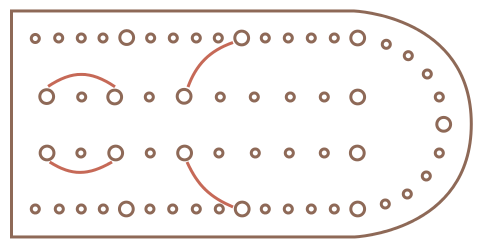
After searching for some time for any ancient board game on which the Great Stemma might possibly be modelled, I believe the best match would be an Egyptian-devised game-board with 58 holes which has some similarities with our snakes and ladders. Here is a schematic of the game-board, based on a 1952 drawing by Harold Murray in his History of Board Games Other than Chess.


While this is neutrally known among scholars as the Game of Fifty-Eight Holes, in a 2000 article (all references below), Anne-Elizabeth Dunn-Vaturi notes that archaeologists have often called the game Hounds and Jackals. She  proposes her own name for the game, the Monkey Race. According to William Hallo, this game, apparently played with dice, has more than 4,000 years of history.
Such boards are first attested in IXth Dynasty Egypt (ca. 2100 B.C.) and there and in Palestine are made of wood or ivory, elsewhere of stone or clay. Examples of the latter are known from Ras el Ayin and Tell Ajlun in Syria, from Mesopotamia, and from Susa in Elam. Some examples even come from the palace of Esarhaddon and bear his royal inscription. They date from all periods; indeed, their modern counterparts are in use in the Near East to this day. (Hallo, 1996, p. 114)
Hallo does not say who plays the game in modern times, and I can find no one else who claims this to be so. Indeed, the precise rules of the advanced games (one assumes there were many variations) seem to be now lost, and the presentation of the archaeological record suggests the game may have vanished by Roman times.

It is notable that all the boards recovered are much smaller than we would employ for a table-top board game nowadays. In size they are closer to a smartphone or a small tablet computer. For images, one should consult the Louvre website where exquisite variations are assembled into a very impressive interactive page, the best I have found on the internet.

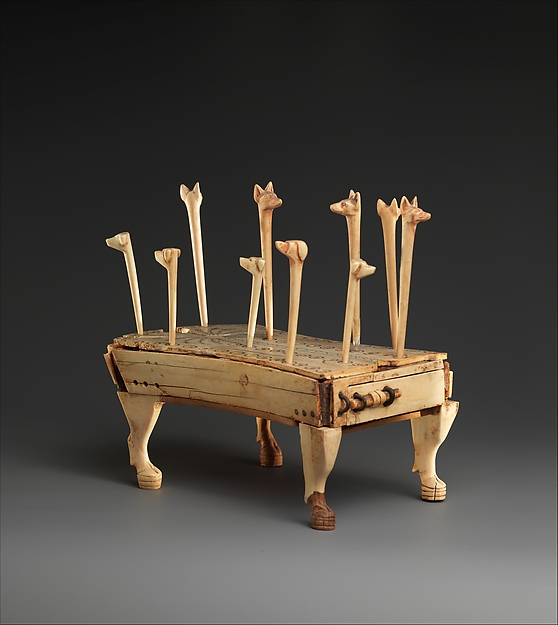
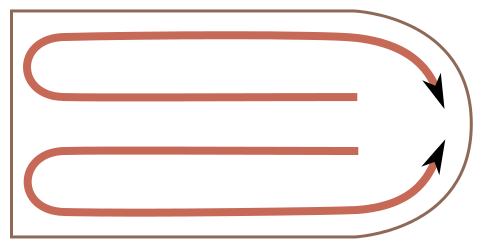
There is a deluxe version of the game (linked picture above) in the Metropolitan Museum of Art in New York.  Despite appearances, it is not a billiard table, but a tiny toy just 15 centimetres long. The stakes in the picture are the counters, five per player, used during play. The Met has six high-resolution photos where you can zoom in for a closer look.This Egyptian grave offering from Thebes explains the order of play through the 29 holes by each player as follows:


The final curves, converging after running along the perimeter, do bear a remarkable resemblance to the closing stages of the fila as they converge on the right side of the Great Stemma, or of the Amiata Stemma (below). I rotated Murray's drawing (above) 180 degrees so you could see this resemblance more plainly.


I have always considered the diagram's circle-by-circle progress to be inspired by a board game rather than by a topological map. Human problem solving and inventiveness is often a matter of transferring some old and familiar method into a new context, then elaborating this new technique by a cumulative process.

I do not suggest that the Great Stemma copies or evokes the 58-hole board game, but simply that the game, which is said to have been played in an altered version among the Copts of Egypt in Late Antiquity (see an image of the Louvre's Coptic variation), might have been the germ that set off a bright idea in the 5th century.

Richard S. Ellis and Briggs Buchanan provide a detailed scholarly discussion of such 58-hole boards. They group them by outline (the commonest are shaped like an axe-head or fish) and offer many line drawings in their 1966 article dedicated to a single artefact, An Old Babylonian Gameboard with Sculptured Decoration, in the Journal of Near Eastern Studies (JSTOR). For older materials, see French archaeologist Roland de Mecquenem's 1905 report, Offrandes de fondation du Temple de Chouchinak, where there are line drawings of several tiny boards from Iran, generally carved from limestone and less than 10 centimetres long. That report is online at Archive.org. See also Iranica Online. Various enthusiast links on the topic have been collected by Alain Tilmant.

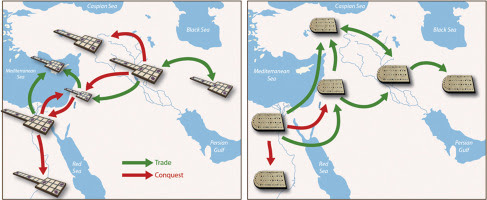
Dunn-Vaturi, whose 2000 bibliography should be consulted, is one of the authors of a current article, Cultural transmission in the ancient Near East: twenty squares and fifty-eight holes (citation below).  It includes the above maps, which I am also linking to with Blogger (without copying) so that you can see them. The left map suggests how the game is likely to have spread out from Egypt: the other map deals with the "royal game of Ur", a similarly popular 20-square board game.

Also available: a February 2012 lecture by Dunn-Vaturi on video (in English), where she suggests (at 1:20) that a Babylonian form of the game board may also have symbolized the human body, and quotes the theories of Carl Schuster that the joints on such a "rebirth" symbol may have been used as a palaeolithic mnemonic system to construct genealogies. The game of 58 holes is among those currently on display at the Musée de Cluny in Paris until March 4. See also Dunn-Vaturi's notice about the game at the Louvre and a November 2012 radio interview (in French).

Dunn-Vaturi, Anne-Elizabeth. ‘“The Monkey Race” – Remarks on Board Games Accessories’. Board Game Studies, no. 3 (2000). http://www.boardgamestudies.info/pdf/issue3/BGS3Vaturi.pdf.

Ellis, Richard S., and Briggs Buchanan. ‘An old Babylonian gameboard with sculptured decoration’. Journal of Near Eastern Studies 25, no. 3 (July 1966): 192–201. http://www.jstor.org/stable/10.2307/543265.

Hallo, William W. ‘Games’. In Origins: The Ancient Near Eastern Background of Some Modern Western Institutions. Brill, 1996.

Mecquenem, Roland de. ‘Offrandes de fondation du Temple de Chouchinak’. Mémoires de la Mission Archéologique de Perse 7 (1905): 61–130. http://archive.org/stream/mmoires07franuoft#page/104/mode/2up.

De Voogt, Alex, Anne-Elizabeth Dunn-Vaturi, and Jelmer W. Eerkens. ‘Cultural transmission in the ancient Near East: twenty squares and fifty-eight holes’. Journal of Archaeological Science 40, no. 4 (April 2013): 1715–1730. http://www.sciencedirect.com/science/article/pii/S0305440312004955.

2013-01-28

School Stemma

A couple of days ago I published a post about an adaptation of the Great Stemma that appears in the bibles of Parc, Floreffe, Foigny and Burgos. For a long time, my working name for that diagram has been the Lesser Stemma, built on the sense that it employs fewer diagrammatic features than the original 5th-century document.

It has been rightly pointed out that this is misleading, since in sheer bulk it is one of the biggest biblical stemmata ever made.

Counted in pages -- 18 -- it is bigger than the other versions. (Epsilon: 16 pages. Alpha and Beta: 14.) Counted in words, it is vast, inflated with supplementary material from Isidore's Quaestiones including the elaborate allegorical account of the Wandering in the Desert divided into 27 stages or mansio. Even counted in roundels -- Burgos has 529 of them -- it is on a par with the other versions which have an average of 540.

So I began to think about a better name for it.

One idea was to name it from its aggressive intention, which was first identified nearly three decades ago by Yolanta Zaluska. The new stemma employs the techniques of the old one, but to oppose the Great Stemma's purpose. The original explains Jesus's dual ancestries as a mother-plus-father descent. The revision explains the doubling as an effect of Jewish society's levirate marriage custom. One might therefore compare the new stemma to a ship captured by an enemy. Taken as a prize, it sails with a new crew and turns its guns against its former owners. However there is no simple, obvious word to describe this repurposing phenomenon.

One might equally well consider the uses of the new work. The original Stemma was a rather flashy infographic designed to demonstrate at a glance certain ideas about chronology and descent. The new stemma was more like a turgid textbook, loaded up with etymologies, explanations and lists (like that of the prophets). Like a textbook, it has been checked for its doctrinal orthodoxy and has clearly been approved for use by the impressionable student monk. It is not there for easy reading, but to supply information that can be learned by rote and tested.

From this more educational purpose, it might be best to describe the new version as a "school stemma". That is the working name I will employ for it in the next stage of research.

I have fixed the tabulation of "School Stemma" pages on my catalog page, and have discovered that two pages of the Foigny Bible version are online, though in low resolution: the page with Sem and Joktan, 4r, and the Incarnation page, 11r. These two links to the BNF images database work intermittently, but not always.

Zaluska, Yolanta. ‘Entre texte et image: les stemmata bibliques au Sud et au Nord des Pyrénées’. Bulletin de la Societé nationale des antiquaires de France (1986): 142–152.

2013-01-27

Window into the Past

Until now I have paid very little attention to a derivative version of the Great Stemma which is found in four bible manuscripts of the 12th and 13th centuries (described here). There are however some indications that this version may provide a window into the past, since it was probably adapted from the Great Stemma at quite an early date.

At first sight, the version that is found in the bibles of Parc, Floreffe, Foigny and Burgos seems very different from the 5th-century original: it is a frontal attack on the Great Stemma author's belief that the Virgin Mary had a father, Joachim, and a grandfather, Joseph, who were direct male-line descendants of King David. It asserts the early medieval orthodoxy, based on the idea that Mary's spouse Joseph had two separate male-line ancestries.

This assault on the Great Stemma imitates its structure while condemning its author's theology and Umfeld as erroneous. Rather like silver-tongued Edmund Burke using radical argumentation to attack radicalism itself, the revisor has appropriated the diagrammatic technique of his opponent to defend the mainstream represented by the thought of Isidore of Seville. He wished to:
  • erase the Joachimite explanation of the Gospel contradiction (it is replaced by part of Rufinus's translation of the Letter to Aristides); 
  • add the etymologies of Jerome of Stridon (as adopted by Isidore) to explain the biblical names, implicitly rejecting the counter-etymologies in the Liber Genealogus
  • adjust the content wherever possible to harmonize it with the Vulgate and suppress influences from the Vetus Latina biblical text. As an example, the order of the Minor Prophets is changed to that prescribed by Jerome.
Screeds of Isidore's Mysticorum expositiones sacramentorum also known as the Quaestiones in Vetus Testamentum have been overlaid on the diagram, presenting Old Testament events as allegories of the New. "The Old Testament is exclusively read in the Quaestiones according to the allegorical interpretation," explains Claudio Leonardi in his essay, Old Testament Interpretation ... from the Seventh to the Tenth Century. "Allegory is used by him to read every Old Testament passage and to discover in it the proclamation of Christ's own message.

Despite this revised document's hostility to the Great Stemma, it does offer a few indications of how the Great Stemma might have looked before our oldest extant manuscripts came into existence. Comparing its page divisions with the "purest" recension of the Great Stemma, that in the manuscript of Florence, we are struck by some uncanny similarities.

The section describing the Horrite and Edomite rulers from Genesis 36: 20-43 appears precisely as in the Epsilon recension under the heading, Hi sunt filii Esau qui in Monte Seir nati sunt. The Horrites from Lotan to Anah appear on one page, while Dishon, Ezer and Dishan are delayed to the next page. The Judaean kings from Rehoboam to Ahaz are neatly fitted into a single page with some zigzags, avoiding the strange muddle that afflicts the 13th page of the Florentine manuscript where this succession ends in a kind of graphic traffic jam.

In the Judges section there are two interesting amplifications. For the foreign-rule period we read Alienigene annis XL, and for the peace period in the Foigny Bible we read, Pacem habuerunt et sine lege fuerunt.

Later we read, David filius Iesse, magnus rex et propheta, regnavit super Israel annis XL, in Ebron sex, in Ierusalem XXXIIII, and Salomon pacificus filius David rex Israel regnavit annis XL. As in the Liber Genealogus, durations are given for most of the reigns after the kingdom is divided as a result of the Judaean secession. Of interest is the inclusion in the Foigny, but not in the Burgos text, of certain chronological data from after the Exile which is notably lacking in the other recensions of the diagram. Whether it comes from Isidore or from the early diagram is uncertain:
  • Regnum persarum et medorum a temporibus Cyri vel Darii usque ad extremum Darium qui ab Alexandro Magno victus occubuit fuerunt anni centum octoginta novem. 
  • Rex macedonum a temporum et Alexandri Magni usque ad Cleopatram regnam Egypti. Rex Antiochus ex Syrie qui Iudeos varia calamitate oppressit plurimos que ex ipsis ob defensionem legis mortes? fecit.
  • Iulius Cesar regnavit annum unum ex quo in regno romanorum imperatores et?? ceperunt. 
  • Octavianus augustus regnavit annis LX iste obtinuit monarchiam. 
  • Thyberius Augustus regnavit annis XXIII huius Tyberii imperatoris anno XVIII Christus passus est.

One also suspects a couple of the glosses in Foigny might pre-date Isidore, although there is nothing that verbally resembles them in the Liber Genealogus. The division into the Northern and Southern Kingdoms is explained with the words, Ab hinc regnum Israel in Roboam atque in Iheroboam divisum bipertitum est, effectum ex quo tribus Effraim principatum obtinuit, and the expiry of Samaria is explained: Osee iste est qui quondam fuit rex super X tribus Israel in Samaria qui temporum Salmanasar regis ab Assiriis captus ...

All of these passages need to be studied more closely, since they could potentially preserve lost text of the original Great Stemma. I am grateful to Dr Andrea Worm for sharing with me information and insights about the Foigny Bible which have led to these observations.

2013-01-19

Biblia Pauperum

The Biblia Pauperum is a kind of medieval Reader's Digest version of the Bible which interprets the Old and New Testament as if the mass of biblical texts had been purposefully written as a book of allusions, where the events of Jewish history foreshadow events in the life of Christ. This exegesis, known as typology, goes back to Origen and beyond.

Each of these connections is demonstrated by a collage of images that comprises two Old Testament events (the types), one New Testament event (their antitype) and head-and-shoulder portraits of four patriarchs or prophets. Bruno Reudenbach of the University of Hamburg says the original Biblia Pauperum manuscripts comprised 34 groups in this format. In the beginning they were laid out two to a page, so that four were visible on a spread.

The usual first collation, for example, would link an image of the Annunciation to the temptation of Eve by the serpent and Gideon finding the fleece soaked by dew, along with David, Isaiah, Ezekiel and Jeremiah. This can be seen in a British Library manuscript (King's 5 f. 1), in Tamara Manning's Internet Biblia Pauperum woodcut (reproduced with the Wikipedia article), or with a slight variation in clm 19414 in Munich.

There is another fine digitized example online at the Heidelberg manuscripts site. This German-language manuscript has extended descriptions of each group. Its first extant collation, for example, shows Joseph being cast into the well, Jonah being swallowed by the whale, Jesus being laid in the tomb and David, Solomon, Jacob and Isaiah (compare this to the English version on Manning's website, go to *g*).

Reudenbach's work at the University of Hamburg is a project of the Centre for Manuscript Cultures. The presentation by Reudenbach and Hanna Wimmer (PDF) says more than 80 such manuscripts still exist.

2013-01-07

Diagrammatic Reasoning Again

Far from the Patristic period, but nevertheless very relevant to its infographic inventiveness is a 2010 essay on diagrams by Robbie Nakatsu, Diagrammatic Reasoning in AI. I call this a book-length essay, because Nakatsu goes short on notes and references and instead rushes at the big question of what diagrams are for.

The title is a touch misleading, since the book comprises sections about diagrams and artificial intelligence, but the connection between them which Nakatsu proposes in the final chapter is little more than an idea. Chapters 1-4 and 9 are about diagrams, while 5-8 describe artificial intelligence, a technology that can be used to manage business processes and high-frequency trading on stock markets. Nakatsu’s finale is an argument that diagrams would constitute a more effective interface between users and these "expert systems" than existing methods of giving commands with such software. (His faculty page says he designed Expert-Strategy, a software that provides a graphical user interface to an expert system’s knowledge base.)

The main value to us of his essay lies in his earlier observations about mental models and why diagrams are effective for reasoning when compared with sentential statements:
In an sentential representation we form system descriptions by employing the sentences of a language. A diagram, by contrast, is a type of information graphic that "preserves explicitly the information about topological and geometric relations among the components of the problem." [Larkin/Simon]  In other words, an information graphic indexes information by location on a plane. ... For example, a graphical hierarchy can help humans sort through information much more efficiently and understand how the objects of a domain are classified much more rapidly than a verbal description, which must be processed sequentially. (page 57)
This comes close to my own description of why the Great Stemma is likely to have been devised and what advantages it offered to its users. Oddly, his discussion of hierarchic diagrams only briefly mentions their use for classifying biological species and is silent about their first use to represent human pedigrees.

In his final chapter, Nakatsu briefly alludes to an earlier paper he published on the effectiveness of diagrams when compared them to an alphabetic tabulation of the important data which could be fed into an expert system.
When asked to comment on possible weaknesses of the hierarchic system, participants were able to come up with a few responses. The most popular response was that the hierarchic interface was more complex and that more training would be required to learn and use it (28 participants). It is interesting that a few participants (6 individuals) suggested that the hierarchic interface might be harmful in terms of biasing the user toward a certain way of using the system. That is to say, the user of a flat system is more actively engaged in trying to understand the relationships in the variables, whereas the user of the hierarchic system is more likely to passively accept what the system teIls him or her to do. However, overall, it was c1ear that the hierarchic interface was highly preferable to the flat one. (page 315)
This relates to a point I have referred to myself: diagrams offer a more powerful tool to someone seeking to convince others, because diagrams are more difficult to test analytically. The doctrines in the Great Stemma appear less plausible when explained verbally, but somehow more logical in a neat visualization. Audiences are suspicious, because they are generally aware that diagrams tend to lead to "passive" acceptance and can be inimical to a critical response. It may simply be that we are educated to question what we are told, but we are not trained to question the veracity of what we see.

Nakatsu, Robbie T. Diagrammatic reasoning in AI. Wiley, 2010.

-------- ‘Explanatory Power of Intelligent Systems’. In Intelligent Decision-making Support Systems, 123–143. Decision Engineering. Springer London, 2006. http://link.springer.com/chapter/10.1007/1-84628-231-4_7.

2012-12-22

The Amiata Stemma

We can be quite certain that a copy of the Great Stemma was at the Benedictine Monastery of San Salvatore on Monte Amiata in Italy in the eleventh century, because it inspired an author-artist on the mountain to attempt his own adaptation of it, "correcting" it, abridging it and extending its content up to "modern" times.

In this update, the structure and essential text of the diagram were retained, but most of the stemmata that fill its central space were discarded and replaced by a vast tableau of successive rulers of the western world in 128 roundels, spanning fifteen centuries from Darius the Great to Henry III. The latter name allows us to date this document, because Henry III must have been the current Holy Roman Emperor when this remix was laboriously copied by the scribes onto four blank folios at the back of a book of commentaries by great theologians on books of the Old Testament. Henry III ruled Germany and Italy between 1039 and 1056. His year of death is added in another hand to a list of kings elsewhere in the same codex.

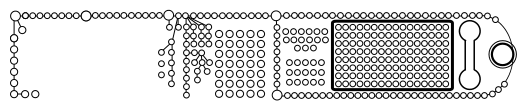
This graphic adaptation of the Great Stemma scheme for a new age must have existed in multiple copies, but we only possess one of them,which has been penned into a codex which was made and kept at Monte Amiata and is preserved today in the Laurentian Library in Florence under the name Codex Amiatinus 3. The diagram spanning eight pages (ff. 169r-172v) in Amiatinus 3 is demonstrably not the original, because the artist evidently laid out his first draft on a wide scroll, and that is how I have sketched it here:

It is not too difficult to prove that the drawing now spread over eight pages must have once occupied a single sheet. The tableau of 128 kings, which is designed to be read left-to-right in eight rows of sixteen roundels, has been split and placed on two sides of a folio. This obliges a reader who wants to read it in historical order to continuously turn the page back and forth: a situation which would never have been intended by the artist. The split is merely the consequence of sectioning the overall diagram into frames so that it would fit in a codex.

In the above plot, I have drawn a black rectangle around the 128 historic rulers of the west. The succession (it makes many wild jumps) comprises Achaemenid rulers, emperors of Rome, kings of Italy and Holy Roman Emperors. Some of the authors below perceive this as a documentary forerunner to the translatio imperii doctrine.

It is conceivable that this remix (which dispenses with most of the stemmata except for the families of Adam and Isaac) was compiled before Henry III came to power, and was merely updated to keep up to date with changes in political control. The revision contains a list of popes which the scribe has not bothered to update. This roll-call of the papacy ends with Agapitus (pontificate 946-955), so it is conceivable that the re-drawing took place in the middle of the tenth century.

Very little has been published about this document, although a plot of it, not quite as accurate as mine, appeared some years ago in an article by Gert Melville. The latter two authors below appear not to have realized that the abbey possessed a copy of the Great Stemma from Spain which mentions the Visigothic King Wamba. None of them explore the theological position of the Amiata drawing, which rejects the Joachimite account of Jesus's ancestry and restores an orthodox genealogy that exactly follows the text of the Luke Gospel with 42 generations from David to Christ via Nathan.

Gorman, Michael. ‘Manuscript Books at Monte Amiata in the Eleventh Century’. Scriptorium 56 (2002): 225–293: 268–271. Lists the contents of Amiatinus 3 and discusses the Amiata scriptorium. See my earlier discussion of this article in respect of the Liber Genealogus.

Klapisch-Zuber, Christiane. L’ombre des ancêtres. Paris: Fayard, 2000. Discusses the Amiata Stemma at pp. 72-73.

Melville, Gert. ‘Geschichte in graphischer Gestalt. Beobachtungen zu einer spätmittelalterlichen Darstellungsweise’. In Geschichtsschreibung und Geschichtesbewusstsein im späten Mittelalter, edited by Hans Patze, 57–154. Vorträge und Forschungen / Konstanzer Arbeitskreis für Mittelalterliche Geschichte 31. Sigmaringen [Germany]: Thorbecke, 1987. Contains a drawing of the Amiata Stemma on a fold-out, making clear that Melville also interpreted it as a single-page diagram. Given the work that went into the plot, one is surprised by the brevity of the discussion at pp. 66-67.

2012-12-21

Cyclopaedia

The Florence copy of the Great Stemma appears in a codex which seems to be an idiosyncratic scrapbook containing snatches of ancient things. I described in an earlier post how Michael Gorman reconstructed its putative source, a library book at Monte Amiata that doubtless had as its title work the Etymologiae, a copious dictionary of legal, religious and other terms by Isidore of Seville, the seventh-century Spanish bishop.

A good many blank pages had evidently been left free at the end of the Monte Amiata copy of the dictionary, and a monkish user, perhaps a teacher or an abbot, had used them as a kind of scrapbook, copying into them a personal miscellany of the sort of items often formerly appended to dictionaries: a guide to syllables, vowels and consonants; Bede's alphabetical directory of Latin grammar exceptions; how to study the bible; the list of Lombard kings; brief repetititions from the Etymologiae; four different chronologies of biblical time; and our diagram.

Seen on its own, each item seems absurdly and wilfully truncated, but if one assumes that its learned user only copied what he really needed - the things he could not easily remember - this begins to make sense. The items belong to a class of things that in my student days I would have photocopied and kept on a window-sill, and that I might now scan and tuck into a miscellaneous folder on my computer.

The book by Junilius, for example, is a collection of thoughts about bible education written in 551 CE and seemingly aimed at a teaching audience. It was published and comprehensively discussed by Kihn (link below to archive.org). John F. Collins prepared a 20th century introduction and English translation, now on James O'Donnell's Cassidorus website.

Other items in this anthology are intended handbook-style for the classroom or self-study.

An illuminating dissertation by Carin Ruff translates sample sections of Bede's De Orthographia and stresses  that it was mainly written to instruct the intermediate student of Latin in the many exceptions of usage and declension in Latin grammar. It is in alphabetical order of keywords. It sets out for example verbs that take the dative. A sample:
Noceo, obsum, incommodo, maleficio, officio, in una significatione ponuntur, quod graece dicitur βλάπτω, et cuncta datiuum casum trahunt. (Noceo, obsum, incommodo, maleficio, officio, are used in one sense (“hinder”), which in Greek is βλάπτω, and they all take the dative case. Translation by Ruff.)
You can read this on the 10th line of the left column of folio 12v of the Florence manuscript Plutei 20.54 (the scribe seems to have got the Greek wrong). Ruff quotes a suggestion that the intended audience for Bede's manual was "the less-experienced copyist or glossator who might 'be dissuaded from making a rash emendation' if he could find an apparently anomalous reading discussed in a readily accessible manual."

The inclusion of four or more contradictory chronologies should not suggest the book's owner had a burning interest in chronography or in resolving the differences among them. Quite the opposite: he clearly wanted something comprehensive which he could look up when he came across a seeming error in a book, resolve quickly whether the anomaly had a genuine source or was merely a "typo" and then move on. He seems to have regarded the Liber Genealogus as a handy quick guide to biblical names and the Great Stemma doubtless served for him a similar purpose.

I deliberately term the Etymologiae here a dictionary, although it is conventionally termed an encyclopaedia, because our modern conception is that an encylopaedia should summarize scientific and scholarly knowledge whereas a dictionary is mainly an aid to finding and correctly spelling the words with which we write about such things. The Monte Amiata handbook must have been much more the second of these things, and it occurs to me that I had just such a book when I was a school pupil and student: Pears Cyclopaedia.

When I first began working as an editor at dpa in the 1980s, the newsroom had no ready references and I arranged for the purchase of a Pears and a Quid. Both had their heyday before the internet and were useful to editors and proofreaders who faced all sorts of unexpected dilemmas over correcting texts and needed this kind of omnibus collection of seemingly useless facts. The cyclopaedia, which is subtitled "A Book of Background Information for Reference for Everyday Use" and was conceived in the medieval spirit as something in between a modern encycylopaedia and a handbook, begins with a chronicle of events from the formation of the Earth.

The appendices to the Monte Amiata copy of the dictionary were probably accumulated with a similar intent: not to transport the texts themselves (which are only excerpted and are largely offered without the necessary metadata such as author's names) but simply to have key facts close to hand. It is interesting that not even a very erudite later owner of Plutei 20.54, Coluccio Salutati, seems to have realized that the handlist of Latin exceptions was a work of Bede, although Coluccio was familiar with Bede's church history. Coluccio began writing out the headwords of the alphabetical list, but only got as far as C and never finished. He never attached the author's name to the list, and his own Latin doubtless became solid enough that he no longer needed such an intermediate-level reference for himself.

Kihn, Heinrich. Theodor von Mopsuestia und Junilius Africanus als Exegeten : nebst einer kritischen Textausgabe von des letzteren Instituta regularia divinae legis. Freiburg: Herder, 1880. Archive.org. Edition and discussion of a work found near the Great Stemma in a codex in Florence.

Ruff, Carin. ‘The Hidden Curriculum: Syntax in Anglo-Saxon Latin Teaching’. University of Toronto, 2001. Website. Usefully translates samples from and discusses Bede’s De orthographia. Follow link to dissertation, go to chapter 4, which is a PDF containing Part II, section 2.