2013-01-27

Window into the Past

Until now I have paid very little attention to a derivative version of the Great Stemma which is found in four bible manuscripts of the 12th and 13th centuries (described here). There are however some indications that this version may provide a window into the past, since it was probably adapted from the Great Stemma at quite an early date.

At first sight, the version that is found in the bibles of Parc, Floreffe, Foigny and Burgos seems very different from the 5th-century original: it is a frontal attack on the Great Stemma author's belief that the Virgin Mary had a father, Joachim, and a grandfather, Joseph, who were direct male-line descendants of King David. It asserts the early medieval orthodoxy, based on the idea that Mary's spouse Joseph had two separate male-line ancestries.

This assault on the Great Stemma imitates its structure while condemning its author's theology and Umfeld as erroneous. Rather like silver-tongued Edmund Burke using radical argumentation to attack radicalism itself, the revisor has appropriated the diagrammatic technique of his opponent to defend the mainstream represented by the thought of Isidore of Seville. He wished to:
  • erase the Joachimite explanation of the Gospel contradiction (it is replaced by part of Rufinus's translation of the Letter to Aristides); 
  • add the etymologies of Jerome of Stridon (as adopted by Isidore) to explain the biblical names, implicitly rejecting the counter-etymologies in the Liber Genealogus
  • adjust the content wherever possible to harmonize it with the Vulgate and suppress influences from the Vetus Latina biblical text. As an example, the order of the Minor Prophets is changed to that prescribed by Jerome.
Screeds of Isidore's Mysticorum expositiones sacramentorum also known as the Quaestiones in Vetus Testamentum have been overlaid on the diagram, presenting Old Testament events as allegories of the New. "The Old Testament is exclusively read in the Quaestiones according to the allegorical interpretation," explains Claudio Leonardi in his essay, Old Testament Interpretation ... from the Seventh to the Tenth Century. "Allegory is used by him to read every Old Testament passage and to discover in it the proclamation of Christ's own message.

Despite this revised document's hostility to the Great Stemma, it does offer a few indications of how the Great Stemma might have looked before our oldest extant manuscripts came into existence. Comparing its page divisions with the "purest" recension of the Great Stemma, that in the manuscript of Florence, we are struck by some uncanny similarities.

The section describing the Horrite and Edomite rulers from Genesis 36: 20-43 appears precisely as in the Epsilon recension under the heading, Hi sunt filii Esau qui in Monte Seir nati sunt. The Horrites from Lotan to Anah appear on one page, while Dishon, Ezer and Dishan are delayed to the next page. The Judaean kings from Rehoboam to Ahaz are neatly fitted into a single page with some zigzags, avoiding the strange muddle that afflicts the 13th page of the Florentine manuscript where this succession ends in a kind of graphic traffic jam.

In the Judges section there are two interesting amplifications. For the foreign-rule period we read Alienigene annis XL, and for the peace period in the Foigny Bible we read, Pacem habuerunt et sine lege fuerunt.

Later we read, David filius Iesse, magnus rex et propheta, regnavit super Israel annis XL, in Ebron sex, in Ierusalem XXXIIII, and Salomon pacificus filius David rex Israel regnavit annis XL. As in the Liber Genealogus, durations are given for most of the reigns after the kingdom is divided as a result of the Judaean secession. Of interest is the inclusion in the Foigny, but not in the Burgos text, of certain chronological data from after the Exile which is notably lacking in the other recensions of the diagram. Whether it comes from Isidore or from the early diagram is uncertain:
  • Regnum persarum et medorum a temporibus Cyri vel Darii usque ad extremum Darium qui ab Alexandro Magno victus occubuit fuerunt anni centum octoginta novem. 
  • Rex macedonum a temporum et Alexandri Magni usque ad Cleopatram regnam Egypti. Rex Antiochus ex Syrie qui Iudeos varia calamitate oppressit plurimos que ex ipsis ob defensionem legis mortes? fecit.
  • Iulius Cesar regnavit annum unum ex quo in regno romanorum imperatores et?? ceperunt. 
  • Octavianus augustus regnavit annis LX iste obtinuit monarchiam. 
  • Thyberius Augustus regnavit annis XXIII huius Tyberii imperatoris anno XVIII Christus passus est.

One also suspects a couple of the glosses in Foigny might pre-date Isidore, although there is nothing that verbally resembles them in the Liber Genealogus. The division into the Northern and Southern Kingdoms is explained with the words, Ab hinc regnum Israel in Roboam atque in Iheroboam divisum bipertitum est, effectum ex quo tribus Effraim principatum obtinuit, and the expiry of Samaria is explained: Osee iste est qui quondam fuit rex super X tribus Israel in Samaria qui temporum Salmanasar regis ab Assiriis captus ...

All of these passages need to be studied more closely, since they could potentially preserve lost text of the original Great Stemma. I am grateful to Dr Andrea Worm for sharing with me information and insights about the Foigny Bible which have led to these observations.

2013-01-19

Biblia Pauperum

The Biblia Pauperum is a kind of medieval Reader's Digest version of the Bible which interprets the Old and New Testament as if the mass of biblical texts had been purposefully written as a book of allusions, where the events of Jewish history foreshadow events in the life of Christ. This exegesis, known as typology, goes back to Origen and beyond.

Each of these connections is demonstrated by a collage of images that comprises two Old Testament events (the types), one New Testament event (their antitype) and head-and-shoulder portraits of four patriarchs or prophets. Bruno Reudenbach of the University of Hamburg says the original Biblia Pauperum manuscripts comprised 34 groups in this format. In the beginning they were laid out two to a page, so that four were visible on a spread.

The usual first collation, for example, would link an image of the Annunciation to the temptation of Eve by the serpent and Gideon finding the fleece soaked by dew, along with David, Isaiah, Ezekiel and Jeremiah. This can be seen in a British Library manuscript (King's 5 f. 1), in Tamara Manning's Internet Biblia Pauperum woodcut (reproduced with the Wikipedia article), or with a slight variation in clm 19414 in Munich.

There is another fine digitized example online at the Heidelberg manuscripts site. This German-language manuscript has extended descriptions of each group. Its first extant collation, for example, shows Joseph being cast into the well, Jonah being swallowed by the whale, Jesus being laid in the tomb and David, Solomon, Jacob and Isaiah (compare this to the English version on Manning's website, go to *g*).

Reudenbach's work at the University of Hamburg is a project of the Centre for Manuscript Cultures. The presentation by Reudenbach and Hanna Wimmer (PDF) says more than 80 such manuscripts still exist.

2013-01-07

Diagrammatic Reasoning Again

Far from the Patristic period, but nevertheless very relevant to its infographic inventiveness is a 2010 essay on diagrams by Robbie Nakatsu, Diagrammatic Reasoning in AI. I call this a book-length essay, because Nakatsu goes short on notes and references and instead rushes at the big question of what diagrams are for.

The title is a touch misleading, since the book comprises sections about diagrams and artificial intelligence, but the connection between them which Nakatsu proposes in the final chapter is little more than an idea. Chapters 1-4 and 9 are about diagrams, while 5-8 describe artificial intelligence, a technology that can be used to manage business processes and high-frequency trading on stock markets. Nakatsu’s finale is an argument that diagrams would constitute a more effective interface between users and these "expert systems" than existing methods of giving commands with such software. (His faculty page says he designed Expert-Strategy, a software that provides a graphical user interface to an expert system’s knowledge base.)

The main value to us of his essay lies in his earlier observations about mental models and why diagrams are effective for reasoning when compared with sentential statements:
In an sentential representation we form system descriptions by employing the sentences of a language. A diagram, by contrast, is a type of information graphic that "preserves explicitly the information about topological and geometric relations among the components of the problem." [Larkin/Simon]  In other words, an information graphic indexes information by location on a plane. ... For example, a graphical hierarchy can help humans sort through information much more efficiently and understand how the objects of a domain are classified much more rapidly than a verbal description, which must be processed sequentially. (page 57)
This comes close to my own description of why the Great Stemma is likely to have been devised and what advantages it offered to its users. Oddly, his discussion of hierarchic diagrams only briefly mentions their use for classifying biological species and is silent about their first use to represent human pedigrees.

In his final chapter, Nakatsu briefly alludes to an earlier paper he published on the effectiveness of diagrams when compared them to an alphabetic tabulation of the important data which could be fed into an expert system.
When asked to comment on possible weaknesses of the hierarchic system, participants were able to come up with a few responses. The most popular response was that the hierarchic interface was more complex and that more training would be required to learn and use it (28 participants). It is interesting that a few participants (6 individuals) suggested that the hierarchic interface might be harmful in terms of biasing the user toward a certain way of using the system. That is to say, the user of a flat system is more actively engaged in trying to understand the relationships in the variables, whereas the user of the hierarchic system is more likely to passively accept what the system teIls him or her to do. However, overall, it was c1ear that the hierarchic interface was highly preferable to the flat one. (page 315)
This relates to a point I have referred to myself: diagrams offer a more powerful tool to someone seeking to convince others, because diagrams are more difficult to test analytically. The doctrines in the Great Stemma appear less plausible when explained verbally, but somehow more logical in a neat visualization. Audiences are suspicious, because they are generally aware that diagrams tend to lead to "passive" acceptance and can be inimical to a critical response. It may simply be that we are educated to question what we are told, but we are not trained to question the veracity of what we see.

Nakatsu, Robbie T. Diagrammatic reasoning in AI. Wiley, 2010.

-------- ‘Explanatory Power of Intelligent Systems’. In Intelligent Decision-making Support Systems, 123–143. Decision Engineering. Springer London, 2006. http://link.springer.com/chapter/10.1007/1-84628-231-4_7.

2012-12-22

The Amiata Stemma

We can be quite certain that a copy of the Great Stemma was at the Benedictine Monastery of San Salvatore on Monte Amiata in Italy in the eleventh century, because it inspired an author-artist on the mountain to attempt his own adaptation of it, "correcting" it, abridging it and extending its content up to "modern" times.

In this update, the structure and essential text of the diagram were retained, but most of the stemmata that fill its central space were discarded and replaced by a vast tableau of successive rulers of the western world in 128 roundels, spanning fifteen centuries from Darius the Great to Henry III. The latter name allows us to date this document, because Henry III must have been the current Holy Roman Emperor when this remix was laboriously copied by the scribes onto four blank folios at the back of a book of commentaries by great theologians on books of the Old Testament. Henry III ruled Germany and Italy between 1039 and 1056. His year of death is added in another hand to a list of kings elsewhere in the same codex.

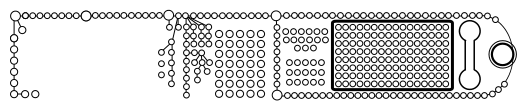
This graphic adaptation of the Great Stemma scheme for a new age must have existed in multiple copies, but we only possess one of them,which has been penned into a codex which was made and kept at Monte Amiata and is preserved today in the Laurentian Library in Florence under the name Codex Amiatinus 3. The diagram spanning eight pages (ff. 169r-172v) in Amiatinus 3 is demonstrably not the original, because the artist evidently laid out his first draft on a wide scroll, and that is how I have sketched it here:

It is not too difficult to prove that the drawing now spread over eight pages must have once occupied a single sheet. The tableau of 128 kings, which is designed to be read left-to-right in eight rows of sixteen roundels, has been split and placed on two sides of a folio. This obliges a reader who wants to read it in historical order to continuously turn the page back and forth: a situation which would never have been intended by the artist. The split is merely the consequence of sectioning the overall diagram into frames so that it would fit in a codex.

In the above plot, I have drawn a black rectangle around the 128 historic rulers of the west. The succession (it makes many wild jumps) comprises Achaemenid rulers, emperors of Rome, kings of Italy and Holy Roman Emperors. Some of the authors below perceive this as a documentary forerunner to the translatio imperii doctrine.

It is conceivable that this remix (which dispenses with most of the stemmata except for the families of Adam and Isaac) was compiled before Henry III came to power, and was merely updated to keep up to date with changes in political control. The revision contains a list of popes which the scribe has not bothered to update. This roll-call of the papacy ends with Agapitus (pontificate 946-955), so it is conceivable that the re-drawing took place in the middle of the tenth century.

Very little has been published about this document, although a plot of it, not quite as accurate as mine, appeared some years ago in an article by Gert Melville. The latter two authors below appear not to have realized that the abbey possessed a copy of the Great Stemma from Spain which mentions the Visigothic King Wamba. None of them explore the theological position of the Amiata drawing, which rejects the Joachimite account of Jesus's ancestry and restores an orthodox genealogy that exactly follows the text of the Luke Gospel with 42 generations from David to Christ via Nathan.

Gorman, Michael. ‘Manuscript Books at Monte Amiata in the Eleventh Century’. Scriptorium 56 (2002): 225–293: 268–271. Lists the contents of Amiatinus 3 and discusses the Amiata scriptorium. See my earlier discussion of this article in respect of the Liber Genealogus.

Klapisch-Zuber, Christiane. L’ombre des ancêtres. Paris: Fayard, 2000. Discusses the Amiata Stemma at pp. 72-73.

Melville, Gert. ‘Geschichte in graphischer Gestalt. Beobachtungen zu einer spätmittelalterlichen Darstellungsweise’. In Geschichtsschreibung und Geschichtesbewusstsein im späten Mittelalter, edited by Hans Patze, 57–154. Vorträge und Forschungen / Konstanzer Arbeitskreis für Mittelalterliche Geschichte 31. Sigmaringen [Germany]: Thorbecke, 1987. Contains a drawing of the Amiata Stemma on a fold-out, making clear that Melville also interpreted it as a single-page diagram. Given the work that went into the plot, one is surprised by the brevity of the discussion at pp. 66-67.

2012-12-21

Cyclopaedia

The Florence copy of the Great Stemma appears in a codex which seems to be an idiosyncratic scrapbook containing snatches of ancient things. I described in an earlier post how Michael Gorman reconstructed its putative source, a library book at Monte Amiata that doubtless had as its title work the Etymologiae, a copious dictionary of legal, religious and other terms by Isidore of Seville, the seventh-century Spanish bishop.

A good many blank pages had evidently been left free at the end of the Monte Amiata copy of the dictionary, and a monkish user, perhaps a teacher or an abbot, had used them as a kind of scrapbook, copying into them a personal miscellany of the sort of items often formerly appended to dictionaries: a guide to syllables, vowels and consonants; Bede's alphabetical directory of Latin grammar exceptions; how to study the bible; the list of Lombard kings; brief repetititions from the Etymologiae; four different chronologies of biblical time; and our diagram.

Seen on its own, each item seems absurdly and wilfully truncated, but if one assumes that its learned user only copied what he really needed - the things he could not easily remember - this begins to make sense. The items belong to a class of things that in my student days I would have photocopied and kept on a window-sill, and that I might now scan and tuck into a miscellaneous folder on my computer.

The book by Junilius, for example, is a collection of thoughts about bible education written in 551 CE and seemingly aimed at a teaching audience. It was published and comprehensively discussed by Kihn (link below to archive.org). John F. Collins prepared a 20th century introduction and English translation, now on James O'Donnell's Cassidorus website.

Other items in this anthology are intended handbook-style for the classroom or self-study.

An illuminating dissertation by Carin Ruff translates sample sections of Bede's De Orthographia and stresses  that it was mainly written to instruct the intermediate student of Latin in the many exceptions of usage and declension in Latin grammar. It is in alphabetical order of keywords. It sets out for example verbs that take the dative. A sample:
Noceo, obsum, incommodo, maleficio, officio, in una significatione ponuntur, quod graece dicitur βλάπτω, et cuncta datiuum casum trahunt. (Noceo, obsum, incommodo, maleficio, officio, are used in one sense (“hinder”), which in Greek is βλάπτω, and they all take the dative case. Translation by Ruff.)
You can read this on the 10th line of the left column of folio 12v of the Florence manuscript Plutei 20.54 (the scribe seems to have got the Greek wrong). Ruff quotes a suggestion that the intended audience for Bede's manual was "the less-experienced copyist or glossator who might 'be dissuaded from making a rash emendation' if he could find an apparently anomalous reading discussed in a readily accessible manual."

The inclusion of four or more contradictory chronologies should not suggest the book's owner had a burning interest in chronography or in resolving the differences among them. Quite the opposite: he clearly wanted something comprehensive which he could look up when he came across a seeming error in a book, resolve quickly whether the anomaly had a genuine source or was merely a "typo" and then move on. He seems to have regarded the Liber Genealogus as a handy quick guide to biblical names and the Great Stemma doubtless served for him a similar purpose.

I deliberately term the Etymologiae here a dictionary, although it is conventionally termed an encyclopaedia, because our modern conception is that an encylopaedia should summarize scientific and scholarly knowledge whereas a dictionary is mainly an aid to finding and correctly spelling the words with which we write about such things. The Monte Amiata handbook must have been much more the second of these things, and it occurs to me that I had just such a book when I was a school pupil and student: Pears Cyclopaedia.

When I first began working as an editor at dpa in the 1980s, the newsroom had no ready references and I arranged for the purchase of a Pears and a Quid. Both had their heyday before the internet and were useful to editors and proofreaders who faced all sorts of unexpected dilemmas over correcting texts and needed this kind of omnibus collection of seemingly useless facts. The cyclopaedia, which is subtitled "A Book of Background Information for Reference for Everyday Use" and was conceived in the medieval spirit as something in between a modern encycylopaedia and a handbook, begins with a chronicle of events from the formation of the Earth.

The appendices to the Monte Amiata copy of the dictionary were probably accumulated with a similar intent: not to transport the texts themselves (which are only excerpted and are largely offered without the necessary metadata such as author's names) but simply to have key facts close to hand. It is interesting that not even a very erudite later owner of Plutei 20.54, Coluccio Salutati, seems to have realized that the handlist of Latin exceptions was a work of Bede, although Coluccio was familiar with Bede's church history. Coluccio began writing out the headwords of the alphabetical list, but only got as far as C and never finished. He never attached the author's name to the list, and his own Latin doubtless became solid enough that he no longer needed such an intermediate-level reference for himself.

Kihn, Heinrich. Theodor von Mopsuestia und Junilius Africanus als Exegeten : nebst einer kritischen Textausgabe von des letzteren Instituta regularia divinae legis. Freiburg: Herder, 1880. Archive.org. Edition and discussion of a work found near the Great Stemma in a codex in Florence.

Ruff, Carin. ‘The Hidden Curriculum: Syntax in Anglo-Saxon Latin Teaching’. University of Toronto, 2001. Website. Usefully translates samples from and discusses Bede’s De orthographia. Follow link to dissertation, go to chapter 4, which is a PDF containing Part II, section 2.

2012-12-02

Tábara

Today's virtual tour is to Tábara in Spain, where the Morgan Beatus was made. There is not much to see. Today's church of Santa María occupies the site of the old monastery, which was probably sacked by Almanzor, the Muslim chancellor and warlord of al-Andalus, during his late 10th century campaigns against the Christian kingdoms of northern Spain.

We start at the old church which is romanesque and dates from well after the time of the monastery, though it may be partly built of dressed stone from the abbey.


If you can get Google Street View to work, turn around and consider getting a coffee from the Scriptorium Cafe on the other side of the highway. There is a good account of the history at Arteguias, which you can translate into English with Bing.

John Williams now thinks the Morgan Beatus was commissioned from Maius by San Miguel de Moreruela Abbey, a sister house which was less than two hours' walk away. Here is a map of how to get there by road.

At Moreruela, the present-day church of San Miguel Arcángel de Moreruela also dates from long after the abbey days.


The Catholic parish there has its own website with a little more information. The church appears to have various pieces of stonework of the old abbey incorporated into it:


As far as I can see, San Miguel Abbey was here, not on the nearby site of the later Cistercian abbey at Granja de Moreruela:


2012-12-01

Books, Books, Books

I have just refreshed the bibliography on the Great Stemma which now runs to more than 180 items. The  major change is that it is now annotated, following the urging of Phoebe Acheson of the University of Georgia (Athens) Miller Learning Center, who founded the Ancient World Open Bibliographies (AWOL). She added the original bibliography to her list in May 2011, where it is tagged under both information architecture and paragraphy.

Additions include the article by Helena de Carlos which I recently posted about as well as a rather shallow discussion by Carlos Miranda in 2000 of the differences between the Great Stemma, Lesser Stemma and Compendium of Peter of Poitiers:
Miranda García, Carlos. ‘Mnemonics and Pedagogy in the Compendium Historiae in Genealogia Christi by Peter of Poitiers’. In Genealogia Christi, edited by Maria Algàs, translated by Anne Barton de Mayer, 29–89. Barcelona: Moleiro, 2000.

This appears in a very interesting volume devoted to a Rome manuscript in roll form of the Compendium. To my astonishment this is quite a rare book: there is only one copy as far as I know in any research or public library in the north of Germany (and only two in the south, at Passau and Munich). As an insert, it contains a printing of what I would guess is the first-ever digital plot of a medieval stemmatic diagram. The work on this very impressive poster-style, fold-out sheet is credited in the book (page 15) to Enrique de Castillo. I will give it a bibliographic reference of its own when I do a medieval book-list.

2012-11-18

Gospel Contradictions

One of the new pages I posted online this year dealt with the efforts in the early years of Christianity to explain why the different Gospels do not agree on some details about Jesus.

One of the harder-to-find texts dealing with this is an anonymous tract that may date from the third or fourth century and which was published in 1852 by Angelo Mai. I have grabbed this from a facsimile (title page below) on Archive.org and have cleaned it up a bit so that you can either read it (if you know Latin) or cut and paste it into Google Translate for a rough and ready translation into your language of choice.

As far as I know, this is the first time this tract has ever been edited online, which is always a special moment with any ancient text that has lasted 1,000 years plus.

The text is perhaps of more general interest. It offers a rather abstruse meditation on the contradictions between Matthew and Luke, based on theories of the auspicious numbers hundred, sixty, thirty and three, and contends that Matthew's last group of 13 ancestors properly adds up to 14 because the missing element is either Eli, or the church, or the Holy Spirit. My own particular interest is only in the second of its 12 sections, where it alludes to an explanation for the Gospel contradiction which it rejects: that Luke's genealogy is a list of Mary's ancestors.
A lot of people want the generations which Matthew enumerates to apply to Joseph, and the generations which Luke enumerates to apply to Mary, arguing that the man is the "head" of the woman, and so requiring that, even for her generation, the man be named.
This is an early, independent and hostile allusion to the family of ideas on which the Great Stemma is based, though of course without the element of Mary being allotted a father named Joachim. The tract's author approves (if I understand him or her correctly) a simplified version of the levirate-marriage theory first developed by Julius Africanus. For an overview of all six different theories which circulated, see my article about the Gospel contradictions.

The author of this tract is referred to as Pseudo-Hilarius because the text was once thought to be a work of the fourth-century bishop Hilary of Poitiers, and the piece (along with a second tract on the Gospel of John) is listed in the Beuron Répertoire General (RGAEL) of Gryson and Frede as one of the pieces with the code "PS-HIL tr" (p. 562).

Christophe Guignard (earlier post) states in La lettre de Julius Africanus (2011: page 116, note 503) that the part of the text down to section 7 below is also reproduced in a series of pseudo-Augustinian sermons published in Bibliotheca Casinensis, seu Codicum manu-scriptorum qui in tabulario Casinensi asservantur series (volume 2, [Monte Cassino]: Typis Montis Casini, 1875, pp. 63-66 of the Florilegium Casinense, at the end of the volume: see the Google Books digitization). He also quotes the RGAEL, which I have not yet checked, as noting that there is a similarity between this text and a group of Gospel commentaries known under the name Epiphanius Latinus (dated to either the 5th or the 5th-6th centuries). I think it is entirely possible that the text below does date from between 250 and 450.

Having gone to the trouble to digitize this, I present the text in full in case it is of use to anyone else:

1. A transmigratione Babylonis usque ad Christum generationes quattuordecim dicuntur, et tredecim inveniuntur. Huius rei ratio nobis exponenda est. Quaestio haec generationum iuxta regulae rationem solvitur, Scribitur in lege, ut si defunctus fuerit quis sine filiis, frater aut proximus eius accipiat uxorem ipsius, ut suscitet semen in nomine defuncti. Est ergo Ioseph duorum filius, unius iuxta carnem, id est Iacob; et alterius iuxta legem, id est Heli. Iacob cum esset proximus, accepit uxorem Heli, et generavit Ioseph. Idcirco Matthaeus enumerans generationes, filium dicit Iacob; Lucas eum, iuxta legem scribens evangelium, servans regulae suae rationem, filium dicit Heli; iuxta illud videlicet quod iam dudum in lege fuerat praeceptum, ut in nomine defuncti, qui sine filiis excesserat, suscitaretur semen, deputabatur in nomine defuncti filius; sicut hic Ioseph deputatur filius Heli. Sed veritatis imaginabat lex personam. Ubi ergo completum est, imago percurrens abscessit, et veritas loco suo fixa stetit. Igitur ut plenius ostendatur, nullum in nomine defuncti suscitatum, nisi ei cui res parabatur, Iacob genuit filium; et non cum nominavit Heli, sed Ioseph.
2. Superest nunc ut intellegamus, apostolos omnes quasi unum virum, qui fratres a Domino sunt appellati, iam non dicam vos servos sed fratres, accipientes ecclesiam post mortem Domini, id est post eius passionem. Et vere suscitatus est ab eis filius in nomine defuncti, id est Christi, populus Christianorum, qui vere ex defuncti nomine nominatur. Matthaeus evangelium sic incipit: “liber generationis Iesu Christi filii David, filii Abraham.” David Christum dicit ob hoc, quia multis in locis idem Christus dictus est David: vel quia Maria ex eadem tribu et Ioseph fuerit, id est de tribu Iuda, unde et David. Idcirco et Christus verus et aeternus rex nominatur vel dicitur David. Multi volunt, generationem, quam enumerat Matthaeus, deputari Ioseph; et generationem quam enumerat Lucas, deputari Mariae; ut quia caput mulieris vir dicitur, viro etiam eiusdem generatio nuncupetur. Sed hoc regulae non convenit, vel quaestioni quae est superius: id est, ubi generationum ratio demonstratur, verissime solutum est. Ut superius dictum est filium David Christum, sic David, sic Abraham, sic Adam, sic Dei. Quia ab Adam decurrens generatio pervenit ad Abraham; et ab Abraham ad David regem, ut superius dictum est; ostendit verum et aeternum regem Christum, sicuti prophetae dixerunt. Ut autem intellegi manifestius possit, cur Iudas cum esset quarto loco natus, acceperit benedictionem, et non primitivus natus, haec ratio fuit. Cum sit mos in lege non alium accipere benedictionem, nisi qui maior natu sit, et qui habeat promogenita, Ruben primogenitus illa ratione non accepit, quia incestaverat concubinam patris. Simeon et Levi illa ratione, quia cum indigne ferrent stuprum Dinae sorori suae illatum ab Emor et Sichem, circumcisos civitatis viros, et in dolore constitutos, gladiis interfecerunt. Quo facto, his non contulit benedictionem, quae datur Iudae, quarto loco nato: propter illum numerum, quo Salvator propter historiam et legem et prophetiam venerat, qui solus benedictionem totam habet: sicuti Iudas, qui quartus fuit, accepit benedictionem, qui leo et catulus leonis est dictus. Iam tunc Christus ob potentiam leo dictus, qui victor et triumphator diaboli, etiam ipsius mortis invenitur.
3. Satis anxie satisque trepidanter, cur sanctissimus Matthaeus tali usus sit principio, exponere aggredior. Ait namque: “liber generationis Iesu Christi filii David, filii Abrahae.” Quaeritur ergo principii istius ratio, quare sic coeperit, cum Lucas praemissa quadam oratione coeperit evangelium conscribere. Sed quia veterum scripturarum series studens novitati, et quaecumque vetus testamentum singulariter continet, novum ipsa veritatis ratione adimplevit; iam dudum enim fuerat per sanctissimum David ita praenuntiatum: in capite libri scriptum est de me; non inmerito sanctus Matthaeus ita praefatus est dicendo: liber generationis Iesu Christi; hoc est, in capite libri scriptum est de me. Quod Spiritus futurum sciens, dicebat librum evangelii, qui nativitatem filii Dei contineret. Vel quia Hebraei Christum venturum manifeste sciunt, vel quia iam venisse non credunt, idcirco tali principio Matthaeus utitur dicendo: liber generationis Iesu Christi, et cetera. Illa igitur ratione filius dicitur David, quia ex prosapia David, per virginem Mariam erat venturus. Hic est quem sanctissimus Iacob in benedictione Iudae demonstrans, leonem et catulum leonis dixit. Et Moyses sanctissimus ait: “Prophetam vobis suscitabit dominus Deus vester de fratribus vestris. Hunc sicut me audietis. Erit autem, quaecumque anima non audierit prophetam illum, eradicabitur de populo suo. Vel quia Esaias Emmanuhelem, id est nobiscum Deus, per virginem venturum dixerit. Et Hieremias: hic Deus noster, et non reputabitur alius. In terra visus est, et cum hominibus conversatus est.”
4. Ideo ergo Hebraeis occurritur, ut quem venire sperant, iam venisse certo certius eis demonstraretur. Et ideo ne sit aliqua excusatio, tali principio sanctissimus Matthaeus utitur: liber generationis Iesu Christi filii David; carnalem scilicet generationem describens, quia sic venturus per prophetas est annuntiatus, id est ex David. Quia virgo Maria per traducem veniens David, non inmerito ait propheta: virga ex radice Iessae, et flos de radice eius ascendet. Virga, Maria; flos ex virga, Christus dominus, filius Abraham. Prius enim quam circumcideretur, Abraham credidit Deo, sicut scriptura testatur: credidit Abraham Deo, et reputatum est ei ad iustitiam. Ergo Abraham iustus, qui credendo, pater fidei invenitur. Denique ad eius contubernium et sinum omnes fideles inveniuntur. Quod autem ait: filii David, filii Abraham; Christus dominus noster, quia per Abraham; ex tribu Iuda, quia per David, decurrentibus generationibus, ex Maria virgine carnem accepit. Idcirco dicitur filius David, ut per prophetas idem filius Dei dicitur David, et David filius Abrahae, a quo generationum propter iustitiam a sanctissimo Matthaeo sumitur principium. Ergo quia iustus est filius Dei, qui iuste iudicat, et iustitiam diligit, et rex est perpetuus, merito generationem secunduin carnem sanctissimus Matthaeus ab Abraham exorsus est. Sed quia per traducem, et David regis fecit mentionem, ostendit filium Dei Iesum Christum et regem; merito eius iustitiae, et regalis secundum carnem progenies ascribitur.
5. Decursis igitur generationibus Matthaeus et ostensis, rursus recapitulat dicendo: “ab Abraham usque ad David generationes quattuordecim. Et a David usque ad transmigrationem Babylonis, generationes quattuordecim. Et a transmigratione, Babylonis usque ad Christum, generationes quattuordecim.” Facit tres ordines ter decusquartus, quo fiunt quadraginta duo. Non sine ratione hoc scripsisse invenitur; sed diligentius ratio stili eius requisita, et magna cum sollicitudine discussa, ordinum factorum nobis mysterium adiuvante Deo patefiet; testimoniis scilicet ad hanc rem pertinentibus contractis et perquisitis. In parabola enim seminis boni invenimus per eundem Matthaeum enuntiatum, incipientem scilicet a centesimo fructu ad sexagesimum, et a sexagesimo ad tricesimum, qui sunt ordines tres. Qui ordines hactenus simpliciter accipiendi sunt. Centesimus fructus, perfecta fides, ut centenario Abrahae, id est patri fidei, natus sit Isaac. Vel quia centum in manu dextera tenentur, quod est dextri lateris, in qua parte agni collocati inveniuntur a pastore. Ideo ergo ab Abraham incipit, qui est pater fidei, generationes enarrare. Sexagesimus autem fructus, secundus ordo est virginum. Ordo enim primus usque ad David: secundus vero ordo a David usque ad transmigrationem. Merito ergo a David ordo virginum declaratur, in sexagesimo scilicet fructu, quia virgo Maria ex David, de qua dominus noster Christus carnem accepit. Tricesimus autem fructus ordini tertio conveniens, a transmigratione Babylonis ad Christum; ideo quia Christus dominus et Deus noster, ut ait Lucas evangelista “et ipse Iesus erat incipiens fere annorum triginta, ut putabatur esse filius Ioseph.” Quibus annis passus est dominus noster Iesus Christus.
6. Videmus ergo haec omnia spiritaliter in filio Dei, Deo ac domino nostro, deputari, in quo perfecta iustitia et virtus invenitur consummata. Et quia sanctissimus Matthaeus, descensionem filii Dei nititur insinuare e caelis ad terram, quando dignatus est nostri causa venire, et hominem induere, ideo a centesimo numero ad tricesimum pervenit, id est a maiori summa ad minorem, hoc est de caelis ex illa gloria, ad hominis corpus induendum descendisse filium Dei demonstrat. Et ideo a centesimo ad sexagesimum de caelo veniens ad virginem per quam editus, ad tricenarium numerum veniens annorum, quo tempore passus est. Lucas autem evangelista passionem eius et ascensionem, et ad dexteram patris sessionem, a tricesimo numerans fructu, quot annorum passus est; et ad sexagesimum veniens, quod est caro virginalis incorrupta; quam Dominus ab inferis suscitans, secum pertulit ad caelos. Centesimi autem fructus adimpletio fidelis, et martyrii Christi cum virtute et potentia perfecta, ad dexteram patris consedisse manifestum est. Non inmerito et Lucas evangelista, generationes a Christo rursum per Ioseph numerans, id est ab homine usque ad Deum perveniens, verissime eius ascensionem demonstrans, a Ioseph per David et Abraham, et per Adam usque ad Deum pervenit. Et quem dixerat filium, ut putabatur esse, Ioseph; hunc dicit filium esse Dei. Igitur quia fides vel martyrium, quod est centesimus fructus; et virginitas, sexagesimus; et tricesimus, virtus; omnia haec per gradus, quos diximus, in filio Dei qui in omnibus, utpote Deus, perfectus invenitur, conveniunt et concurrunt. Quod autem Matthaeus a centesimo ad sexagesimum, et inde ad tricesimum decurrit, descensionem domini nostri Iesu Christi ostendit, quippe qui iuxta carnem nativitatem eius descripserit. Lucas autem quod a tricesimo ad sexagesimum, et inde ad centesimum percurrit, demonstrat, ut superius dictum est, passionem, id est virtutem qua diabolum vicit per crucem et incontaminatam carnem, quam resuscitatam imposuerit in caelis; et ideo a minori summa, rursum ascendere ad maiorem numerum invenitur; non inmerito, ut supra exposuimus, aquilae gerit imaginem, qua eum ad caelum volasse demonstrat. Et quia tres ordines numerantur de fructibus, de quibus breviter demonstravimus, tres etiam ordines in generationibus demonstrantur, et numero certo ascribuntur. Quique tres ordines generationum et seminum, sine dubio trinitatem patris et filii et spiritus sancti demonstrant.
7. Sed quia novissima summa, quam a transmigratione Babylonis usque ad Christum dixerat, generationes quattuordecim inveniuntur, scrupulum quoddam legentibus incutit, quasi Matthaeus vel mendacii reus, vel subtractor unius arguatur, cum praescriptus numerus non totus inveniatur. Ideo necesse est hoc quoque omni diligentia exponere ac discutere, et veritatem patefacere. Ergo quia numerus unius generationis facit nobis quaestionem, cum quattuordecim dicuntur, et tredecim inveniuntur, spiritalis intellectus invenit istam generationem, quae in numero non invenitur. Dinumeratis scilicet generationibus iuxta carnem, una inde ad simplicem intellectum invenitur esse subtracta; sed, ut dixi, spiritali intellectu numero conveniente significantur. Et sic incipit veritas evangelistae, cui nec mentiri nec fallere licet, tota hice clarescere. Dicit igitur, usque ad Christum generationes quattuordecim; et tredecim inveniuntur. Sequitur spiritalis generatio, quae licet numeretur inter carnales, non tamen in eo numero inveniatur. Sic enim decet ut ea generatio, quae de saeculo non est, cum saeculi generationibus non inveniatur. Quartadecima spiritalis est, de qua sic rettulit dicendo: Christi autem generatio sic erat. Christi autem generatio ecclesia intelligitur. Et merito David ait: Deus autem in generatione iusta est. Haec generatio Christi, id est ecclesia, in qua filius Dei permanere invenitur. Igitur quia ecclesia Dei spiritali nativitate renata, in saeculo non est, habens scilicet conversationem caelestem, quam Salomon in nave figurans ait, inter se naves in pelago natantes non cognoscere; id est conversationem vel generationem ecclesiae in saeculo non posse repperiri; siquidem actus eius et nativitas sit spiritalis; et ideo generatio iusta, in qua filius Dei consistit, ecclesia est; de qua dictum est: Christi autem generatio sic erat. Quatenus autem excitata sit haec generatio post apostolos, satis ut opinor, in quaestione generationum discussum est et ostensum.
8. “Cum esset disponsata mater eius Maria Ioseph, ante quam convenirent, inventa est in utero habens de Spiritu sancto. ”Hanc igitur conceptionem Mariae futuram sanctissimus Esaias propheta plenissime retulit dicendo: “ipse Dominus dabit signum: concipiet virgo in utero, et pariet filium, et vocabitur Emmanuhel.” Non immerito Lucas evangelista eundem partum describens futurum, angeli Gabrihelis interventum plenissime demonstravit dicens:
eodem tempore missus est Gabrihel angelus in civitatem Galilaeae, cui nomen erat Nazareth, ad virginem disponsatam viro, cui nomen erat Ioseph, de domo David, et nomen virginis Maria. Et ingressus ad eam angelus Domini, benedixit eam, et dixit illi: abe, gratia plena, Dominus tecum, benedicta tu inter mulieres. Ipsa autem ut vidit eum, obstupuit in introitu eius, et erat cogitans quod sic benedixit eam. Et ait illi angelus Domini: ne timeris, Maria; invenisti enim gratiam apud Deum: ecce concipies in utero, et paries filium, et vocabis nomen eius Iesum. Hic erit magnus, et filius Altissimi vocabitur. Et dabit illi dominus Deus sedem David patris eius, et regnabit in domo Iacob in aeternum, et regni eius non erit finis. Dixit autem Maria ad angelum: quomodo fiet istud, quoniam virum non cognovi? Et respondens angelus dixit illi: Spiritus sanctus superveniet in te, et virtus Altissimi obumbrabit tibi; ideoque quod nascetur sanctum, vocabitur filius Dei.
Cogitabat igitur Ioseph quid facere debeat, quoniam nullam adhuc propter hoc monitionem angeli acceperat, sicuti ait: “Ioseph autem vir eius cum esset iustus, et nollet eam traducere, voluit occulte dimittere eam.” Postea quam cogitata sua Ioseph efficere nititur, inhibetur ab angelo. Denique ait: “haec eo cogitante, angelus Domini in somnis apparuit ei dicens: Ioseph fili David, noli timere accipere Mariam coniugem tuam; quod enim ex ea nascetur, de Spiritu sancto est. Pariet autem filium, et vocabis nomen eius Iesum: ipse enim salvum faciet populum suum a peccatis eorum.” Iesus enim salvator interpretatur. Ergo quia erat Ioseph iustus, et sciens scriptum esse per prophetas, quia venturus esset salvator filius Dei ex virgine natus, non solum credidit angelo Dei dicenti, sed et iussa mox perfecit.
9. Introducens itaque sanctissimus Matthaeus virginis partum vel conceptum, prophetae Esaiae usus est testimonio. Dixerat enim Deum ipsum signum daturum. Et quasi interrogatus, quod signum? respondit: “ecce virgo in utero accipiet, et pariet filium, et cetera.” Hanc per Ioatham, postea quam septuaginta duo interpretes, Ptolemaeo iubente segregati, tamquam uno ore et sermone totam legem ex hebraeo in graecum interpretassent; sed quidam ex Iudaeis adulteratores et interpolatores scripturarum, non virginem sed iuvenculam fecerunt. Quod enim signum futurum diceretur, si iuvencula conciperet ex viro? Hoc, naturae consuetudo est. Sed signum Dominus repromittit, quia virgo parere haberet Emmanuhelem, quod est nobiscum Deus. De hoc Hieremias quoque sic ait: “hic Deus noster, et non reputabitur alius. In terra visus est, et cum hominibus conversatus est”. Hic est igitur Emmanuhel, nobiscum Deus, quem virgo Maria edidit. De qua re quid cogitaret Ioseph, per angelum sine intermissione docetur, et perficit. Denique ait: “exurgens autem a somno, fecit sicut praecepit illi angelus Domini. Et accepit coniugem suam, et non cognovit eam, donec peperit filium, et vocavit nomen eius Iesum.”
10. Quod autem ait, non cognovit eam donec peperit, multis haec verba, sed carnalibus dumtaxat non spiritalibus, scrupulum incutiunt, quasi postea quam natus sit Iesus, cognoverit eam Ioseph, quia dixit, donec. Sed quicumque sanae mentis sunt et spiritales, sic sentire non debent, ut potuisset Ioseph vir iustus, qui et visiones angelorum videbat, et quid ageret angelo monente ediscebat, contingere Mariam, de qua didicerat filium Dei natum; cui etiam ut nomen Iesu imponeret, quod est salvator, ab angelo didicit. Quia fieri non poterat, ut homo iustus Ioseph, qui custos positus Mariae invenitur; qui signum quod per prophetas fuerat dictum, in populo futurum cernebat, ut hic Mariam libidinis causa temptaret. Angelos enim sanctis et pudicis viris semper apparuisse, manifestum est. Igitur nisi Ioseph in sanctimoniae itinere gressus firmos habuisset constitutos, numquam puto eum angelorum visiones videre potuisse, et quid agere deberet eorum insinuatione edidicisse. Quod utique si fuisset verum, numquam profecto diceret Iesus in passione constitutus ad matrem suam de Iohanne discipulo: “ecce filius tuus. Et ad ipsum Iohannem: ecce mater tua. Et recepit eam discipulus ille apud se ex illa die.”
11. Constat igitur sanctissimam Mariam post editum Iesum sic permansisse, et ei semper fuisse obsecutam, et postea cum apostolis orationi vacasse, sicuti actas continet apostolorum. “Hi omnes erant unanimes deservientes orationi, cum mulieribus, et Maria matre Iesu, et fratribus eius.” Videmus etiam hic exceptam personam matris, quae utique si mulier eo genere ut ceterae haberetur, fuisset inter easdem dinumerata. Sed quando dicit cum mulieribus et Maria matre Iesu, videmus Mariam praecellere mulieribus, sicuti apud Moysen et Aaron invenimus: praecedens autem Maria dicebat: cantemus Domino, et cetera. Ilia ratione praececedebat mulieres, quia virgo erat. Sed et hic Maria, ex partu mulier quidem, quantum autem ad virum expectat, virgo, non immerito inter mulieres non numeratur, sed excipitur, et dicitur: cum mulieribus, et Maria matre Iesu. Quantum autem ad Iudaeos attinet, non solum dicebant Iesum fratres et sorores habere, verum etiam Iesum fabri filium dicebant; ut etiam docenti se ingerere non destiterint temptantes illum “ecce fratres tui foris stant, quaerentes loqui tecum.” Et alibi cum virtutum ipsius miracula cernerent, quae sine dubio homo facere non posset, admirantes dicebant: “nonne hic est Iesus fabri filius, cuius fratres scimus et sorores?” Erant ergo stupentes in mirabilibus, non intellegentes dicta prophetarum, quia filius Dei veniens talia esset facturus.
12. Ut ergo plenius demonstremus de sanctissimae Mariae glorificatione, quae idcirco a Ioseph cognosci non potuit, donec peperit dominum gloriae et totius potentiae, habens in utero non cognoscebatur; sanctissimi Moysis cum Deo colloquentis glorificata est facies, ita ut non possent intendere in eum filii Israhel, sed velamen faciei suae ponens, ad eos loquebatur; quanto magis sanctissima Maria agnosci vel intueri non poterat, quae ut diximus dominum potentiae in utero habebat, id est Emmanuhelem? Sed plenius de hac ipsa re angelus dixit, cum ait ad Mariam: Spiritus sanctus superveniet in te, et virtus Altissimi obumbrabit tibi. Hanc igitur obumbrationem virtutis Altissimi, non obscuritatem sed infinitam claritatem debemus intellegere. Sicuti enim oculis nostris cum radiis solis attentius voluerimus intendere, hebetat visus, et nimiam ob claritatem fit obscuritas, ut videre omnino nequeamus; sic ergo sanctissima Maria claritate virtutis Altissimi obumbrata cognosci non poterat a Ioseph, donec pareret. Post partum ergo hactenus, ut diximus, a Ioseph cognita invenitur specie faciei, non tactu libidinis. Completa est quaestio generationis Iesu Christi domini nostri, cui cum Patre sanctoque Spiritu est gloria in saecula saeculorum. Amen.

The tract quotes the Vetus Latina version of the bible, not Jerome's Vulgate, which is a strong indicator that it may date from the fifth century or earlier. Jerome's revision of the Vetus Latina was conservative, changing only occasional words, but none of his changes appear in the main scriptural passage quoted above.

Here is Luke 1:26-35 from Sabatier's version of the Vetus Latina, (based mainly on the Codex Colbertinus but with verse 29 from the Codex Corbeiensis II). The main differences from the Vulgate are marked in bold:
[26] Eodem autem tempore, missus est angelus Gabriel a Domino in civitatem Galilaeae, cui nomen Nazareth, [27] ad Virginem desponsatam viro, cui nomen erat Ioseph, de domo David, et nomen virginis, Maria. [28] Et ingressus Angelam ad eam dixiti: Ave, gratia plena, Dominus tecum, benedicta tu inter mulieres. [29 Corb.] Ipsa autem ut vidis eum, meta est in introitu eius, et erat cogitans quod sic benedixisset eam.  [30] Et ait angelus ei: ne timeas, Maria; invenisti enim gratiam apud Deum: [31] ecce concipies in utero, et paries filium, et vocabis nomen eius Iesum. [32] Hic erit magnus, et filius Altissimi vocabitur, et dabit illi Dominus Deus sedem David patris eius, et regnabit in domo Iacob in aeternum, [33] et regni eius non erit finis. [34 Mss.] Dixit autem Maria ad Angelum: quomodo fiet istud, quoniam virum non cognovi? [35] Et respondens Angelus dixit ei: Spiritus sanctus superveniet in te, et virtus Altissimi obumbrabit tibi. Ideoque et quod nascetur ex te Sanctum, vocabitur Filius Dei.
Mai says the text of the tract comes from a codex in the Vatican Library: Cod. Vat. 4222, f. 37 ff. He apparently thought the author really was Hilary of Poitiers. The second tract, on questions connected to the Gospel of John, can be consulted in the volume at Archive.org.

2012-11-13

Roda in Northern Spain

A visit to Roda de Isábena, Spain, where the Codex of Roda was kept for centuries, is not possible with the help of Google Street View because the road ends at the carpark: link. A tourist website, which notes that it is the smallest town in Spain to have a cathedral, offers this fine view from above:


The Cathedral of Saint Vincent in this tiny town in Aragon appears to be well worth a visit.

The scriptorium which produced the codex has never been finally established. The Spanish Wikipedia article notes that the locations suggested by the key scholars include Nájera, where a Francisan community has its own small website enabling a look at the public parts of Santa María La Real Monastery. This monastery was founded by the kings of Navarre. Other suggested origins include Leire, Pamplona and San Millán de la Cogolla.

2012-11-12

An Abbey on an Extinct Volcano

Google Street View enables a virtual visit to the Abbadia San Salvatore at Monte Amiata, Italy which was mentioned a few months ago in this blog as the source of three outstanding medieval codices.

The abbey was suppressed in 1782 in consequence of a scandal involving Filippo Pieri, the last abbot, his brother who was also a monk and their live-in girl friend, who had become pregnant. The account, quoted by Michael Gorman, includes an outraged duke denouncing the monks for their "airy, careless, protected, ignorant, liberal" ways and the public scandal they sowed.

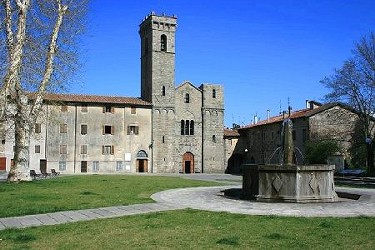
A religious community was re-established in 1939, but as far as I can see on the internet, it is no longer there. A municipal website for the town, which took over the name from the religious community, provides no further useful information. Elsewhere, I find an imperfectly translated history of the site and photos including:


Monte Amiata is reckoned at 1,738 metres to be the second-highest volcano in Italy, but is now extinct and covered with forest. The abbey and its town are on the mountain flank, not the top (Roberto Ardigo photo):

2012-11-11

An Ideological Kernel

A new article on the Great Stemma was published last year in Spanish, as I see from a new web search. In it, Helena de Carlos Villamarín seeks the reason for the inclusion of the diagram in the Codex of Roda. She argues that the diagram is the "ideological kernel of the Codex" and "points to the typological meaning of the textual ensemble, showing one of its interpretative clues to be the opposition between the Old and New Testament."

Perhaps. She says she is discussing all this "sin entrar a profundizar en el posible origen de estos textos o en sus avatares de transmisión". I would think that ignoring the possible origin of the genealogical diagram and its transmission history might make her interpretative argument rather vulnerable.

There is nothing wrong with speculating about the theological intentions of the Codex compiler, and de Carlos certainly knows the Codex as well as anyone today (this is her third published scholarly article about it), but surely one needs to also discuss what customers of the 10th-century book trade wanted (this was an expensive book to make), what was available for inclusion and why an illustrative frieze like the diagram was esteemed.

If the Christians of 10th century northern Spain knew that the diagram was of patristic origin, were aware that it had once existed in roll form and where it had been displayed, or even regarded it as an authoritative source, they might have used the diagram as a core document of their belief. If it was little known or obscure, it might have been taken up merely because of its decorative value. The errors in the diagram as copied leave the question open: did it go uncorrected because it was too authoritative to alter, or because the editors had a cavalier attitude to it?

The article is: "El Códice de Roda (Madrid, BRAH 78) como compilación de voluntad historiográfica". Edad Media: revista de historia, ISSN 1138-9621, 12 (2011), pp 119-142. Accessible here from Dialnet (which is an academic digitization portal, not a mobile-phone provider). (De Carlos's and other recent articles on the Codex by various authors are listed on Regesta Imperii.)

While I would not have expected de Carlos to have discovered my own Great Stemma research, which did not began to arrive online in bulk until 2010, I think she ought to have cited Christiane Klapisch-Zuber's L'ombre des ancêtres (2000) rather than an exploratory article published in 1991 by that author after her 1985-1986 Villa I Tatti stay in Florence. Klapisch-Zuber does not include the 1991 article any longer in her selected publications.

Admittedly my Spanish is too basic to go beyond the broad lines of argument of de Carlos, who teaches philology at the University of Santiago and edits an annual journal, Troianalexandrina, I find her re-interpretation of the genesis of the Codex an interesting contribution to the debate about the Great Stemma. In essence, she argues that the Codex contains two elements in tension: worldly history and biblical history, with a monastic editor trying to align them in a kind of harmony.

What I would have liked to see included would be some analysis of the diagram's history in Spain, including the known sightings of it in 772 and 672. Whether the Great Stemma in its 10th-century form really had kept its purely biblical character could also be debated. The Eusebian chronology and its synchronisms had long been introduced into the diagram by this stage via the Ordo Annorum Mundi. The version of the Great Stemma in the Codex of Roda is the closest in Spain to the lost original, and second only to the Florence version of the diagram as a witness, but we should not lose sight of the fact that the work was already at least 550 years old when the parchment for the Codex of Roda was still lying blank on a scriptorium shelf.

2012-11-10

Wooden Horse

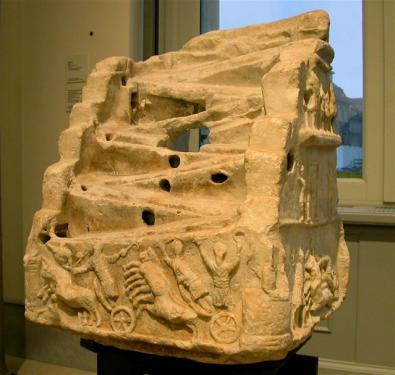
An equi lignei gaming machine (photo and original) found near the hippodrome in Constantinople (Istanbul) is one of the treasures of the Bode Museum in Berlin. It seems to be one of the class of devices outlawed in 534 by the emperor Justinian:
Prohibemus etiam, ne sint equi lignei: sed si quis ex hac occasione vincitur, hoc ipse recuperaret: domibus eorum publicatis, ubi haec reperiuntur. (Text link.) Translation: We also prohibit (the game with) wooden horses; if any one loses in it, he may recover the loss. The houses of those where these games are played shall be confiscated. (English translation by Fred Blume: link.)
Now plainly these wooden horses are not the sort used in the Greek capture of Troy, nor the sort that may have been vaulted over during Graeco-Roman gymnastic exercises. The museum has an online description of the item, which has exhibit number Ident.Nr. 1895, and a public image (bigger on the museum site):


This is a gaming machine. A commentary quoted on the museum page says the players placed four differently coloured marbles and let them run down through the holes. The marble which emerged first from the last hole produced a win for whoever had placed his bet on it. When this legal commentary was written is unclear.

The marble run or ball run in Berlin dates from about 500 and is a luxury stone-carved version of the machine. The marble is richly sculpted on the exterior with reliefs depicting the excitement of chariot racing: statues of horses, flute (aulos) players, men raising a banner, racetrack employees operating the draw for the teams and the start of a chariot race. The races appear to be conducted among teams of four horses, which was a passion among the people of Constantinople.

Jan Reichow refers to an account by the scholar Diether Roderich Reinsch and a museum guide by Arne Effenberger, quoted without page numbers or a proper bibliographic reference. The scholars appear to concur that the device was not a toy for a princeling but a capital investment for an entrepreneur in the equi lignei gambling trade, with the decoration on it conferring luxury and prestige, rather like the croupiers in casinos wearing tuxedos and bow ties to make the whole squalid experience seem as if it is high-class.

I made several marble runs from corrugated cardboard when I was about 10, and made another later as a father to amuse my sons. The frame was a cardboard carton and the tracks were strips of cardboard bent into V-cross-sections. With a box-cutter knife, I cut triangular holes in the carton to fit the tracks so that the marble could run through each track in succession. Children love marble runs, and this sort is easy to make and easy to recycle through the paper bank.

What makes a good marble run fun, until you have figured it out, is the unexpected way that the marble pops out on all sides of the block, rather like a mole showing up from a tunnel at an unexpected spot in my garden.

In my study of infographic history, the equi lignei device in Berlin firstly drew my attention because I wondered if its Late Antique users would have developed a scientific analysis of the path run through the device by the marble. An image on craft2eu.blog.de shows little holes at the side: it is not entirely clear if these are merely windows to show the players how far the marble has advanced or if these are exits for marbles that have been thrown out of the race:


Certainly some kind of mental projection of a path is a prerequisite for understanding a graph or a complex infographic like the Great Stemma.

The second aspect of interest is the illusionist potential of a marble run. Its operations are amusing because the marble can emerge, or at least be seen, where it is not expected. The marble seems to violate the rules of space by appearing magic-fashion in all sorts of unlikely places. It disrupts our sense of normal space. Some of the organization of the Great Stemma also breaks the rules of vision and is therefore slightly illusionist.

The marble run in Berlin at least confirms that the Late Antique world had a degree of experience with technical inventions that bent the rules of perception and vision when dealing with paths. This connects to the interesting technical guides by Hero of Alexandria including the one on ways to fake miracles in temples. These books were the subject of a post last year by Roger Pearse and there are links to the editions on the Wilbour Hall site.

2012-11-07

The Tamar Storyboard

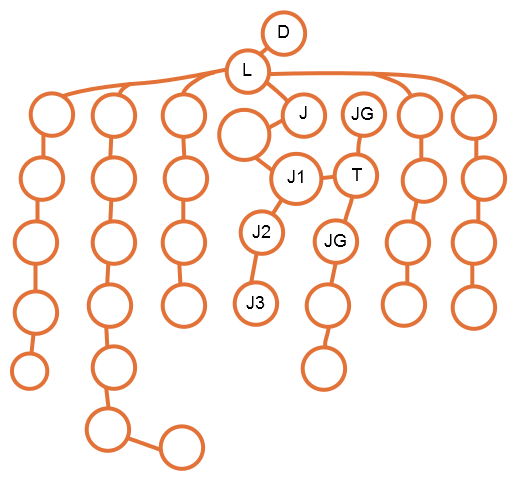
I've been studying a curious little flow-chart embedded in the Great Stemma of the Morgan Beatus that describes  Tamar's lucky-on-the-third-shot pregnancy in Genesis 38.

A revisor has added to this diagram a visualization of his own creation for one of the strangest sexual scandals in the Bible story, Tamar's seduction of Judah while pretending to be a veiled prostitute.

Tamar had been married to Judah's eldest son, Er. After she was widowed, Judah's second son Onan had sex with her but employed a crude form of contraception. Tamar then used a ruse to seduce her lecherous father in law and became pregnant. Her twin sons are either the sons or the grandsons of Judah, depending on your interpretation of this soap-opera plot.

Whether Shua, the wife of Judah, accepted this unusual family constellation is not recorded in Genesis, but the revisor devised the following compact visual summary of the story which retains for Shuah the place of honour in the emotionally tangled Judah household. It appears in flow-chart fashion in the Morgan Beatus like this: 

Leah
I have left out the text and instead used letters to mark the characters. Here, J is Judah, J1 and J2 are his first and second sons Er and Onan, and T is Tamar. Her twin children are marked JG, since the text marks them as sons of Judah and ambo gemini. Having the two twins arrayed in symmetry either side of their mother is a neat trick.

Perhaps it was Maius himself, the scribe-scholar who was in charge of making M 644 at the Morgan Library in New York, who devised this little flow chart. The roundel intervening between J and J1 is Shua, Judah's wife.

This addition, thus arranged, is only found in one other manuscript of the diagram, that made 100 years later by Facundus for King Fernando and Queen Sancha of León.

The whole group in the above sketch is composed of the six sons and daughter Dinah (D) of Leah (L). Links to online views of the manuscripts can be found on my manuscripts page.

2012-09-23

Farewell Hippolytus

In the past day I have been re-analysing some of the data which I examined and proceeded to describe two years ago in a blog post entitled Setback or Progress. At that time I was trying to discover the source of manuscript data which portrayed different ethnicities of the western world as tribal descendants of the biblical patriarch Noah. I was able to establish that this data was not part of the original version of the Great Stemma.

In the course of that research I took a closer look at the Chronicle (about 235 AD) of Hippolytus of Rome and formed the mistaken impression that Hippolytus had been a believer in a certain inflated and baroque chronology which had been abstracted from the biblical Book of Judges by an early Christian or Jewish chronographer.

Finding one's way among the subtle differences in Antique chronography (which is only preserved in fragmentary manuscripts based on repeated revisions of the original works) is an immensely tedious and complex affair which has never been the main focus of my research. The modern scholarly analysis of this material often employs elaborate arguments which magnify the faintest of evidence to arrive at some kind of usable conclusion.

In this case, much of the argument turns on how many phases make up the Book of Judges chronology and which phases were included. My Studia Patristica article, which is already in press, states:
Distinctively Hippolytan elements in the account can be found for example in the period from Joshua to Eli inclusive, which is divided by the Great Stemma into 22 political phases. Hippolytan features here include the rule of an apocryphal judge Shamgar (6th phase) and his alter ego Samera (21st). Both phases were witnessed as present in the Great Stemma when it was seen by the author of the Liber Genealogus in 427, whereas their existence had been firmly ruled out by Eusebius. This would suggest that the author was either hostile to or ignorant of Eusebius.
However I have now read and re-read Rudolf Helm's 1955 edition of the Hippolytus Chronicle (particularly pages 164-167) and understood that (at least in the editor Helm's view), Hippolytus divided the period (Joshua to Eli inclusive) into only 20 phases and excluded the rule of an apocryphal judge Shamgar (6th phase) and his alter ego Samera (21st). These are tiny distinctions, but are enough to derail the argument that Hippolytus was involved.

Farewell Hippolytus: you are no longer on the Great Stemma team.

I have duly changed the page on my website that deals with the matter. In the Studia Patristica article, which can no longer be altered, I would now want to say that there are elements in the diagram which clash with the theories of Eusebius and plainly come from an older, as-yet unidentified chronographer. The misidentification of that chronographer as Hippolytus is a very minor issue, and does not in any way weaken the main thrust of the article: that the Liber Genealogus is a description of an early version of the Great Stemma diagram.

The necessary conclusion after dumping Hippolytus is that some other chronological tradition influenced the Great Stemma. Perhaps the chronographer involved was Julius Africanus, perhaps not. I am not intending to research the issue further. If my error proves to be the stalking horse for a future scholarly article by a specialist, so much the better. I would welcome scholars in the history-of-chronography field taking up the matter and giving it a thorough review.

2012-08-12

Subway Map

A nice piece appeared Monday in the International Herald Tribune on the 1972-79 New York City Subway Diagram. Alice Rawsthorn tells us that that the diagram was re-activated this year on the Weekender, a page that alerts travellers to weekend construction and maintenance work on the train system:

Some diagrams fail because they do not offer any advantages over existing methods: a very small "family tree" which only covers two generations – a person and their parents – provides no benefit compared to describing the family verbally. Others fail because they over-reach themselves. 

New York City's Metropolitan Transportation Authority introduced a system diagram designed by Massimo Vignelli in 1972. It was based on Harry Beck's 1931 design for the London Underground. But New York City's rail engineers had built a system that could not be well diagrammed. The tangle of rail lines built through Lower Manhattan remained a tangle despite being schematized; the artwork was cluttered; worst of all, the design failed to connect to pre-existing mental representations of the city's bizarre geography. The MTA retired the Vignelli diagram in 1979 in the face of public criticism. 

New York City's current subway diagram, which is like a skin superimposed on a simplified map of the city, is an easier connect between its designer and its readers. Even tourists find it easier to find their way with the current map.

2012-07-27

Books of the Bible

I have chanced on a curious medieval infographic showing all the books of the Old Testament in stemmatic fashion, an idea that goes back to Cassiodorus (see my Cassiodorus abstract). The drawing, discovered with the help of Digital Scriptorium, is in the Lawrence Library at the University of Kansas and available in a high-resolution image.

It shows God as the origin node at the top, forking to the various books, for example the Pentateuch as a group of five at the top left, and employing trunk connectors below to connect the books of the prophets. The colours and style recall the Great Stemma.


The bibliographic information places the document (f. 2v of MS 9/2:29) in the 13th or 14th centuries and it is on the back of the final page of a Peter of Poitiers Compendium (see my list). It appears to be a continuation of the Compendium by the same scribe/artist. In the bibliographic description, the library considers it to be French.

2012-07-19

Finding Bernhard Pez

Bound into Heinrich Brauer's papers on the Compendium of Peter of Poitiers (the subject of my preceding blog post) is a library research report dated 1951 May 9 compiling reference-book data on this 12th-century work. It was drawn up by the Staatsbibliothek (then the Öffentliche Wissenschaftliche Bibliothek in the Soviet-controlled sector of Berlin).

It is evidence of the industrious help that could once be obtained from research library staff, back in the days before the budgets of such institutions were cut. Brauer was living and working in Celle, half a day's train ride from Berlin, but was able to save himself the trip to Berlin by simply writing and asking for an "Auskunft". We are immeasurably better off nowadays with the instant access available via the internet.

The reply from Berlin is of no great scholarly value and is defective in not containing any mention of the principal survey of Peter's work then in print, that published by Moore in 1930. The librarian also promises to inquire at other German libraries, but as there is no letter on file with any such results, this probably led nowhere. However one of its references, to Bernhard Pez, caught my eye.

The compilation duly mentions the editio princeps by Zwingli the younger published in 1592 in Basle and quotes from a series of reference works:
  • Georgi: Allgemeines europäisches Bücherlexikon
  • Jocher: Allgeneines Gelehrten-Lexikon
  • Nomenclator literarius theologiae catholicae
  • Wetzer und Welte: Kirchenlexikon
  • The Catholic Encyclopedia
  • Histoire littéraire de la France, vol 16
The last of these can be consulted on Google Books and the librarian quotes its mention of an edition by Pez based on the manuscript from "Metsen" in the diocese of Passau, Bavaria. This is a misprint or authorial error for the Benedictine house Kloster Metten.

Bernhard Pez was the librarian of the Benedictine abbey of Melk in Austria and volume 1 (published in 1721) of his Thesaurus anecdotorum novissimus notes that he found a copy of the Compendium in the monastic library during a visit to Metten. The Thesaurus has been digitized by the MDZ (click on the link and go to page 59 of the scan). A researcher has usefully added the handwritten information that the Compendium is at folio 101 of the codex, and Pez states:
Petri Pictaviensis Compendium historie veteris ac novi Testamenti, quod incipit: considerans historiae sacrae prolixitatem etc.
One presumes this manuscript is now in the state library in Munich.