2011-05-26

Ekphrasis

In the classic sense, ekphrasis means a poem that vividly describes a work of art or other physical artefact. During the Greek period, such texts might describe weapons, exceptional clothing, household items of superior craftsmanship (urns, cups, baskets) and splendid buildings.

This form of expression connects with the Roman pride in showing off one's education (paideia) at dinner parties which Michael Squire describes (p. 219) in his book Image and Text in Graeco-Roman Antiquity: Learned discussions of myths and philology were the bread and butter of the cena and convivium, and it seems to have been de rigueur to intersperse dinner with all manner of literary entertainments, he notes. Even Petronius's Trimalchio appreciates that 'one must know one's philology at dinner' (oportet etiam inter cenandum philologiam nosse: Petron. Sat. 39.3), though getting his own woefully wrong, Squire notes.

Squire traces this back to Hellenistic examples, quoting (p. 239) a passage in Greek (Dom. 2) from Lucian's On the Hall: When it comes to what we see, the same law does not apply for ordinary as for learned men. For the former, it is enough to do the usual thing: simply to gaze, look around ... But when a man of learning looks upon what is beautiful, he would not, I think, be content with harvesting his delight in looking alone, nor would he allow himself to witness their beauty in silence; instead, he will do all he can to take his time and to reciprocate the image with speech.

Lucian's speaker later says: 'Visual judgement lies not in the act of looking, but a rational eloquence also concurs with what is seen' (Dom. 6, quoted Squire p. 240). Addressing this Hellenistic 'etiquette of viewing', Squire adds (p. 243): 'The art of being an educated viewer once again becomes the art of being equipped with paideia - of having the terms, language and knowledge to articulate what is remarkable in an image.

The remainder of Squire's argument, that 'verbally mediated responses might actually force viewers to look harder at what they saw' (p. 247), need not concern us here. Instead, I am concerned with the relationship between the Great Stemma and the Liber Genealogus. The one is a very large and impressive diagram, the other an extended text which muses, in list order, on the etymology of biblical names and drops in various tendentious remarks of a Donatist nature about the Church of Rome. In the order of the material, the earliest, G recension of the Liber Genealogus closely follows the diagram. It is all but inconceivable that this order would have been independently adopted without reference to the diagram.

We are thus left with the issue of how and why the Liber Genealogus was written.

It seems to me that the practice of ekphrasis offers a plausible hypothesis to explain its creation. Much of what we read in the Liber seems to be a response to the visualization, perhaps by a Christian displaying both classical learning and biblical knowledge. It might be too fanciful to imagine three or four Christian literati going out to dine with a secretary at hand to jot down what they say and the Great Stemma pinned up on the wall of the dining room. But certainly the Liber does seem to be written with the purpose of dazzling somebody with the eloquence and resourcefulness of its etymological speculation about Hebrew names of the Bible.

2011-04-10

Liber Genealogus

A 9,000-word study of the links between the Liber Genealogus and the Great Stemma more or less completes my detailed research into the oldest stemma diagram known. I have just placed this new article online. I do not pretend it offers any great amusement: it is rather dry stuff. But we need the detail to assemble the case that the Liber is the textual account of someone who had read the Stemma, or something like it. I don't think many people read the Liber Genealogus: it is difficult to see what use it ever was to any reader. Mommsen's edition of the Liber does not help the contemporary reader much either. It is not particularly easy to use, given that the composite Mommsen text overlays the original G recension with material from the Origo Humani Generis and a lot of Donatist disputation. It might have almost been easier for me to just read a manuscript. Unfortunately, the best and oldest one is not online. The excellent Swiss e-codices project has not yet digitized Cod. Sang. 133, which contains the G recension dating from the late 8th or early 9th century. That is quite impressive: this codex was penned less than 400 years after the Liber Genealogus was written in 427. In the absence of this much-needed digital work, one can only consult Plutei 20.54 in Florence, which contains the inferior F recension. This is in fact the same codex that contains the most primitive form of the Great Stemma.

2011-03-09

Greek Place-Names

An interesting blog post from last year by Nick Nicholas on old Greek names for a stretch of coast that is much in the news at the moment. Hippolytus's Chronicon comprehensively lists places that a mariner might need to know about on the desert coast of North Africa.

2011-03-08

New Revisions

So we now have two new pages on the site: one deals in more detail with Eusebius and the likely debt of the Great Stemma to his Chronological Canons. The other explores in more detail the oddities of the Ordo Romanorum Regum. I have also fully revised the bibliography to make it more comprehensive.

2011-02-17

Ordo Annorum Mundi

A new page, dealing with the Ordo Annorum Mundi, has now been placed on the Macro-Typography website. It seems to me that the OAM may be a piece of writing by the Great Stemma's author, but I am still looking for the killer evidence. The OAM seems to appear only in Iberian-origin manuscripts, but has achieved wider diffusion through its incorporation in the Commentary on the Apocalypse of Beatus of Liebana.

Note added in August 2012: No killer evidence found. It seems more than likely that the Ordo Annorum Mundi is not by the Great Stemma author, who probably worked from a chronology drafted by Hippolytus of Rome. However the OAM's history seems intimately entwined with that of the diagram. It could well be the work of someone who revised and altered the diagram at a later stage, altering it to reflect a chronology of world history computed by Eusebius of Caesarea. Professor José Carlos Martín of the University of Salamanca will soon be issuing an editio princeps of the Ordo Annorum Mundi, and we are keenly awaiting this important publication.

2011-02-16

The Vetus Latina Hispana of Ayuso

In 1953, Teófilo Ayuso Marazuela published the first volume of his Vetus Latina Hispana. It was an ambitious project, presumably with government funding, to recover the bible texts that circulated in Iberia before the introduction of Jerome's Vulgate. It was in direct rivalry with the Vetus Latina that was being reconstructed at the Abbey of Beuron in Germany, and it was awarded a prize (marked on the title page) in the name of Spanish dictator Francisco Franco.

Ayuso devised his own numbering system for the codices and other manuscripts he used. The numbers seem to have fallen completely out of use, but are still essential in reading scholarly Spanish articles of the period, in particular Ayuso's own writing, about biblical manuscripts. Since the numbers seem to be nowhere on the internet, I am tabulating them online in the hope they can be of service to modern scholars.

The left column comprises the VLH or Ayuso numbers themselves, followed by the abbreviations commonly used and the sequence numbers for each manuscript of the same provenance. For example, Leg2 or Legionense2 is the Codex gothicus. Burgense1 is the Burgos Bible, also called Biblia de San Pedro de Cardena. The last column lists the (1953) locations of the manuscripts.


1 Guelf


Vaticano -Guelferbitano Vaticano
2 Tur


Turonense Paris
3 Fragm. To


Fragmentos toledanos Toledo
4 Freís


Fragmentos de Freising München
5 Palimps


Palimpsesto de León León
6 Ottob


Ottoboniano Vaticano
7 Lugd 1 Lugdunense Lyon
8 Lugd 2 Lugdunense Paris
9 Escu 1 Eseurialense El Escorial
10 Ov 1 Ovetense (Desaparecido) Oviedo
11 Luxeuil


Leccionario de Luxeuil Paris
12 Ov 2 Ovetense (Desaparecido) Oviedo. Escorial
13 Cav


Cavense Cava
14 Cav dpdo


Cavense duplicado Vaticano
15 To 1 Toledano Madrid
16 To dpdo


Toledano duplicado Vaticano
17 Co 1 Complutense Madrid
18 Co 2 Complutense Madrid
19 Leg 1 Legionense León
20 On


Oniense Salamanca
21 Leg 2 Legionense León
22 Leg dpdo


Legionense duplicado Vaticano
23 Leg 3 Legionense supuesto (Desaparecido) León
24 Emil 1 Emilianense Madrid
25 Burg 1 Burgense Burgos
26 Valv


Valvanerense (Desaparecido) Escorial
27 To 2 Toledano Toledo
28 Pin


Pinatense Madrid
29 Moz


Breviario Mozárabe Madrid
30 Psalt 1 Salterio Madrid
31 Psalt 2 Salterio Madrid
32 Psalt 3 Salterio Madrid
33 Psalt 4 Salterio London
34 Psalt 5 Salterio Nogent-sur-Marne
35 Psalt 6 Salterio Escorial
36 Psalt 7 Salterio Madrid
37 Psalt 8 Salterio Santiago
38 Cant


Liber Canticorum Madrid
39 Com 1 Liber Commicus Toledo
40 Com 2 Liber Commicus París
41 Com 3 Liber Commicus León
42 Com 4 Liber Commicus Madrid
43 Seg 1 Seguntino Sigüenza
44 Esc 2 Escurialense El Escorial
45 Tolos 1 Tolosano Toulouse
46 Tolos 2 Tolosano Toulouse
46* Esc


Escurialense Misceláneo (not a bible) El Escorial
47 Lugd 3 Lugdunense Lyon
48 Teod


Teodulfiano Paris
49 Anic


Aniciense Le Puy
50 Bern


Bernense Bern
51 Hub


Hubertiano London
52 Sang


Sangermanense Paris
53 Sang


Sangermanense Paris
54 Sang


Sangermanense Paris
55 Riq


Saint Riquier Paris
56 Laud


Laudiano Oxford
57 Mon


Monacense München
58 Aur


Aureo Escorial
59 Cas 1 Casinense Monte Cassino
60 Cas 2 Casinense Monte Cassino
61 Cas 3 Casinense Monte Cassino
62 Cas 4 Casinense Monte Cassino
63 To 3 Toledano Toledo
64 Matr 2 Matritense Madrid
65 Matr 3 Matritense Madrid
66 Matr 4 Matritense Madrid
67 Matr 5 Matritense Madrid
68 Matr 6 Matritense Madrid
69 Matr 7 Matritense Madrid
70 Matr 8 Matritense Madrid
71 Purp


Purpúreo (Desaparacido) Urgel
72 Urg


Urgelense Urgel
73 Rip


Ripollense Vaticano
74 Roa


Rodense Paris
75 Vic 1 Vicense Vich
76 Vic 2 Vicense Vich
77 Vic 3 Vicense Vich
78 Vic 4 Vicense Vich
79 Par 1 Parisiense Paris
80 Par 2 Parisiense Paris
81 Par 3 Parisiense Paris
82 Esc 3 Escurialense El Escorial
83 Mall


Malloricense Palma
84 Leg 3 Legionense León
85 Leg 4 Legionense León
86 Leg 5 Legionense León
87 Leg 6 Legionense León
88 Leg 7 Legionense León
89 Osc


Oscense Madrid
90 Matr 9 Matritense Madrid
91 Burg 2 Burgense Burgos
92 Burg 3 Burgense Burgos
93 Cal


Calagurritano Calahorra
94 Emil 2 Emilianense Madrid
95 Ler


llerdense Lérida
96 Co 2 Complutenses Madrid
97 Av


Avilense Madrid
98 Esc 4 Escurialense El Escorial
99 Alf


Alfonsino (Desaparacido) Barcelona?
100 Avig


Avignoniense (Desaparcido) Avignon?
101 Barc 1 Barcinonense Barcelona
102 Barc 2 Barcinonense Barcelona
103 Barc 3 Barcinonense Barcelona
104 Barc 4 Barcinonense Barcelona
105 Barc 5 Barcinonense Barcelona
106 Bil 1 Bilbilitano Calatayud
107 Bil 2 Bilbilitano Calatayud
108 Burg 4 Burgense Burgos
109 Burg 5 Burgense Burgos
110 Cal


Calagurritano Calahorra
111 Conc


Concentainense Concentaina
112 Dar


Darocense Daroca
113 Esc 5 Escurialense El Escorial
114 Esc 6 Escurialense El Escorial
115 Esc 7 Escurialense El Escorial
116 Esc 8 Escurialense El Escorial
117 Esc 9 Escurialense El Escorial
118 Esc 10 Escurialense El Escorial
119 Esc 11 Escurialense El Escorial
120 Esc 12 Escurialense El Escorial
121 Esc 13 Escurialense El Escorial
122 Esc 14 Escurialense El Escorial
123 Esc 15 Escurialense El Escorial
124 Esc 16 Escurialense El Escorial
125 Esc 17 Escurialense El Escorial
126 Esc 18 Escurialense El Escorial
127 Esc 19 Escurialense El Escorial
128 Esc 20 Escurialense El Escorial
129 Esc 21 Escurialense El Escorial
130 Esc 22 Escurialense El Escorial
131 Esc 23 Escurialense El Escorial
132 Esc 24 Escurialense El Escorial
133 Esc 25 Escurialense El Escorial
134 Esc 26 Escurialense El Escorial
135 Hisp


Hispalense Sevilla
136 Mall 2 Malloricense Palma
137 Mall 3 Malloricense Palma
138 Matr 10 Matritense Madrid
139 Matr 11 Matritense Madrid
140 Matr 12 Matritense Madrid
141 Matr 13 Matritense Madrid
142 Matr 14 Matritense Madrid
143 Matr 15 Matritense Madrid
144 Matr 16 Matritense Madrid
145 Matr 17 Matritense Madrid
146 Matr 18 Matritense Madrid
147 Matr 19 Matritense Madrid
148 Matr 20 Matritense Madrid
149 Matr 21 Matritense Madrid
150 Matr 22 Matritense Madrid
151 Matr 23 Matritense Madrid
152 Matr 24 Matritense Madrid
153 Matr 25 Matritense Madrid
154 Matr 26 Matritense Madrid
155 Matr 27 Matritense Madrid
156 Matr 28 Matritense Madrid
157 Matr 29 Matritense Madrid
158 Matr 30 Matritense Madrid
159 Matr 31 Matritense Madrid
160 Matr 32 Matritense Madrid
161 Matr 33 Matritense Madrid
162 Matr 34 Matritense Madrid
163 Matr 35 Matritense Madrid
164 Matr 36 Matritense Madrid
165 Matr 37 Matritense Madrid
166 Matr 38 Matritense Madrid
167 Oxorm


Oxomense Burgo de Osma
168 Par 4 Parisiense Paris
169 Plas 1 Plasentino Plasencia
170 Plas 2 Plasentino Plasencia
171 Salm


Salmanticense Salamanca
172 Segov


Segoviense Segovia
173 Segunt


Seguntino Sigüenza
174 Ser


Serenense Villanueva de la Serena
175 Sor


Soriano Soria
176 Tar


Tarraconense Tarragona
177 Tir


Tirasonense Tarazona
178 To 4 Toledano Toledo
179 To 5 Toledano Toledo
180 To 6 Toledano Toledo
181 To 7 Toledano Toledo
182 To 8 Toledano Toledo
183 To 9 Toledano Toledo
184 To 10 Toledano Toledo
185 To 11 Toledano Toledo
186 To 12 Toledano Toledo
187 To 13 Toledano Toledo
188 To 14 Toledano Toledo
189 To 15 Toledano Toledo
190 To 16 Toledano Toledo
191 To 17 Toledano Toledo
192 To 18 Toledano Toledo
193 To 19 Toledano Toledo
194 To 20 Toledano Toledo
195 Urg 2 Urgelitano Urgel
196 Urg 3 Urgelitano Urgel
197 Valent 1 Valentino Valencia
198 Valent 2 Valentino Valencia
199 Valent 3 Valentino Valencia
200 Valent 4 Valentino Valencia
201 Valv 2 Valvanerense Valvanera
202 Vat


Vaticano Vaticano
203 Zar 1 Zaragozano Zaragoza
204 Zar 2 Zaragozano Zaragoza

You are welcome to copy my list and reproduce it as you wish, though a credit would be appreciated. As far as I can assess, the list in the book can no longer be subject to copyright, and in any case I have modified it to present it here on the web.
There is one peculiarity, perhaps a lapse in attention by Ayuso. Pages 25-6 (IV. Lista de codices espanoles o de origen hispanico estudiados, numeros y siglas correspondientes) list 203 sources only, while pages 347-83 (Los manuscritos bíblicos espanoles) contain a list that is one element longer (204). The extra item in the latter list comes at position number 113, Escurialense5, which is inexplicably missed from the summary table, so that every item below it is displaced by one position when the two lists are compared. In the above tabulation, I have followed the numbering on pages 347-83, since this seems to be correct. Perhaps there is an errata page, or a handwritten correction, in a copy in a Spanish library, and I would be grateful to anyone willing to check this. But there is no such correction in the Hamburg State Library copy, which is kept in the city's Bergedorf stack and does not seem to have been much used down the years.
[A later note:] Ayuso's earlier articles use quite different sigla, including A2, A3, A4, A5, A6, 7-8. These are apparently the items in the Biblioteca Nacional in Madrid (lines 64-69 above). A2 for example is the Bible of San Juan de la Peña, and these are listed in the print catalog (Tomo 1) here. His earlier "Bu" is the Burgos Bible in line 25, as noted above. Ayuso renumbered the León bibles, since 3 Legionense in line 23 is a lost one, whereas the Leg3 he had referred to in 1943 was clearly the Second León Bible which is very much in continued existence. In line 12, 2 Oventense is the lost Gospel Book of Justus which I discuss in another post.

2011-01-19

A Latin Counterpart to Eusebius?

Six years ago, Roger Pearse led a magnificent distributed effort to create an English translation of the Chronological Canons of Eusebius. This was a work in Greek, now mostly lost, that we know through a Latin translation by Jerome and through Armenian translations from the Greek. The translation of the Canons is freely available as two (very large) HTML tables, beginning here on Tertullian.org or mirrored at CCEL here. They may take a while to download to your screen. The Latin of Jerome has also been tabulated on the same websites.
The chronological canons explore synchronisms in the histories of the cultures arrayed between Rome and Persia, keyed to biblical history starting at the birth of Abraham.

So what has this got to do with the Great Stemma? Well, it seems that both are essentially about the same thing, synchronisms. Eusebius created what was in a sense the world's first spreadsheet, with a patient scribe doing the autofill of dates in sequence down the left column. Eusebius then filled in events across the rows from the chronicles of the various civilizations he knew, Graeco-Roman and barbarian. Anthony Grafton in Christianity and the Transformation of the Book explores how revolutionary this method of visualizing information was. One point he might have made, but I don't think he did, is the importance of blank space in this content. The blanks are a key to reading the tabulation. There's a certain tension about it, because Eusebius obviously knew a lot of the content was rubbish, but he puts it in and lets the reader judge.

Now, the Great Stemma, in my view, must have done the same thing, but working left to right, and takes another step forward technically by eliminating the scale of years.
I've now posted a hypothetical reconstruction (link) of how the chronographical elements in the Great Stemma might have looked.

How was it progress to simplify Eusebius? The chart shows the reader the various synchronisms in the Bible: the descendants of Seth with the offspring of Cain, the offspring of Nathan with those of Solomon, the kings of Judah with those of Samaria, the founders of Rome with the Persians. But it finds a way to mix the resolution of the matches. In some cases it can state in a gloss to an exact year what is synchronous. In other cases it gives just a rough estimate of synchronicity, give or take a few hundred years. The author was probably teaching his students that the offspring of Cain were wiped out by the Great Flood, but thanks to his page design he does not need to say exactly when Lamech the Boaster lived or when Noema introduced her a capella music: he just draws them as a series of roundels crawling along the foot of the page till they stop. Big fat roundels don't need to be precisely placed. So in a sense, the Great Stemma is the first mind map: information in bubbles. If it had any kind of exactitude, this was probably confined to a separate tabulation. Perhaps the Ordo Annorum Mundi is that tabulation. We'll have to keep looking into this.

Eusebius obviously had the same issue to contend with. In fact he explains that some of his data is less exact, with a resolution in the order of decades only, not years, or at least that is one of the implications I draw from the following remark. Here is Grafton's translation (p. 140) of Chronici Canones, 14:
To prevent the long list of numbers from causing any confusion, I have cut the entire mass of years into decades. Gathering these from the histories of individual peoples, I have set them across from each other, so that anyone may easily determine in which Greek or barbarian's time the Hebrew prophets and kings and priests were, and similarly which men of the different kingdoms were falsely seem as gods, which were heroes, which cities were founded when, and, from the ranks of illustrious men, who were philosophers, poets, princes and writers.

Eusebius's thoughts on this are useful to an understanding of the Great Stemma. Understanding that Eusebius decided to simply ignore what he saw as prehistory, the time before Abraham, suggested to me that the Great Stemma author also probably decided to treat it differently, arranging it in unform arches and not bothering too closely about its possible synchronisms.
It still seems odd that the Great Stemma seems serenely unaware of Eusebius. Still, if the author worked entirely from Latin sources and did not have any of Jerome's translations to hand, neither the Vulgate nor the Chronici Canones, that would be understandable.
The Roger Pearse translation and Latin allows me to hunt and look for any resemblances and I find no matches in the proto-text of the Stemma. Something only shows up in a later recension, Urgell, where we have: Sexaginario Isaac nascuntur filii gemini: primus Esau, qui est Edom, a quo gens Iudamaeorum; secundus Jacob, qui posthea Israhel, a quo Israhelitae, qui nunc Iudaei. This matches Jerome's Latin translation of Eusebius: Sexagenario Isaac nascuntur filii gemini: primus Esau, qui et Edom, a quo gens Idumaeorum. Secundus Jacob, qui postea Israel, a quo Israelitae, qui nunc Judaei.

Now I don't wish to suggest that the Great Stemma is contemporary with the Canons, which were drawn up in the decade or so after 300 CE. The Stemma might have been drawn up 100 or even 150 years later. But in a wonderful way it is a kind of Latin counterpart to the Canons, finding new conventions to visualize a similar kind of content, preferring traditional roll form to new-fangled codex format, devising new ways to mix exactitude and vagueness, yet very successfully getting its message about synchronisms in biblical history across to the student who reads it. Or more correctly, who read it, past tense. By the time the document reached Spain, most of the careful parallelisms had probably been ruined by careless scribes, and the reader was left to guess at what episode above matched which episode in the rows below.

2011-01-02

Léon Abbreviations

The great Léon bible known as the Codex Legionensis or Leg2 (to distinguish it from Leg3, a copy made 100 years later, and Leg1, also known as ....) has never been published online as far as I know. I was able to see a facsimile of it in the summer at the Prussian State Library in Berlin: it is brought to you in a suitcase-sized wooden box, and the volume would probably not be transportable as hold baggage without paying a supplement: it weighed over 20 kilograms.

In the end I decided against transcribing its version of the Great Stemma and preferred that in the Facundus Beatus. However the Léon bible is sometimes considered the greater treasure by scholars. I have just been looking at Téofilo Ayuso's 1960-61 article in Estudios Bíblicos which comprehensively describes it. Ayuso offers some useful instructions on how to read it, summing up its abbreviations and punctuation. Most of these features are applicable in the other documents in Visigothic script, and are worth reproducing here:

Nexos y Abreviaturas
No vale la pena insistir. Son los propios de la escritura de la época, sin rarezas.
Son normales los nexos y abreviaturas de at, bis, en, er, es, et, ex, nt, per, re, rtem, rum, se, ti, ter, tre.
Normalmente usa ȩ (e con cedilla) en los diptongos ae, oe: uitȩ, suȩ, quȩ, prȩdicasse, etc. A veces la omite: celum, etc. A veces la pone en falso rȩcedent, ȩgo, ȩnim. En alguna ocasión tiene et diptongo.
Ya hemos insinuado algunas abreviaturas por suspensión:
que: usqs, negs, dixeruntqs;
y la de bus: tribs,quibs, etc.
Igualmente ius, mus, pus, etc.: huis, sums, temps, y la de bis, con una especie de cedilla: noḅ.
En cuanto a las abreviaturas por apócope, en las mayúsculas suele ser una raya horizontal gruesa ( ¯¯ ) con adornos o doble suspensión; y en las minúsculas dos o tres puntos: cü ...dṡ ..., bien para la supresión de una letra uitulü, bien para la contracción aüm.
Para e' relativo (qve, qvem), suele usar una v pequenita, volada.
A base de eso las abreviaturas suelen ser las ordinarias:


apslapostolus
aumautem
dddauid
dnsdominus
dsdeus
eplaepistola
glagloria
gragratia
frfrater
ihrslmiherusalem
ihsihesus
kmikarissimi
msmeus
nmnnomen
nsnoster
oms,omnis
pplspopulus
qmquoniam
pprpropter
ppreapropterea
scdmsecundum
spsspiritus
scssanctus
srlsrahel
usauestra
xpschristus

Signos de puntuación
Valen todas las observaciones que hicimos sobre la Biblia de Oña.
Usa con bastante regularidad los signos correspondientes al incisum o subdistinctio, media distinctio y ultima distinctio o punto final. Estos signos son ·(punto alto); · (punto en medio de linea); y ., o de .' (punto bajo, seguido de una comita un poco mayor, ya sea al mismo nivel, ya un poco mas elevada). Como es sabido, indican, poco más o menos, lo que nuestra coma, punto y coma, dos puntos y punto final.
[A note of explanation here: this is the medieval system of punctuation as developed by Aristophanes of Byzantium which we generally ignore in transcriptions, since it does not match current notions of grammatical punctuation:
media distincto: midlevel pause (≈ comma)
subdistincto: pause (≈ semicolon)
distincto: long pause (≈ period)]
Después de ., o de .' suele seguir mayúscula. Unas veces a ren­glón seguido, otras comenzando la linea siguiente.
Usa, como dijimos, una cedilla para expresar los diptongos ae, oe,
Usa un puntito sobre 'a y levantada.
Usa corrientemente un signo de interrogación, chie consiste en una pequeña espiral o rayita quebrada, sobre et espacio que signe a la última letra.
Para indicar la división de capitulos, bien en et margen, bien en medio de linea, usa un ángulo recto, alto, dentro del cual incluye los números romanos correspondientes: I, II, etc.

2010-12-27

Statistics

I've recently completed collating the fifth and last recension of the Great Stemma, found in the Urgell and San Juan manuscripts and it has gone online, along with an expanded bibliography of about 100 works. The collation of the manuscripts has been fairly tedious work and I think I'll stop here. I don't think it would achieve much if I transcribed the Saint-Sever (Sigma) manuscript, and the only other document I am at all curious about at this stage is the one in the Codex Amiatinus III. Perhaps I'll do it later.

It's time for a few statistics now that we have collated all five early recensions of the Great Stemma. Here are the tallies of genealogical roundels for the ancestry of Christ (A), other biblical figures such as Moses and Saul (B) and lone kings (C) with a subtotal of A+B+C.

All versions include about 114 sections of timeline material, of which 44 to 48 sections take the form of roundels. Adding these into the tally brings us to a grand total of roundels for each recension noted in the final row below:


EpsilonDeltaGammaAlphaBeta
A390380379396406
B8378778183
C1919181919
subtotal492477474496508
all roundels540521516542555
In general, the colums to the left tell us the most about the Great Stemma as it existed in Late Antiquity and those at the right measure what changes later editors made to the document, both losing data and adding material. These numbers are surprising in various ways.

For one thing, it turns out the Zaluska's estimated total of about 600 roundels, presumably based on her transcription of the Saint-Sever stemma, is somewhat deceptive. The Late Antique version probably only contained the 540 roundels in Epsilon. The higher tallies come from interpolated versions, of which Saint-Sever (not tallied here) is certainly the biggest.

We also see that despite the rearrangements in structure, the compressions, the many Vulgate-based alterations in the text and the extensive interpolation of material from Isidore, Jerome and others, the Great Stemma remained remarkably constant in its underlying scale during hundreds of years of copying.

Another implication is that the Urgell manuscript, which looks unfinished because of all its empty roundels, is in fact more complete than it seems: the scribe was careless and left out a dozen individuals, but he clearly also drew far more roundels than he ultimately needed. And after supplementing the Gamma collation with material from the San Juan bible, we can see that the Gamma total is only a score or so short of the full muster.

2010-12-06

False Alert

A check today in the Faider and Sint Jan catalog of pre-War Tournai manuscripts reveals that the manuscript I blogged about last week did not contain a stemma. The codex was destroyed in the Luftwaffe bombing of Tournai 1940 May 17. It was shelf-marked Ville Cod. 135 and the catalog (which does indeed survey what survived of Sander's discoveries) describes it thus:
L'ensemble du volume paraît être constitué par les cahiers de copies, de notes et d'extraits, recueillis par un seul travailleur, probablement anglais, au cours d'un séjour dans une bibliothèque déterminée (à Metz ou dans les environs de cette ville). Il se décompose en trois parties (fol. 1-28, 29-87, 88-117), accusées par des changements d'écriture, mais non nécessairement de main. -- Aucune indication explicite d'origine. -- En tête, note sur papier libre (4 ff.), de l'écriture de Franz Cumont (vers 1896), donnant une analyse du contenu du volume, avec quelques annotations supplémentaires. A fait partie de la bibliothèque du chanoine de Villers (cfr Sanderus, p. 215: uno volumine continentur sequentes tractatus 23, etc.). Le relieur du XVIIIe siècle a rogné dans les marges supérieures un certain nombre de titres qui peuvent être restitués grâce au témoignage de Sanderus. Même reliure que le cod. 134. Au dos: De situ Britan ac de re. eius.
The pages where Sander saw the name Gedeon are catalogued thus:
23 (84 v-87r). (Excerpta ex historia sacra)
Fol. 84v, col. 1: Adam prothoplastus colonus paradisi nomina creature dedit, per inobedientiam...; fol. 87r, col. 1: ...Gedeon ...mortuus est senex et sepultus in sepulchro ioas patris sui in effrata (le reste de la page en blanc). - Fol. 87v blanc (essais de plume).
Suite de paragraphes, accusés par des lettres initiales en vert (fol. 84v-85r), puis en rouge, et consacrés aux principaux personnages de l'Ancien Testament jusqu'à Gédéon. - Le fol. 87 est coupé à la moitié de sa hauteur. Les essais de plumes du verso se réfèrent au même texte (Ave Maria ad cuisis, etc.) que ceux du fol. 63 v.
So it was plainly a purely textual account. The other genealogical passage seems to be this:
18 (51r-55 r). Genealogia (seu Epitome Historiae sacrae usque ad Regnum Aristobuli).
Fol. 51r, col. 1: Considerans historiarum prolixitatem, uero unde? et difficultatem scolarium quoque circa studium sacre lectionis... temptaui seriem sanctorum patrum... sed ab adam inchoans ... ad christum finem nostrum ordinem produxi. Adam in agro damasceno formatus... ; fol. 55r, col. 2: ... decursis CCCC LXXV annis a sedechia quando regnum interruptum fuit. - Fol. 55v-56r blancs.
Here again, the 18th-century binder guillotined off the page edges and the heading seen by Sander, as the catalogers note: Résumé de l'Histoire sainte, interrompu après le règne d'Aristobule. Titre ancien coupé dans la marge supérieure du fol. 51r. On déchiffre I(nci)p(it) g(enealo)g(ia).

2010-11-30

Mount Seir

I have completed one of the more obscure analyses of the Great Stemma: a tabulation of the passage dealing with the chieftains of Mount Seir. These are outland people mentioned in Genesis 36 and are not part of the stated ancestry of Christ. We cannot even begin to guess why they were included in the Great Stemma. Interesting sounding names? To fill a blank area of the page? To prove that the author had read Genesis exhaustively? We just don't know. Your guess is as good as mine. Zaluska thought it was of great importance, but never published her own tabulation. I have filled the gap.
In all honesty, this tabulation is not going to make history, but as a piece of utilitarian work, it positions us for further analysis. The passage is the key proposed by Zaluska to identifying the different recensions of the Great Stemma. It is also important in demonstrating that the Epsilon version (not studied by Zaluska) is the oldest and purest that we have got.

2010-11-29

Intriguing Lead

This post has been superseded. Further investigation showed the intriguing lead led nowhere.
The Bibliotheca Belgica Manuscripta by Anton Sander, a listing of Belgian manuscripts sighted in or before 1640, contains an intriguing lead at page 215: in a codex which unites a variety of short genealogical works, there is one item described as a Genealogia ab Adam usque ad Christum, and another described as a Genealogia ab Adam usque ad Gedeonem. There is no note to say that these genealogies are in table form, but their owner must have had an interest in graphic stemmata, since another item in the volume is Boccaccio's Genealogia Deorum, which often contained Boccaccio's 14th century stemmata. *

What is particularly interesting about the second genealogy (Adam-Gedeon) is that Gedeon is neither a figure in Christ's ancestry, nor, as far I know, does he figure in the bogus medieval ancestries of the European nobility. What is he doing in a genealogy? A glance at the 10th page of Plutei 20.54 in Florence suggests a possible answer. Gedeon is the penultimate item on the fifth out of eight sheets. The Tournai codex, which seems to be a grab-bag of thieved and salvaged fragments, might have contained an incomplete Epsilon manuscript where the last three sheets that cover the period from David to Christ had been lost.

After 370 years, this codex probably no longer exists. Sander saw it in Tournai Cathedral Library.** It had been left to the library by Denis de Villers, who seems to have been chancellor of the diocese (I'm not fully clear about the ecclesiastical offices in this period).*** Tournai and its cultural treasures were bombed by the Luftwaffe in 1940, and much was lost (pictures).

How do we discover the fate of the genealogy codex? The Bibliothecae Cathedralis Ecclesiae Tornacensis now has a weblink, but this codex is not listed. I searched for "Genealogia ab Adam..." and a selection of the other partworks in In Principio, the Brepols database of incipits, but found no promising leads. Where else should I look? Has anybody analysed Sander's work and established, codex by codex, what happened to the various manuscripts?

* Sander's book was published by Insulis, Ex officina Tussani le Clercq, apparently a printer at Lille in France.
** Sander describes the legacy thus: codices Mss. qui sunt in bibliotheca reverendi Domini Hieronymi de Winghe canonici Tornacensis, nunc in bibliotheca publica eccelsiae cathedralis solerte studio et cura R.D. Ioannis Baptistae Stratii decani et donationibus clarissimorum viriorum Hieronymi Winghii, Dionysii Villerii, ac Claudii Dausqueii, eiusdem ecclesiae canonicorum inchoata et luculenta editorum voluminum supellectile instructa.
*** Samaran, Ch. 'La Chronique latine inédite', says Denis de Villers (1546-1620) was a literary man of Tournai, versed in genealogy and numismatics, who held a doctorate in canon law from Louvain University. He and canon Jerome van Winghe founded the cathedral library which is now the Tournai public library (catalog) (article in Bibliothèque de l'école des chartes (1926), 87,144, note 3). There is a more substantial 2004 article by Claude Sorgeloos on de Villers' book collecting here and note 9 says most of de Villers' books were destroyed in the bombardment in 1940. However some had been moved to Mons (catalog) and Courtrai (catalog) and were saved, and one of de Villers' books from Tournai later ended up in the hands of Sir Thomas Phillipps, so perhaps we should also check records of the Phillipps auctions.

2010-11-17

Bamberg Cassiodorus

The State Library at Bamberg has recently digitized the stemma diagrams from its splendid codex Staatsbibliothek Bamberg Msc.Patr.61 and placed them online. The quality is excellent and this is very welcome. The library deserves to be congratulated.
The page of references to written documentation dealing with the codex includes the URLs of my catalog of Cassiodorus stemmata and my reconstruction of how Cassiodorus may have originally conceived the diagrams. There are several recent articles mentioned there which I did not know about: now to order and read them.

2010-11-13

Translation Finished

Another marker passed: the translation of the Great Stemma into English is complete. Bar a few unintelligible passages where I may have messed up the transcription, the publication is now fully bilingual. Seumas Macdonald of Sydney took charge of putting 30 of the most difficult passages into English. With the text getting so long, I have now split the collation into four sections:
  1. The Genealogy of Christ
  2. Other Genealogies
  3. The Timeline
  4. The Interpolations
The latter section emerged as a separate entity during the recent research into where the many glosses had come from. It turns out that most are almost verbatim quotes from works of Isidore of Seville or from Jerome's Vulgate text. The only text where a clear attribution is not possible is the apocalyptic prediction about the defeat of evil and the coming of the Seventh Age which has been inserted into the Plutei manuscript. For the time being I am leaving out the mappamundi text, since its separate history remains unclear.

2010-11-06

Decoding the San Millán Manuscript

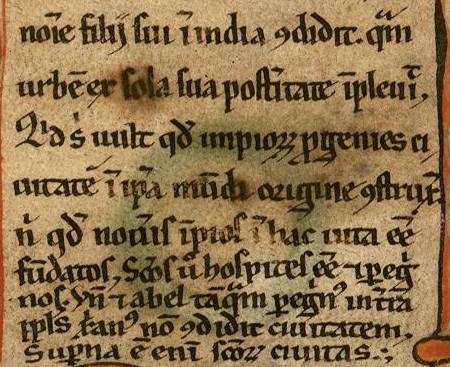
A tricky decoding job with the San Millán stemma seems almost complete, thanks to Brepols and their Library of Latin Texts (LLTA), an online database of Latin. Here is an image of the text:
My first transcription of this gloss about the secular city built by Cain turned out to be nonsense, but I was fortunate to find that the bulk of the text was simply borrowed from a theological exposition by Isidore of Seville, the Mysticorum expositiones sacramentorum seu Quaestiones in Uetus Testamentum. This is easily found in the LLTA: Quid ergo sibi per figuram vult, quod impiorum progenies civitatem in ipsa mundi origine construxit? nisi quod noveris impios in hac vita esse fundatos, sanctos vero hospites esse et peregrinos. Unde et Abel tanquam peregrinus in terris, id est, populus Christianus non condidit civitatem. Superna enim est sanctorum civitas (In Genesim, 6).
That allows us to transcribe the script as follows: Primus ante diluvium Cain civitatem Enoch nomine filii sui in India condidit quam urbem ex sola sua posteritate in plevit, quod sibi vult, quod impiorum progenies civitatem in ipsa mundi origine construxit? nisi quod noveris impios in hac vita esse fundatos, sanctos vero hospites esse et peregrinos. Unde et Abel tamquam peregrinus in terra populus Christianus non condidit civitatem; superna enim est sanctorum civitas.
As a result we can draft the following abbreviations key, which is useful for decoding the entire manuscript, including the Ordo Annorum:
2id = quid
s with a spike over it = sibi?
qd+ = quod
p with a downwards hook at the left = pro
9 = con
n with a rightwards hook above it = nisi
nov+is = noveris
ee with a downwards hook above = esse
sc+os = sanctos
u with a circle over it = vero
p with a straight stroke through the descender = per, with e = pere
g with a top right cantilever and a rightwards hook above = gri (cf. nisi)
vn with a line over the n = unde
qm with a kind of W over and between them = quam
9 on the shoulder at the right = -us
t+ra = terra
ppls = populus
xianus = Christianus
e with a line over it = est
LLTA also indicates that Isidore lifted the latter part of the text from Augustine, De Civitate Dei 15.1: scriptum est itaque de Cain, quod condiderit ciuitatem; Abel autem tamquam peregrinus non condidit; superna est enim sanctorum ciuitas.
In other parts of the same codex we have seen:
c with a spike over it = cri
p with a spike over it = pri
scdam where d ascender has a stroke throught it = secundam

2010-10-04

Mommsen's Fingerprints

The great Mommsen seems to have left his fingerprints on a copy of the Great Stemma. His edition of the Liber Genealogus (link) cursorily describes the copy in Florence. It is odd that Mommsen (or his research agent) thought the document of no further interest, since he only notes a "foreign" interpolation on it, and the text of the Ordo Annorum Mundi that has been attached to the end. His record reads as follows:
cod. 54 f. 38 index alter eorundem regum et deinceps imperatorum ad Othonem II a. 961 adscriptus postea manu diversa, editus ibidem p. 506 seq. sub littera B.
cod. 54 f. 38–45 stemmata sacra ad Christum usque adiectis interdum adnotationibus, quarum prima haec est: Adam cum esset annorum CCXXX, genuit Seth: fiunt omnes vite sue DCCCCXXX, alia haec: Gog et Magog. Canuc Ageth Acenazel (acenezel m. 1) Defarfoti Repi Libusei Pharisei Declimei Garmathei Armatiani Caconei Zamartei Agrimarcli Assophargi Cinecefali Tasbei Alanei Priorsolonici Armei Saltarei. iste autem generationes de genere Cham aiunt exortas fuisse, qui propter omnes abominationes suas, quas egerunt, quia nullam legem habuerunt, ab Alexandro Magno Macedonum rege in partibus aquilonis inclusi sunt; qui ante consummationem seculi egrediuntur quattuor angulos terre et circuibunt universa castra sanctorum et civitatem magnam Roman circumdabunt.
cod. 54 f. 45 computatio sub titulo item (exsecta quaedam) orum mundi brevi collecto. ab Adam, finiunt: ab incarnationem (m deletum) domini nostri Iesu Christi usque in presentem primum gloriosi Wambani principis annum, qui est era DCCX ann. DCLXXII, ab exordio autem mundi usque ad adventum domini ann. V̅CXCV.


The quote comes from an interpolated account of the Gog and Magog legend. That text continues (my translation): As has been said by the prophet: Come to me, beasts of the field and birds of the sky, let us congregate for the sacrifice to the greatness of God, to devour the flesh of mighty men and drink the blood of kings, on the mountains of Israel. This is based on Ezekiel 39:18.

The very final sentence in the manuscript is one I cannot decode:I make of it: a quorum iteritu omnis mundus letabitirunt et invicem re munera mittent. Any improvements?

2010-10-01

Peeling the Layers

I am picking another layer of skin off the Great Stemma at last. Yolanta Zaluska, in her study of the document, was the first to point out that large chunks of this Late Antique work have been copied from works by Isidore of Seville (c. 560 – 636). She described the longest recension, the Beta, as being fortement interpolé, en grande partie, semble-t-il, à l'aide des Etymologies d'Isidore. She was sketchy about the details, but thanks to full-text databases I have been able to track some of these borrowings down.
(1 It turns out that the Table of Nations material, which Zaluska says goes back to Josephus, is quoted practically verbatim from the 9th book of the Etymologiae. These glosses on the biblical ancestors of Mediterranean and Middle Eastern ethnic groups are uniform in both the Alpha and Beta recensions. (2) The so-called Recapitulatio comes from another book by Isidore, the Chronica Majora, a fact which Zaluska also noticed: On peut se référer par exemple à la Chronique d'Isidore, en part. n° 24, 26, 28, 30, 31a, 32a, 32; la phrase Belus pater Nini qui fecit Babiloniam n'est pas d'Isidore. The latter phrase could perhaps be a paraphrase of Isidore, who does insist that Ninus was the son of Belus. (3) Zaluska does not mention it, but a substantial passage dealing with Babylon's temples of precious stones and gold and the Tower of Babel has also been lifted from the Chronica and inserted into the chronology material of the Beta manuscript: perhaps she missed this. (4) Zaluska also considered the mappamundi in the Roda manuscript (Ro) and the Beta recension came from Isidore: Ro est très intéressant sur ce point car il interrompt le déploiement des tables à cet endroit et recopie autour de la mappemonde les textes des Étymologies d'Isidore qui s'y réfèrent: Orbis de rotunditate...; Asia ex nomine...; Post Asiam Europam...; Libia dicta... (Etym, lib. XIV, cap. II, III, IV et V), nous livrant ainsi la source principale de cette composition. She is perhaps right about this, but we will have to recheck the evidence. I will be looking for more borrowings as I go.
Naturally one should not exclude the possibility that it was Isidore who copied the material from the antecedent Great Stemma. However that seems implausible, since Isidore's material is not only much more comprehensive, but also seems to be drawn from a text-format source, perhaps the works of Jerome.
This analysis is important not only in explaining how the Great Stemma grew by accretion, but also in stripping off the accretions to get a picture of how it looked in the beginning. It is like peeling off the brown layers from an onion to get at the edible white interior.

2010-09-20

Mappaemundi

The Digital Mappaemundi Project contains a very useful English translation of the geographical text from the Historiarum Adversum Paganos Libri VII (Seven Books of History against the Pagans) of Paulus Orosius. He was an Iberian priest (ca. 385-420) who was commissioned by St. Augustine of Hippo to write up the story of the bad old world. Digital Mappaemundi looks as if it will become a wonderful and important resource: the maps are high-quality digital images from medieval manuscripts and the plan is to completely index and cross-reference them.

2010-09-12

Diplomatic Editions of Diagrams

I've so far looked in vain for scholars' ideas on how to create what one might describe as a "diplomatic" edition of a diagram. As a 21st-century scribe, what one is looking to do is to recopy an antique or medieval diagram while:
  • preserving its original language and wording;
  • adapting its script and linework to contemporary lettering and drawing conventions;
  • unwinding physical deterioration that mars the old medium.
The last objective could perhaps be adequately met by taking a photographic image of an old document, and photoshopping away the blotches, mould, tears and distortions. There is an interesting 2008 account (pdf) in e-Perimetron of how this can be done with old maps. But this does not allow much editorial amendment, nor does it make the document readable. Since the age of print began, we expect documents to be recast with modern typographic lettering.
In the digital age, we also expect a document to be searchable, and it would be perverse nowadays to publish on paper only: one must produce a full digital edition.
The solution I have been experimenting my way towards is to use XML documents which contain the text and all the necessary instructions to draw a vector image of the original diagram and lay it out faithfully, either on the screen or on paper via a digital printer. XML files can be directly edited: every word and letter can can be checked and altered if need be without using proprietary or sophisticated software.
The images on my website have all been created using OpenOffice Draw and the master files are saved in odg format. To publish them online, they are converted to Flash files.
I have been learning ways to manipulate odg files so that they could become the definitive transcripts of original manuscript pages, or provide the basis for merged, critical, digital editions. In fact it ought to be possible to do this so one could have several languages all stored in the one file: Layer 1 would be Latin, but you could easily swap to a Layer 2 in English, Layer 3 in German and so on.
I prefer to write transcripts into Microsoft Excel, which allows you to standardize the data, mark it up, sort it, add fields and so on. An early problem was how to convert Excel data into a format that can be used by OpenOffice Draw. These are the steps I take:
  • I create an Excel spreadsheet which attaches the necessary XML tags to the left and right of the list data;
  • An odg file is in fact a zipped-together folder of files, one of which is named content.xml and contains the text within the drawing;
  • Use IZ Arc to open the odg file, and extract content.xml to another folder.
  • Open content.xml and prepare to overwrite all of its text sections as follows;
  • Copy the XML tags and data which you have generated using Excel;
  • In Windows, right click the file icon of content.xml and choose edit from the context menu. Paste the data into content.xml;
  • Save the new version of content.xml;
  • Drag the altered file back into the IZ Arc window and save the odg file;
  • OpenOffice Draw will hiccup a bit as it processes this odg, but it will open;
  • The texts may not be properly formatted. Highlight everything and choose Default style to reformat them, then save;
  • More fixing in OpenOffice Draw then includes converting background to invisible. To make the borders invisible, change "line" to invisible as well.
The Excel file that begins this process includes sequential position information so that each draw.frame element has its own position on the page and is not overwritten. It is easy to construct 10 or more columns of data this way. The first element, at the upper left, is enclosed in the following tags:
  • At the beginning of each element, these three opening tags:
    • draw:frame draw:style-name="gr1" draw:layer="Text" svg:x="-56cm" svg:y="-19cm"
    • draw:text-box
    • text:p

  • At the end of each element, these closing tags:
    • /text:p
    • /draw:text-box
    • /draw:frame

The minus 56 and minus 19 in this case mean the text begins 56 centimetres to the left and 19 centimetres above the top left corner of the virtual canvas in OpenOffice Draw.
I am still thinking about ways to make the resulting document more easily editable.

2010-09-11

Old Vellum and Bookselling

A learned article by Richard Rouse and Charles McNelis appeared a decade ago. North African literary activity is subtitled "A Cyprian fragment, the stichometric lists and a Donatist compendium" and incredibly it rounds up four utterly diverse topics in one discussion: the unlikely discovery of a very worn piece of old vellum in a codex binding, Late Antique bookselling, a North African Christian sect and how 19th-century philologists could not see the wood for the trees. The article comes to the conclusion that a lot of the Late Antique bible-handbook and chronographic material we now have was saved for posterity in a single compendium.
Rouse, who is now emeritus professor at UCLA, and McNelis, now associate professor at Georgetown University, suggest a way by which the Great Stemma (that is not of course their name for it) might derive from the Liber Genealogus. It would be nice if this fitted the facts, but we have three signal differences between these works:
  • they use different versions of the Table of Nations from Genesis 10
  • they use different chronologies of the kings of Rome
  • the Great Stemma has none of the Liber's etymological content
Of course the overall structure of the documents is similar, and both evince a fascination with the Twelve Minor Prophets of the Old Testament. It looks as if the latter topic is going to need some further research...