2015-05-13

Souvenirs of the Sinai

One of the manuscripts digitized this week by Digita Vaticana is Ott. gr. 424, Rome's bit of a Greek-language codex that is now dispersed in three places. The curious story of how it came to be thus dismembered was related a few months ago in an article by Pasquale Orsini. (Follow the link to read it on Academia.edu. The text is in Italian.)

The Vatican codex was part of the second volume of a collection of homilies by the patristic author Gregory of Nazianzen. It seems to have been copied in the ninth century, possibly in Constantinople, and it later entered the library at the monastery of St. Catherine on Mount Sinai in Egypt.

A large chunk of it was taken from there between 1718 and 1721 by a Maronite priest, Andrea Scandar. In Rome, Scandar deposited five books he had taken from St Catherine's including this item.

One very much doubts this was a legitimate removal (there's now a project to trace purloined Sinai manuscripts). A couple more folios were souvenired from Sinai in 1844 by the German Lutheran scholar Konstantin von Tischendorf, who is best known for spiriting away much of the Codex Sinaiticus Greek Bible from the same library. Tischendorf's folios of Gregory's Homilies are now in Leipzig, Germany. "His" folios are bound in Cod. gr. 69 there, but have not yet been digitized.

In an interesting piece of scholarly detective work, on which I rely for the account above, Orsini has now identified more folios that are still at St Catherine's. We might see them digitized some day too.

The full list of five digitizations on May 11 and 13, which brings the front-page total to 1,985:
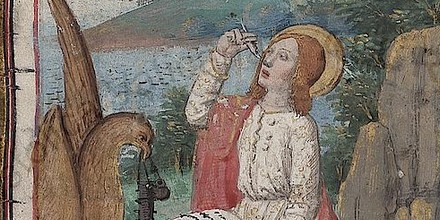
  1. Barb.lat.387: Orationes septem sancti Gregorii papae with fine 15th-century illuminations. The picture above shows John the Evangelist on Patros. The eagle (John's symbol) is holding his ink supply. It's your guess as to why this Italianate John needs to tickle one nostril with a feather. Perhaps the artist just meant that hand to be held to John's ear, waiting for the word of God to arrive, ready to stab quill-pen to papyrus to take dictation, but the composition is unfortunate.
  2. Barb.lat.4295: shows coats of arms, from the library of Federico da Montefeltro
  3. Borg.ill.1: this seems to be a bilingual Croatian-Latin text with glossary containing a church history and scriptures in Croatian (in a form of Cyrillic script) by the 17th-century Croatian archbishop Andrea Zmaievich
  4. Ott.gr.424: Gregory of Nazianzen, as described above
  5. Ott.lat.66: the Codex Ottobonianus, copied in North Italy in the 7th or 8th century: it contains the Heptateuch in the Vulgate version interspersed with portions in the older Vetus Latina text. See the next post.
If you have corrections or additions, please use the comments box below. Follow me on Twitter (@JBPiggin) for news of more additions to Digita Vaticana. [This is Piggin's Unofficial List 11.]

2015-05-04

Bath Time at Pozzuoli

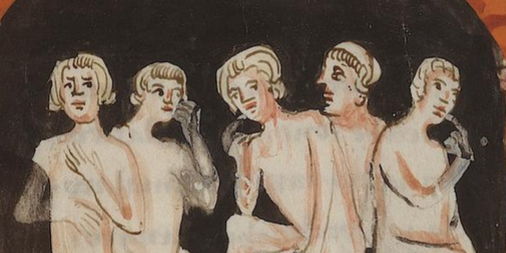
Among the 21 manuscripts uploaded May 4 to the Digita Vaticana library portal is a codex, Ross. 379, with images of group visits to the various thermal baths at Pozzuoli in southern Italy.

These illustrate a didactic poem, De Balneis Puteolanis by Peter of Eboli. This was a widely read guidebook in Latin verse to medicinal bathing written in about 1220. The information about the alleged health benefits of the various waters in the volcanic zone is probably Late Antique and the poem continues to be of interest to historians of medicine.

The pictures supposedly describe the experience of visiting a spa in the High Middle Ages (replete with ribald scenes of men who have somehow managed to gatecrash ladies' pools). I have no prior knowledge of this, but presume De Balneis was often purchased by the wealthy on account of its explicit images of nude people rather than for its scientific knowledge.


A rapid web search informs me that Ross. 379 is one of ten or more extant illuminated manuscripts of this poem. Gallica has a Parisian manuscript, BNF Lat. 8161, of the same, while e-Codices has the Bodmer's. Raymond J. Clark's 1989 article in Traditio on the poem is unfortunately behind a firewall. Of interest to mystery fans: there has been a claim that bathing images in the Voynich Manuscript, a strange fantasy book which no one has ever managed to decode, resemble those in De Balneis.

Here is the full list of releases:
  1. Borg.pers.12
  2. Borg.turc.34
  3. Ross.379, De Balneis Puteolanis, on medieval thermal baths
  4. Urb.lat.1, a magnificently illuminated Renaissance Old Testament of the Bible
  5. Urb.lat.2, another outstanding 15th-century Bible
  6. Vat.ar.351
  7. Vat.lat.841, De Regimine Principum, a guide book for princes, by Giles of Rome (Aegidius Romanus)
  8. Vat.lat.869, philosophical miscellany, with various works by Duns Scotus (c. 1265-1308), plus a few folios of Peter Abelard
  9. Vat.pers.27
  10. Vat.pers.32
  11. Vat.pers.85
  12. Vat.slav.4
  13. Vat.slav.5
  14. Vat.slav.9
  15. Vat.slav.10
  16. Vat.slav.13
  17. Vat.slav.49
  18. Vat.slav.63
  19. Vat.turc.4
  20. Vat.turc.428
  21. Vat.turc.431
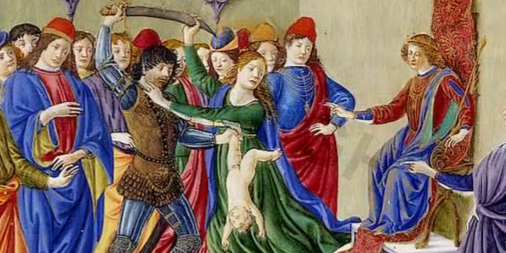
From Urb.lat.2, a fine Florentine painting of Solomon pretending to have a baby chopped in half as a way to determine a dispute between two mothers:


The BAV site now has 1,980 manuscripts online. There are often no descriptions at all. As always, if you can contribute information about any of these manuscripts, use the comments pane below. [This is Piggin's Unofficial List 10.]

2015-04-29

Pliny's Natural History

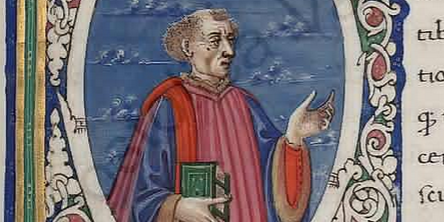
Among the new arrivals online at the Biblioteca Apostolica Vaticana on April 29 is a fine Renaissance copy of Pliny's Natural History, Borgh. 369. This fifteenth-century copy is not one of the ancient manuscripts used to establish the critical editions of Pliny (see a list by Roger Pearse), but it is evidence of the humanist enthusiasm to rediscover the great classical Latin authors.

Here is how the artist fancied Pliny in expository mode:
Also new is Vatican Vat. lat. 3375, a late sixth-century Neapolitan codex excerpting the works of Augustine of Hippo. It is acopy in half-uncial of an anthology that had been composed just a generation earlier by Eugippius of Naples and is an important link to Christian culture at the end of late antiquity.

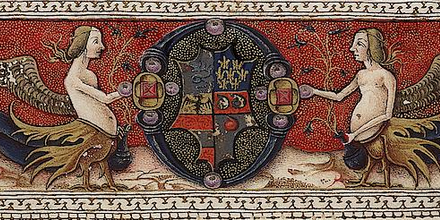
We also have what looks like a couple of chaps with paunches, receding hippie hairlines, and glass steins in the hand. But I am guessing they are actually sirens. They appear in Barb.lat.409, which is a liturgical office for the feast day of King Louis of France (1214-1270), after he had been made a saint.

A further portolan chart, Borg. Carte. naut. V, is in this batch, but sadly the resolution is so low that it is impossible to read the text. Reader Jens Finke points out that a just-about-readable black-and-white image of this appeared in Heinrich Winter, "The Fra Mauro Portolan chart in the Vatican" (Imago Mundi, 16 (1962), pp. 17-28, http://www.jstor.org/stable/1150299.)

Here is the full list:
  1. Arch.Cap.S.Pietro.A.32
  2. Arch.Cap.S.Pietro.C.98
  3. Arch.Cap.S.Pietro.D.157
  4. Arch.Cap.S.Pietro.D.169
  5. Arch.Cap.S.Pietro.D.193
  6. Arch.Cap.S.Pietro.E.33
  7. Arch.Cap.S.Pietro.F.27
  8. Arch.Cap.S.Pietro.G.3
  9. Arch.Cap.S.Pietro.G.54
  10. Arch.Cap.S.Pietro.H.52
  11. Arch.Cap.S.Pietro.K.1
  12. Arch.Cap.S.Pietro.K.2
  13. Barb.lat.409, liturgical office for feast of Louis IX of France, image above
  14. Barb.lat.679, a compilation of canon law, with a folio about the Council of Carthage of 390 CE  (summary)
  15. Borg.Carte.naut.V, illegibly digitized portolan chart, see above
  16. Borgh.22
  17. Borgh.43
  18. Borgh.53
  19. Borgh.91
  20. Borgh.93
  21. Borgh.99
  22. Borgh.104, 14th century codex of Petrus de Ilperinis, Tractatus de praedestinatione
  23. Borgh.113
  24. Borgh.127
  25. Borgh.143.pt.1
  26. Borgh.145
  27. Borgh.155
  28. Borgh.168
  29. Borgh.176
  30. Borgh.180
  31. Borgh.201
  32. Borgh.207
  33. Borgh.215
  34. Borgh.238
  35. Borgh.251
  36. Borgh.257
  37. Borgh.281
  38. Borgh.301
  39. Borgh.305
  40. Borgh.310
  41. Borgh.313
  42. Borgh.334
  43. Borgh.369, Pliny's Natural History
  44. Borgh.384
  45. Borgh.387, anonymous compilation of rules and figures of geometry (ff. 1-27)
  46. Cappon.1
  47. Cappon.2
  48. Cappon.3
  49. Cappon.8
  50. Cappon.10
  51. Cappon.11
  52. Cappon.16
  53. Cappon.19
  54. Cappon.20
  55. Cappon.21
  56. Cappon.22
  57. Cappon.23
  58. Cappon.25
  59. Cappon.36
  60. Cappon.37
  61. Cappon.38
  62. Cappon.40
  63. Cappon.49
  64. Ott.lat.356
  65. Reg.lat.1484
  66. Vat.ebr.119
  67. Vat.ebr.130
  68. Vat.ebr.143
  69. Vat.estr.or.4, Latin-Chinese dictionary
  70. Vat.estr.or.8,
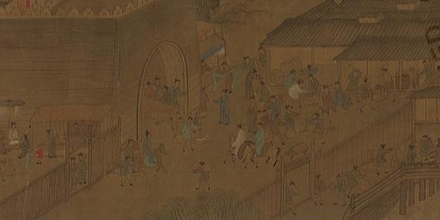
  71. Vat.estr.or.40, panorama painting of qinqming festival
  72. Vat.estr.or.64.pt.2,waterfall drawing
  73. Vat.estr.or.83,
  74. Vat.estr.or.85, Sinhalese
  75. Vat.estr.or.86,
  76. Vat.estr.or.97,
  77. Vat.estr.or.99,
  78. Vat.estr.or.101,
  79. Vat.estr.or.114,
  80. Vat.estr.or.117,"Cahier siamois", only the container!
  81. Vat.estr.or.118, ditto
  82. Vat.estr.or.147.pt.1.2,
  83. Vat.estr.or.147.pt.6,
  84. Vat.estr.or.156, folder of ink sketches, whereby Twitter user @MareNostrum2 points out that Digita Vaticana has (inadvertently) digitized a page from a 1909 Japanese newspaper with it: was this used as wrapping material to send the item to Rome?
  85. Vat.estr.or.159, 19th century (?) Japanese drawings
  86. Vat.gr.180
  87. Vat.lat.3375, excerpts from Augustine (see above)
  88. Vat.turc.50
Here is a detail, sadly darkened, from the qingming festival scroll above. It might reveal more with some photoshopping:

That makes 88 in all. Please add any contributions by way of the comments pane below. [This is Piggin's Unofficial List 9.]

2015-04-04

Military technology at the Vatican

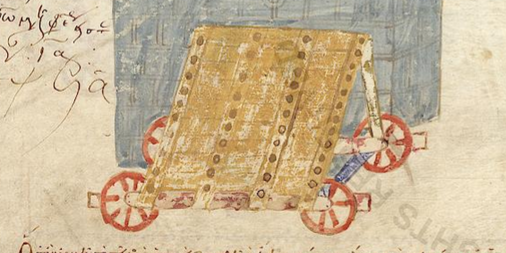
The seven manuscripts digitized and released April 1 by Digita Vaticana include an important 11th-century codex explaining and illustrating contemporary Byzantine military technology, Vat. gr. 1164 (link below). Here is an armoured vehicle that let attackers approach a wall, presumably to work to undermine it, defying boiling oil and stones from above.


Twitter follower Mare Nostrum offers an image from it showing the framework used to swing a battering ram to break a heavy stone wall. It would have been slow, thump-thump work, as he comments:

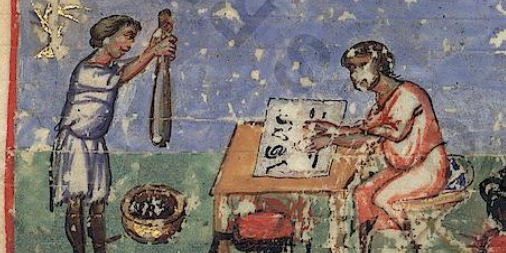
  • Vat.gr.747, one of the six known illustrated Byzantine Octateuchs, full of strange and extraordinary pictures. It also contains the Letter of Aristeas, the earliest text to mention the Library of Alexandria. Here is a scene in which a mortar and pestle are used as a painter is at work, folio 114r
  • Vat.gr.752.pt.2, magificent golden illuminations.
  • Vat.gr.1156, Lectionary 120, designated by siglum ℓ 120 in the Gregory-Aland numbering (Wikipedia).
  • Vat.gr.1164 (above), Byzantine military tactics and technology, see Pinakes.
  • Vat.gr.1513, Gennadius Scholarius, Pinakes, quite short
  • Vat.gr.2195, Leontius of Byzantium.
  • Vat.lat.39, 13th-century New Testament from Verona, apparently with the newly modern chapter divisions devised by the English scholar Stephen Langton
If you know more about these volumes, let us know through the comments box below. [This is Piggin's Unofficial List 8.]

2015-03-25

Prudentius and the odd word

Sometimes we get asked what use old European manuscripts are. The simple answer is that we need them to recover the literature and the histories of antiquity, the medieval period and the Renaissance, and we need to compare lots of manuscripts if we are to establish the most faithful editions of those texts.

Sometimes, though, when you are busy with a topic, a particular manuscript suddenly expands in importance and seems like missive from the past directed at you personally.

I am writing a book about the invention during antiquity of node-link diagrams. The book mentions the probable Latin term for such a diagram, stemma. This is not a book about linguistics, but you need to make sure there is no unseen linguistic evidence lurking there.

As often happens in research, both journalistic and scholarly, you can spend a whole day combing the forest for a catch and come home empty-handed.

In this case, there is no trace of anyone living during antiquity proper who calls one of these diagrams a stemma. My book will simply skip the whole matter, because it will not be an academic thesis and will only concentrate on the fruitful and interesting things I found. What I did discover about the word, I lodged as a bunch of notes in a new page on my website. I don't need such notes, but I routinely archive such things because they might help someone else some day.

What that page says is that stemma meant:
  • a garland of leaves, straw, wool or other materials (in Greece)
  • a niche in a Roman palazzo containing paintings of noble ancestors (in the Republic)
  • a snob's genealogy (under the Empire)
  • ancient glories (in literary vocabulary in Late Antiquity)
  • a twig-like node-link diagram as drawn by lawyers (in 620 CE)
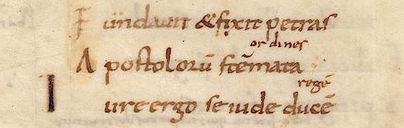
In a poem, Hymnus Epiphaniae, Prudentius, who is among the most obscure of Latin poets, uses a formula, apostolorum stemmata, to refer to 12 rocks set up next to the River Jordan.

The Hymnus Epiphaniae can be conveniently read in full at the Perseus Digital Library if you read Latin.

The Australian coast of Victoria has got a famed set of rocks, the Twelve Apostles, off the shore of the Port Campbell National Park, and South Africa has a Twelve Apostles Range, but Prudentius (348-about 405) seems to have beaten both to the name. Perhaps pilgrims did once get such a feature pointed out to them in the Jordan. [Late addition: It seems Prudentius is referring to the biblical Book of Joshua, the writer of which says 12 stones were taken from the Joshua in the river and placed nearby and are "still" there.]

Why does the poet call the 12 rocks a stemma of the apostles? Could he have possibly meant:
  • an ancient glory of apostles?
  • a node-link diagram of apostles?
[Late correction: A recent translator and commentator on the poetry, Gerard O'Daly, thinks the proper meaning is simply "pedigree".]

As it happens, a bunch of manuscript releases by Digita Vaticana this week (here's my news item) includes a manuscript of Prudentius's poetry. Cilian O'Hogan says it is actually an important one:
What makes codex Reg. lat. 321 so interesting is that its 10th-century editor has packed it with glosses and annotations. What I liked was that the editor seemed to have been baffled by the odd word "stemmata" too. He glossed it with the meaning "ordines" written above it here.


I'm still not clear about this. A similar word does show up in one description of the Great Stemma, Genealogia ab Adam usque ad Christum per ordines linearum. But I doubt if Prudentius had diagrams in mind. More likely the poet simply imagined those rocks in a orderly row or circle to represent the rock-like perpetual authority of the church. Stemma (ancestry) was a way to say in the language of Latin poets that the rocks were a precursor to the apostles [as Daly argues].

All very arcane, and from the manuscript, I knew that an unknown editor of 1,000 years ago had been baffled and had also done his best to unpuzzle Prudentius's odd word.

2015-03-24

Ladder to Heaven at the BAV

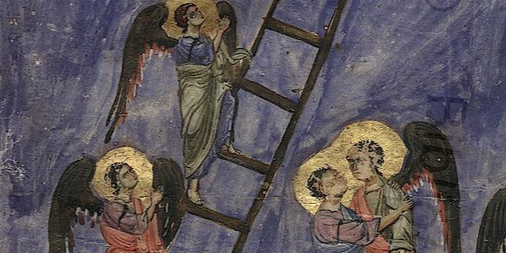
Among the more remarkable items to be admire in the 13 codices placed online March 23 by Digita Vaticana is Ross.251 containing the Ladder of Divine Ascent by the 7th-century Greek-speaking monk John Climacus.

I am told this is Lenten reading among Greek-speaking Christians. There are some vivid illuminations in this Greek manuscript giving you a good idea of how medieval readers imagined the long steady climb through 30 steps of the ladder, assisted by angels if you were doing it right:


This crop of releases takes the tally of Biblioteca Apostolica Vaticana (BAV) digitizations so far to 1,865. After this Lenten issue, I wonder if they are planning any Easter presents for us?
  1. Arch.Cap.S.Pietro.H.56, possibly from the collection of Cardinal Jacopo Stefaneschi (c.1270–1343).
  2. Ott.lat.3119, engravings of Roman personalities of the 18th century.
  3. Reg.lat.321: a fine old 10th-century manuscript of the poems of the Latin author Prudentius (348-405).
  4. Ross.251, with the ladder to heaven (above). Pinakes tells you which folios to consult for the Scala Paradisi of Iohannes Climacus.
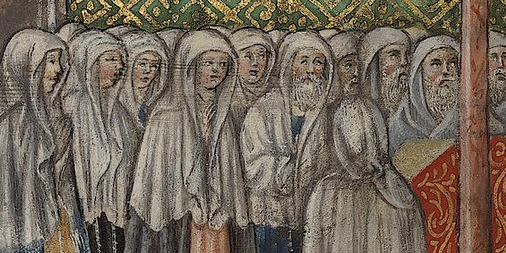
  5. Ross.555, a beautiful Hebrew codex with four fine Italian miniatures. From Evelyn Cohen I read that this is Jacob ben Asher's legal treatise, the Arba'ah Turim, and that the images depict a synagogue scene, animals being slaughtered according to Jewish ritual, a wedding and a courtroom scene. Here is the synagogue, where men and women seem to be mixed:
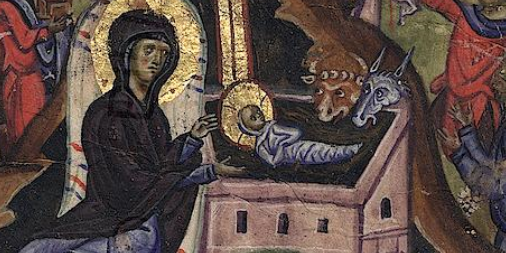
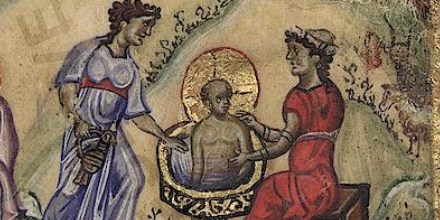
  6. Urb.gr.2, the Urbino Gospels in Greek with gold-leaf illuminations. Here is a most unusual Nativity composition and washing of the newborn, both at folio 20v:
  7. Urb.gr.162
  8. Urb.lat.346, Commentary on the Aeneid, 15th-century copy, attributed to Tiberius Claudius Donatus, but believed in fact to be the work of Suetonius.
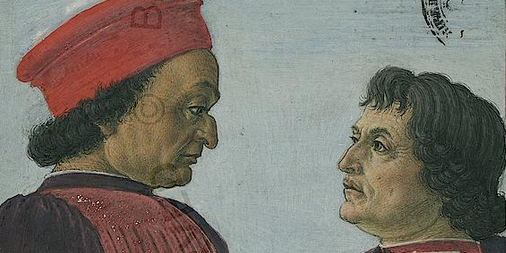
  9. Urb.lat.508, poetry from Duke Federico's collection. This item figured in the Rome Reborn exhibition at the US Library of Congress and St Louis University, where the catalogue identified it as the Camaldulensian Disputations by Cristoforo Landino and Anthony Grafton noted of the image below: "This portrait on the inside cover shows Federigo, duke of Urbino, standing behind a parapet holding a book, gazing intently at his companion, who is probably to be identified with Cristoforo Landino."
    Federico always appeared thus: check another image at his old home.
  10. Vat.gr.344
  11. Vat.gr.699, the Christian Topography of Cosmas Indicopleustes, one of the believers in a flat earth in the face of majority educated opinion in even his own day. This is a 9th-century illuminated copy with copious imagery.
  12. Vat.gr.746.pt.1
  13. Vat.lat.14933, Carlo Labruzzi vedute, possibly a volume inadvertently missed last week.
 If you have corrections or additions, please use the comments box below. Follow me on Twitter (@JBPiggin) for news of more additions to Digita Vaticana. [This is Piggin's Unofficial List 7.]

2015-03-16

The Romance of Ruins

The 13 digitization jobs uploaded March 16 at Digita Vaticana include four volumes of vedute or landscape drawings by the 18th-century artist Carlo Labruzzi (1765-1818), mainly of ruins along the Via Appia outside Rome.

There is also a volume of views by the English artist and antiquary Richard Colt Hoare of buildings and towns on the road south to Naples.

The romance of ruins drew a steady stream in the 18th century of English visitors eager to spend plenty of money to take such pictures home with them and hang them on parlour walls. They are not great art, but certainly better composed than most of the smartphone snaps we tourists take today. It must have been a fascinating time to explore Italy's ruins, before urbanization spread over so much of the area.

The BAV digitization programme also now extends to a second Coptic codex and offers its first codex in the Bulgarian language. Here is my unofficial list:
  1. Vat.ar.695
  2. Vat.copt.59, one of a series of significant 9th-10th-century Coptic Bohairic manuscripts from Wadi el-Natrun
  3. Vat.gr.901, miscellany; (Pinakes)
  4. Vat.gr.1418, contains Dionysius Halicarnassensis's Roman Antiquities: (Pinakes)
  5. Vat.gr.1422, (Pinakes)
  6. Vat.gr.2118, (Pinakes)
  7. Vat.lat.14929, 18th-century drawings of the Via Appia by Labruzzi, bound in London and formerly owned by Thomas Ashby, vol 1
  8. Vat.lat.14930, ditto, vol 2
  9. Vat.lat.14931, ditto, vol 3
  10. Vat.lat.14932, ditto, vol 4
  11. Vat.lat.14934, views 1790-91 by the English artist Richard Colt Hoare of ruins and towns on the road between Rome and Naples, with his annotations (in English of course); the BAV online catalogue lists this as a Labruzzi, but that seems to be a mistake.
  12. Vat.sir.599
  13. Vat.slav.27, Bulgarian codex
The new total: 1,852 items. As always, enter corrections or advice about the significance of these items in the comment box below. [This is Piggin's Unofficial List 6.]