2015-02-17

Is this the world's oldest bound book?

This was the week when the Vatican's library, the BAV, made available online digital images of what is perhaps the world's oldest intact, large, bound book, the Codex Vaticanus. It contains a handwritten text on 759 vellum leaves and is generally estimated to have been made in the second quarter of the fourth century (325–350 CE).

That it survives is amazing. That no one noticed what the Vatican was doing is almost more amazing. But more about that later.

During the 19th century, the BAV customarily only allowed visitors to touch this treasure under guard, so great was the fear that it would be stolen or damaged by a religious fanatic. Scholars grumbled at this, but the librarian's suspicions were not ill-founded. That anybody with web access can now read it without a couple of muscular young clergymen staring at the back of their neck as if they were a terrorist is a wonderful transformation.

The codex contains the Christian Old and New Testament in Greek and is comparable in age and significance with the Codex Sinaiticus, which got its own lush online presentation five years ago.

One can toss up as to whether the Vaticanus or the Sinaiticus is the oldest substantial bound book in existence, but the Vaticanus is the one in better shape, since it is still in one binding. The Sinaiticus got dismembered in the 19th century by the sort of scholar that the Vatican wisely never trusted (see above) and is now divided between four countries.

Neither book has a production date on it, so their ages can only be guessed from palaeographic evidence. Wikipedia's substantial description argues Vaticanus contains more antiquated features and is the older of the two, although one scholar, T.C. Skeat, propounded a theory that the two codices are contemporary and both come from the Late Antique scriptorium of Eusebius of Caesarea.

At the start of this post, I said the codex may be the oldest bound book. The qualification is important since books as we now know can come in three forms: scroll, codex and e-book.

I would have seen my first e-book at the Frankfurt Book Fair about 30 years ago and thought it a strange new thing, and the first owner of the Codex Vaticanus might have seen his first codex used for a scholarly purpose and thought it was a strange thing 30 years before he commissioned this very special codex for himself.

It is generally suggested that codices -- that is, books made of flat pages between two boards, bound at a spine -- began to outnumber the earlier technology, the scroll, in about 300 CE.

So "books" older than the Codex Vaticanus do survive: in scroll form, or as isolated pages torn from codices, among them the Chester Beatty papyri. But if you were to ask me where to find the world's oldest book -- meaning a thing between two covers, which is what most of us would mean -- I would point you to Rome, BAV, Vat. gr. 1209. Look at it and marvel.

On February 16, 2015, the BAV added 31 new items to its stock of online digitizations, raising the total volumes so far to 1,626. The collections added to were Arch. Cap. S. Pietro (10), Borgh. (5), Ott. lat. (1), Sbath. (1), Vat. ebr. (6), Vat. gr. (1, the Codex Vaticanus), Vat. lat. (4) and Vat. turc. (3).
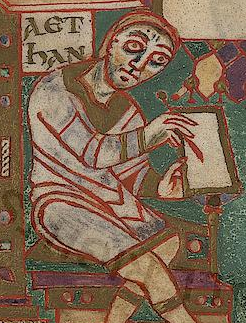
Items in the enormous Vat. lat. series which are newly available are Vat. lat. 83, which is a fine collation of hymns and psalms from the 11th century. It has a wonderful illumination in it of David with harp and the other supposed writers of the psalms, among them Ethan in a sailor suit (right), each with quill and ink-horn and a nifty little mobile desk of the sort that court writers must have used in the 11th century.

Tracking down the psalm authors had always been a matter of interest to Jewish and Christian scholars as we know from my edition of the fifth-century Liber Genealogus.

Also online for the first time are a book catalogue (Vat. lat. 3970) by Cardinal Sirleto (1514-85), a biography of Saint Gerard (Vat. lat. 7660), and a wonderful scrapbook of fragments (Vat. lat. 13501) presumably extracted from old bindings where we see a great variety of writing styles, a palimpsest or two, bits of sheet music and everything else that would have been hurled out in library spring cleanings and landed in this or that medieval book binder's recycling bin.

Sadly, the Vatican Library does not have the time or resources to promote this amazing release. To get in the news nowadays, you need a mass murder, a scandal or PR hype. The sole publicity for the release of the Codex Vaticanus was one modest tweet. Yes, a twiddling, tiny tweet. I suppose that all of the digital project's funds must go into actually scanning the books and getting the files into the servers.

I will keep a continuing watch on what they are digitizing in such honorable secrecy and present an occasional summary on this blog or on my Twitter feed. [This is Piggin's Unofficial List 1.] If you know of anyone else tracking the BAV digitization project, I would be happy to contact them.  Follow this blog, or follow me on Twitter @JBPiggin and I will keep you up to date.

This post originally ended with some debate on the "oldest bound book" hypothesis, but since that material grew so long, I have moved it to a separate blog post.

2015-01-23

Vatican Libary Making Progress

There are signs at last that the Vatican Library's manuscript digitization program is making good progress: there are now 1,549 manuscripts of the Biblioteca Apostolica Vaticana available online (up from 1,503 on January 1, a gain of 3 per cent in just 3 weeks).

The index page, which previously, listed every single digitization, has got so unwieldy that it has now been reduced to a compact, top-level, springboard page listing the collections the project has touched so far.

There's no sign yet of Vat. lat. 5729, the colorfully and richly illuminated Bible of Ripoll, which I want to see. So far only 78 of more than 15,000 medieval and modern items from that collection have been digitized. But the progress makes me optimistic.

UPDATE: After a couple more jumps (30 new items on February 4 alone), the total is 1,595. (And how do I know? Because I checked yesterday and today.)

2015-01-17

Persistence of Games

A curious example of the persistence of board games is mentioned by Irving Finkel of the British Museum in an entertaining New York lecture in 2012 which I watched a couple of years ago.

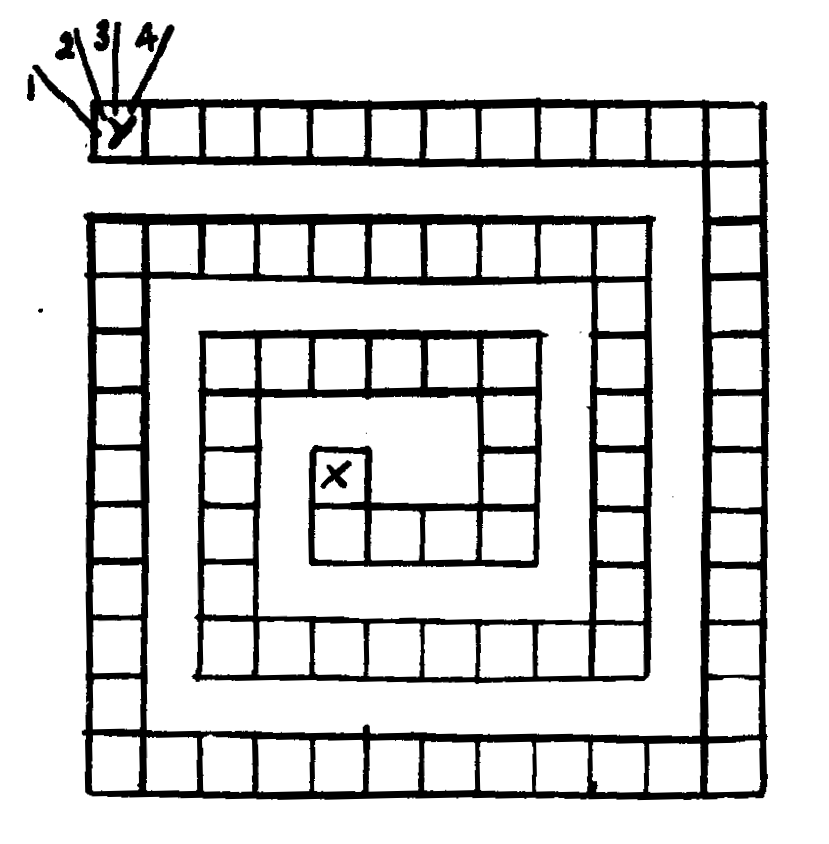
An article published in 1925 in Sudan Notes and Queries describes a "sedentary" game played on marks in the sand by Arabic speakers in Sudan. Finkel points out (from minute 35 of the video) that the game seems to be mehen, the "game of the snake," the spiral boards for which are found in tombs of Egypt's pharaonic period from around 2800 BCE.

"It seems to me that it is compelling to link the one to the other," says Finkel, overruling objections that a game could not have remained in continuous play for nearly 5,000 years.

The article's description of the game terms it Li'b El Merafib and indicates it was principally played by men during Ramadan. The author provides the schematic drawing at right. A transcript can be found at the Waterloo Games Museum, while a digitization of the magazine is offered by AlFahl.net in a large PDF. The author, R. Davies, had no idea that the game was Egyptian. The game involves a chase from Y to X and back, with "hyena" pieces pursuing on the return leg, which makes the last phase of the game very exciting.

I was curious as to the identity of the author, who patronizingly says Li'b El Merafib is more exciting than games played by English children, which makes him appear rather blinkered, although to be fair, he did consult the scholarly literature available to him
A little research establishes that the author must have been Reginald Davies (1887-1971), who left a box of his manuscript papers to Edinburgh University Library (see Archives Hub with biographical details). A printed bibliographical reference to the same papers by Sharkey appears to be entirely unreliable.

Davies became the first British Resident in Darfur in 1922 and his policy of building up a local sultan may bear some responsibility for the appalling civil wars that have rent Darfur in recent decades. Finkel terms him a "British Army officer", which he most certainly was not: He was a civilian and university man, a group who were in fact intensely jealous of army officers who snatched their salaried jobs. For all the trouble Davies created as a colonialist, one must acknowledge that he faithfully recorded one of the remarkable clues we have to one of humanity's most intriguing practices: the board game.

Davies, Reginald. “Some Arab Games and Puzzles.” Sudan Notes and Records, no. 8 (1925): 137–52.

Finkel, Irving. Like Spilt Milk: How Ancient Board Games Were Disseminated, 2012. YouTube.

2014-12-06

Enemies of Hugh Capet

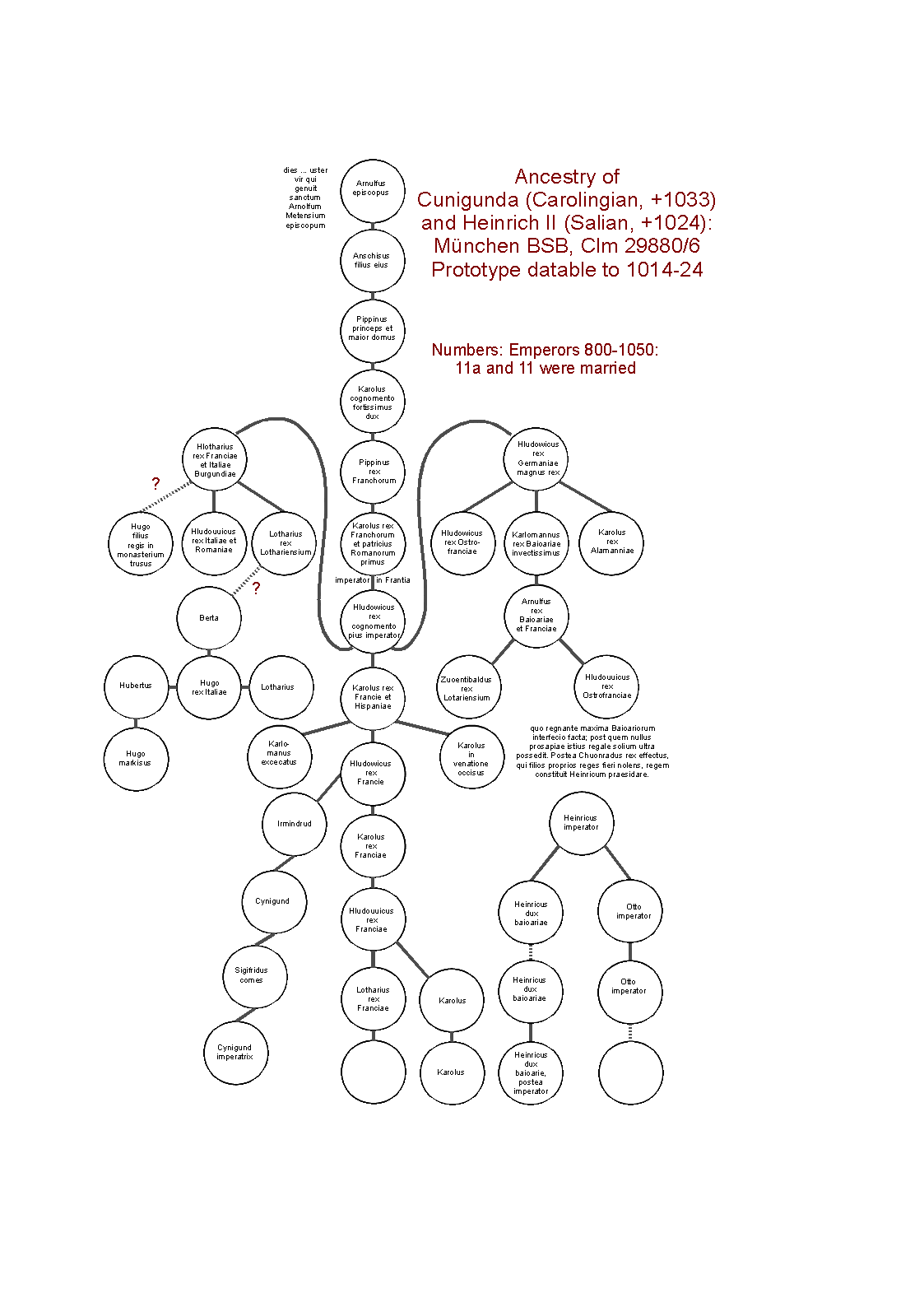
One of the difficulties of publishing a scholarly book is doubtless the fact that the time-span between research and hitting the market can be several years. This struck me when reading a couple of works from 20 years ago on the Stemma of Cunigunde. I mentioned this remarkable diagram some while back in a blog post.
A plot of it on my website allows you to see more detail. This diagram is the oldest visualization in existence of a genealogy that can be independently documented. The only older genealogical visualization is the Great Stemma, where many of the persons, ranging from David and Solomon to Jesus, are historical figures, but are documented by a single source only, the Jewish and Christian scriptures, and the diagram is not contemporaneous but based on that single source.

The great modern authority on medieval tree diagrams is Christiane Klapisch-Zuber, who published her study, L’Ombre des Ancêtres, in 2000. She rightly gave considerable attention to the Stemma of Cunigunde and its medieval evolution into various new formats.

What I now notice is that her investigation must have been conducted a good decade before her book's publication, because she does not cite the two key studies dating from 1992 and 1994, by Nora Gädeke and Karl Schmid, which advance our knowledge of the Stemma of Cunigunde.

Schmid's study of the Stemma was especially interesting. He instantly recognized that its subject and focus is Cunigunde (at the bottom left), not Charlemagne or any of the figures high up the diagram.

He proposed that the Munich manuscript is a copy, perhaps made decades later, of a document probably drawn up in Metz, where Cunigunde's villainous brother Dietrich II was bishop and no doubt had clerks and a library capable of drawing such a work. Schmid does not opt for a date, though tendentially he suggests this would have been after Cunigunde's coronation as empress in Rome in 1013.

The purpose of his article is to argue that the stemma's core content must go back to a 991 visualization that would have been drawn up by "Carolingian legitimists" in support of Karl, a child, as pretender to the kingship of West Francia in opposition to Hugh Capet (elected 987). Hugh won out and is now regarded as the first king of France, the legitimists lost, and little Karl (the last Carolus in the diagram) simply falls off the face of history. Whether he was killed or lived out a full life as a pitiable might-have-been is unknown. Instead he gains his place in history as the original inspiration for a very remarkable diagram.

The eye-catching festoons at the left and right of the drawing above would have been created to make room to add Cunigunde and the Ottonians to the anti-Capet diagram.

Schmid (Wikipedia entry) bases this ingenious lost-diagram hypothesis on an analysis of errors and non-sequiturs in the graphic arrangement that survives. His article is a most impressive feat of graphic reconstruction, and I think his point of view is convincing. As far as I know, this was the last scholarly thing he wrote. It was published following his 1993 death in a volume that contains his obituary.

From Forum Eeerste Wereldoorlog.nl
He even reaches back a little further, tentatively suggesting that the enemies of Hugh Capet may have found their model in a hypothetical document dating from the 978-984 war between Lothair of West Francia and the Ottonians. Schmid thinks that because the stemma often suppresses the title of "emperor" and because the final central roundel in the drawing above is empty, omitting the name of Louis le Fainéant which should obviously fill it, that ur-ur-diagram might have existed. He conjectures that this could have been a piece of proto-French political propaganda circulated during that conflict to ridicule the proto-Germans' pretensions to be upholding a (First) Reich. That is a sobering millennial thought in this year, when we often have in mind the sombre centenary of a war where elaborate French propaganda, like L'Impérial Semeur at right, so often mocked the Second Reich.

Gädeke, Nora. Zeugnisse bildlicher Darstellung der Nachkommenschaft Heinrichs I. Arbeiten zur Fruhmittelalterforschung 22. De Gruyter, 1992.
Klapisch-Zuber, Christiane. L’Ombre des Ancêtres. Paris: Fayard, 2000.
Schmid, Karl. “Ein verlorenes Stemma Regum Franciae. Zugleich ein Beitrag zur Entstehung und Funktion karolingischer (Bild-)Genealogien in salisch-staufischer Zeit.” Frühmittelalterliche Studien 28 (1994): 196–225. doi:10.1515/9783110242263.196.

2014-11-11

Why Greek diagrams are rude

How come it took until Latin Late Antiquity for a great infographic like the Great Stemma to explode on the scene? How come that the earlier Hellenistic culture of the West never evolved a graphic technology like this, with its flows of data that drag the eye down and onwards, with its callouts that divert your attention in the fashion of hyperlinks, and with its blending of multiple data classes - in this case chronography and genealogy?

Last year, the Israeli historian of mathematics Reviel Netz, who is professor of classics at Stanford University, spoke at the British Academy in London and offered an interesting new synthesis of his ideas on diagrams. As far as I know Netz has not paid any attention to the Great Stemma, but his thoughts on the Hellenistic intellectual world have a strong bearing on what followed on from it.

Netz is not only famous as the author of The Archimedes Codex, but also as the scholar who introduced in 1999 the idea that the geometrical diagrams in the works of Euclid, Archimedes and others should not be understood as after-the-fact explanations of geometrical discoveries or as mere ornaments to the text, but as integral to the logical proof, as snapshots of the discoveries themselves.

The geometers thought spatially, or diagrammatically, then honed the explanations in words afterwards.

Ideas evolve, and Netz seems to have moved onwards to a view that, in a sense, restores some of the primacy of text in that polarity. That would be my somewhat exaggerated take on what he was saying last year during Leaping out of the Page, a lecture in London that you can see on YouTube.

The question he explored in his 2013 March 14 presentation at the British Academy was: why are those Greek mathematical diagrams so bare, so sketchy, one might almost say, so rude?

Netz seeks to explain the fact that there is no evidence of anyone debating a better way to draw such diagrams (at 51.10 by elapsed time in the video) and he comes up with the following answer.  Literary texts on papyrus in the classical period lack any word-breaks, paragraphs or illustrations. The readers had to inject all of that. The text they held in their hands was what Netz calls "schematic": rude cues for the educated reader to unlock and "perform" the text in his mind.

The diagrams conform with this: they are schematic too (52.18). Nothing more than that was expected of them. This seems to come out of ideas in Netz's book, Ludic Proof, in which he explored the startling similarities between Hellenistic poetry and mathematical texts from the same era.

So what could this reveal to us about Late Antique diagrams?

Firstly, it highlights the way in which Greek mathematical figures are so very different from Late Antique flow diagrams like the Great Stemma, the arbor porphyriana and the 37 stemmata of Cassiodorus. We may use the English term "diagram" for both types, but they do not belong to the same genera of things at all. The Late Antique graphics are startlingly new and creative, with no identifiable roots in mathematical techniques or any existing literary practices.

The idea of devoting an entire papyrus roll to a graphic without any accompanying text must have seemed strange and new-fangled to people when they first saw it.

Secondly, these observations reinforce our understanding that flow diagrams are part of the haptic world of things that we manipulate. Netz argues (24.57) that geometrical figures are cerebral and differ utterly from touchy-feely arithmetic: "When Greeks do counting, what they do is to operate on an abacus. They have counters that are being moved around on an abacus... You have a flat surface, and on this flat surface you are moving stuff."

Something parallel would have happened when the designer of a flow diagram was laying it out. He had to use counters or ostraca to plan it. Later on, the reader of the flow diagram will inevitably handle it too, putting fingertips on its "icons" and tracing its flows. The flow diagram is something everybody has an urge to manipulate, a Late Antique precursor to the iPad: it's a physical thing, designed to be not only looked at, but touched, and aimed at the "manual" user, even the semi-literate, not the cerebral reader showing off his paideia.

Netz stresses how, in Euclid or Archimedes, text and geometrical figures marry together. Papyri are one of the main media of Antiquity and a "happy" literary papyrus, as Netz calls it, always contains the same thing: column after column of text to be read left to right. The figures are subsumed into these slabs of text (which is why I say, not entirely seriously, that Netz now sees the text having primacy).

So my third reflection is on the thorough-going difference between the unidirectional content of a papryus book and the jump-in-anywhere nature of the first great infographic. The Great Stemma does not have any accompanying text: all its words are build directly into the drawing. It has no mandatory start or finish: you can read it from the right, or the left, or even upside-down.

From the point of view of traditional literary culture, the Great Stemma would have seemed to break every rule in the canon.

Leaping out of the Page: The Use of Diagram in Greek Mathematics. London: British Academy, 2013. https://www.youtube.com/watch?v=7hzzdLsTb5E&feature=youtube_gdata_player.
Netz, Reviel. Ludic Proof: Greek Mathematics and the Alexandrian Aesthetic. 1st ed. Cambridge; New York: Cambridge University Press, 2009.
The Shaping of Deduction in Greek Mathematics: A Study in Cognitive History. Ideas in Context 51. Cambridge University Press, 1999.
Netz, Reviel, and William Noel. The Archimedes Codex. Revealing the Secrets of the World’s Greatest Palimpsest. London. Orion, 2007.

2014-11-02

Floreffe Bible now Online

The only way that we know that a graphic artist – or studio – in the fifth century CE drew a magnificent chart of biblical history and genealogy is from the later copying of that work onto parchment manuscripts during the medieval period. Fortunately, 24 such copies are still in existence.

Since I began studying the Great Stemma in 2009, there have been constant advances by museums, archives and libraries in bringing digital versions of this chart online. The British Library has now added the Bible of Floreffe Abbey to its collection of over 1,000 online manuscript digitizations. This must have happened rather quietly, as I have not seen it mentioned in the BL blog yet.

For the study of the Great Stemma, this is a rather important development. Until now, just seven of the manuscripts had been issued online, but nowhere on the internet could one study a peculiar evolution of the Great Stemma into what I call the "School Stemma," a revision of the graphic to bring it in line with orthodox, 12th-century doctrine about the ancestry of Christ.

The Floreffe Bible contains a beautifully coloured version of the School Stemma, with exquisite script that faithfully reproduces all the defects and nonsenses of whatever text it was modelled on. Check it out and page through its glories.

We do not yet know where the revision took place. I call it the School Stemma because I guess that it was "cleaned up" so it could be safely taught to impressionable young monks. Charts containing this version also come from Parc (now Belgium), Foigny in France and Burgos in Spain. The chart may also have been copied at Arnstein, Germany as well.

As a result, I have revised my table of Great Stemma manuscripts, doing a good deal of re-arranging to make the layout more user friendly. It will be clear after consulting the table that not only are eight of the 24 manuscripts now available online and readable in their entirety, but that these neatly cover six of the seven recensions (alpha, beta, delta, gamma, epsilon and School). Additionally, the sigma recension is online at the BNF, though the resolution there is too low for a visitor to read the script.

As a result, the Great Stemma can now be seen on the internet in its complete range of forms. By the greatest of good luck, the four manuscripts which offer the best evidence about the fifth-century ur-form (Plutei, Roda, San Millàn and one of the School group) are now all accessible. One could hardly wish for more.

My table tabulates all these online witnesses. The amber-gold squares in the table mark all the high-resolution images where you can click through to each archive's website. The paler yellow squares mark low-resolution images and snippets.

Happy clicking.

2014-10-27

Digital Reviews

Getting manuscript documents (and early printings) online in a form that is electronically readable is only half the battle: keeping it accessible and raising standards to the point that multiple projects could be united into a permanent digital library are the follow-ups we tend to forget.

Germany's Institut für Dokumentologie und Editorik is now publishing RIDE, a review of digital editions (issue one is out and issue two is coming up).

The checklist that reviewers use to assess accessibility and inter-operability is an interesting one. There's a chart of technical issues noted so far and here are some of their criteria:
  • Which licenses are used to determine the copyright of the material published by the projects?
  • Do projects adhere to a standard data model like TEI?
  • Is the raw data accessible, either for the individual parts of the edition or as a whole?
  • Which interfaces do the projects support to allow reuse of their data?
The questionnaire picks out other more general issues like:
  • Is search with wildcards available?
  • Are the methods employed in the project explicitly documented? 
All points that I'll have to figure out. I document my methods, but this documentation is scattered, with part of it appearing here in the blog. It should all be combined in one place.

Like most digital publishers, I am keen to put material in the public domain, but am cautious about the form of declaration. I'm sceptical about TEI. I do want to put the raw data out there, but we are all aware that the rate of uptake is going to be minute: at the most, three or four researchers per century are likely to want to use my MS Excel tables. The interfaces question refers to things like an API or Representational State Transfer principles, which are only vaguely in the mind of independent researchers running single-person projects.

2014-09-16

Line-by-line Poetry

A  nice piece in The New York Times this week points to the increasing traction that electronic formatting for poetry is gaining at small presses.

The report, Line by Line, E-Books Turn Poet-Friendly by Alexandra Alter, explains the macro-typography problem with poetry: lines, not paragraphs, are the fundamental unit. If electronic publishers of poetry attend to the formatting of every line, they can create beautiful presentations.

But in early e-books (and needless to say, in most web presentations of poetry), publishers rushed out poems without appropriate formatting and the results were awful. The Text Encoding Initiative and other projects developed enormously complex standards for historic poetry, but these were not appropriate for contemporary poets, because the rules were so ridiculously complicated to apply.

I worked through these issues 12 years ago in developing the poetry page of my Macro-Typography site. [Note: this shows broken at the moment in Firefox, but loads fine in IE.] Sadly, my efforts to devise a few simply standard units were too far ahead of the curve. At that time, poets did not understand the internet, and web designers did not understand poets.

I argued during the the introduction of HTML 5 that poetry should be taken into account. It wasn't.

Perhaps I was too impatient. It took centuries to establish the conventions used by typesetters in setting up poetry for printed books. It was bound to take a few years for web typographers to be understood.

The solution I propounded in 2002 is now gradually establishing itself. Poetry must be formatted in units of lines so that any spillovers when the screen is too narrow always appear indented, not flush left. The range of formats for lines must include various initial indentations, along with special cases such as the caesura and the flush-right line. Stanzas must be appropriately spaced from one another.

Alexandra Alter describes how eBook Architects, a company in Austin, Texas, is now developing virtuous web-display routines as it formats poetry professionally:
[T]he text was hand-coded and marked up semantically, so that the formal elements were tagged as lines, stanzas or deliberate indentations. When a line runs over because the screen is too small or the font is too big, it is indented on the line below — a convention that’s been observed in print for centuries.
Bravo. It's good that poets are gradually realizing that poetry can look beautiful on an electronic screen, and that Aldine blackletter on creamy white paper is not the sole way to publish. It's a pity it is still so hard to set up electronic publication that specialist companies have to be engaged to provide bespoke solutions. It ought to be part of standard HTML.

2014-05-04

Translating Nonsense

How does one translate nonsense that has arisen when scribes fall into a doze and begin to write drivel? There is a celebrated passage in the Great Stemma which I have been looking at today which marks a low point in scriptorial quality control. It derives from the Septuagint version of the Book of Job. I have tried to collate it in six parallel lines of continuous text below:

LXX  οι δε ελθοντες προς αυτον φιλοι  
VL   Nam qui venerunt ad eum amici  eius hii fuerunt: 
del  Nam qui venerunt ad eum amichi eius hic fuerunt: Sophar Israel
gam  Nam qui venerunt ad eum amici  eius hii fuerunt: Sofar filius
alf  Nam qui venerunt ad eum amici  eius hii fuerunt: Sofar filius
bet  Nam qui venerunt ad eum amihi  eius hii fuerunt: Sofar filius

ελιφας των ησαυ υιων         θαιμανων βασιλευς 
Elifaz, de filiis Esau       Themanorum rex;
Elifaz, de filiis Esau       et Temanorum uxor filiis 
Elifaz, de filiis Esau       et Themanorum uxor et filiis
Elifas, de filiis Esau       et Temanorum uxor filiis 
Elifaz                       et Hemanorum uxor filiis

βαλδαδ ο σαυχαιων τυραννος
Baldad sauceorum tirannus;
Ammon                                 qui fuit Ar-auce tiranni
Ballenon filii Ballac  et filiis Amon qui fuit Cobar-auce tiramni 
Balenon filii Ballac uxor filiis Amon qui fuit Chobar-aucce tiranni 
Balexion             uxor filiis Amon qui fuit Bar-auce tiranni

σωφαρ ο μιναιων βασιλευς
Sophar mineorum rex
et Themas de filiis Elifaz dux Idumee
et Heman     filius Elifaz dux Idumee
et Temans    filius Elifaz dux Idumee
et Themas    filius Elifaz dux Idumee

The six texts are: the Septuagint, the Vetus Latina and the Great Stemma's delta, gamma, alpha and beta recensions. This text does not appear in modern bibles, as it has never been incorporated into the Masoretic or Vulgate versions, and must therefore be referenced as LXX Job 42:17e.

The context is that Job sits on his dung-heap, owning just a broken bit of pottery to wipe the discharge from his ulcers, lamenting and asking God what's up.

A trio of guys -- Eliphaz of Teman (a town in Edom); Bildad of Shuah; and Zophar of Naamath -- show up and make the snarky kind of unhelpful remarks that guys always make, to the effect that it might just be Job's own fault. We men tend to brutality.

Rabbis must have often been asked what rank these guys had. One suspects the three names are simply some kind of impenetrable humour, but a midrash which claims they are monarchs is recorded in the Septuagint.

Here is how the New English Translation of the Septuagint renders the midrash: Now the friends who came to him were: Eliphaz of the sons of Esau, king of the Thaimanites; Baldad, the tyrant of the Sauchites; Sophar, the king of the Minites.

The repetitious, inflated mess this turns into in the Great Stemma was first spotted by the great Yolanta Zaluska. I want to mention the passage in my planned book. It's a dilemma deciding which nonsense version to translate and how to render it. Here's one of the more absurd possibilities:
  • Sofar the son of Elifaz of the tribe of Esau
  • the wife of the Thaimanites
  • the sons of Balenon's son Ballac
  • Amon who was tyrant of Chobar-auce
  • Themas son of Elifaz, duke of Edom
That inflates the list to more than five visitors in the scribal version. Of course, the nonsense could be understood as meaning that a throng of sons came to visit Job too. In which case, the country lane outside Job's country estate in Uz would have had a parking problem with chariots, camels and donkey-carts jamming all available roadside space.

2014-04-30

The Old Latin

Readers of this blog will recall that the names of many biblical characters in the Great Stemma are spelled in the fashion of the earliest Latin bibles, rather than in the forms prescribed by Jerome of Stridon in his Vulgate retranslation of the fifth century. I noted in my Studia Patristica paper that the original names in the diagram would seem to have been immune to Jerome's influence (although one must be cautious in guessing why) and that this was especially emphasized by Yolanta Zaluska:
Among the examples she isolates is Chor (Gen. 36:22), from the personal name Chorri in the Septuagint and Vetus Latina, which Jerome had amended to Horrei. Zaluska also detected the Vetus Latina name of a Horrite chief – Ucan – which Jerome had suppressed, as well as another name, Chat, which had arisen through scribal error in the Great Stemma’s transmission. Both names continued to be reproduced in the Great Stemma into the high medieval period although they were no longer current in the Genesis narrative.
I have undertaken various attempts to quantify just how many of the 540 names are present in the diagram in their Vetus Latina forms. Two years ago I wrote a long blog post on a statistical project to distinguish the variants and seek salient points in the data. The effort was rather inconclusive, partly because my methods were rather basic ones.

A recent article by Philip Burton (all references below) points to a possible way forward. Certain ordinary Greek words can be and were translated in alternative ways in Latin: Burton compares how those words are handled by Vetus Latina translators in seven cases and shows the results in a "distance chart of agreements" (page 187). He mentions that he gave a paper in 2008 offering hundreds of such comparisons. It might be useful for a future scholar to employ Burton's method to compare names in the Great Stemma manuscript.

Many other difficulties remain. Not only is it hard to distinguish Vetus Latina variants from bizarre scribal errors. We also simply don't know in many cases what the Vetus Latina text actually said.

Very little of 1 Kings and 2 Kings, two books that are of central importance to the Great Stemma, even survive. Natalio Fernández Marcos, the great Spanish biblical scholar, estimates in Scribes and Translators (page 44) that 90 per cent of what we know of the Vetus Latina version of 1-2 Kings derives from just three very fragmentary sources - the Opuscula of Lucifer of Cagliari, a Naples palimpsest and marginal glosses to several Spanish bibles.

In addition, the manuscript tradition for more substantial sections of the Vetus Latina is not entirely reliable either. As Burton has pointed out, even the question of whether there was just one translation or many remains a moot point in current scholarship. Even the tradition of the Vulgate, often thought of as fixed, retains uncertainties in its transmission. So it will never be possible to take all 540 of the Great Stemma names and fix what proportion have Vetus Latina origins beyond any doubt.

In the past two weeks I have returned to the issue because I need to summarize this matter concisely in my planned book. Among the results: on my website, there is a new tabulation of Vetus Latina reconstructions of the 14 names of women in 1-2 Kings where each name is traced back to the Septuagint. The extreme corruption in the graphic organization of these names in the Great Stemma makes the passage an especially good pointer to the primitive Vetus Latina forms.

In addition, I have done a little more checking of how five of the most salient changes fared in the Vulgate tradition, checking the names usage in the 1926-1995 Biblia Sacra iuxta Latinam Vulgatam versionem where the manuscripts are compared. I was surprised to find how often the Vetus Latina forms crept back into the text, particularly in Spain.


Septuagint Vetus Latina Vulgate Ref. Changes Notes
μαλελεηλ Maleleel Malalehel Gen 5:12, 5:15 e to a, insert h Printed Vulgates 1530-1592 employed the VL form
φαλεκ Phalech Faleg Gen 10:25 ch (k) to g Faleg in largest number of witnesses, but Falech, Falec, Falleg, Phaleg, Phaleg (first printed Vulgates), Phalech also recorded
χορρι Chorri Horrei Gen 36:22 from ch (χ) to h Horrei in largest number of witnesses, but Horraei, Orrei, Hori (first printed Vulgates), Horri and Orri also recorded
ζουκαμ Zucam Zevan Gen 36:27 middle consonant from c (g) to v (b) Zeuan in largest number of witnesses, but Zeban, Zeuam, Zefan, Zephan, Zenan, Zauan (first printed Vulgates), Euan also recorded
βηρσαβεε Bersabee Bethsabee 2Sam 11:3, 12:24 second consonant from r to th Bethsabee in most witnesses, but Bethsabȩȩ, Bethsabe, Betsabee, Betsabeȩ, Bersabee (6 witnesses), Bersabeȩ, Bersabȩȩ and Bersabe also recorded
The last of these cases is particularly interesting. Jerome preserved Bersabee as the name of the city in the southern desert in Genesis 22 (see a discussion by Rico), but there can be no doubt whatever that he desired to suppress Bersabee as the name of Solomon's mother and amend this to Bethsabee. Yet it re-infected "his" text soon enough. The Bersabee witnesses are: Madrid RAH 2, Burgo 2, Milan Biblioteca Ambrosiana B48, Vat. lat. 10510 (2nd Bovino Bible), Paris 15467, Mazarine 5 (all Bersabee), Madrid Mus. Arch. 485 (Bersabeȩ) and Madrid Bib. Nat. A2 (Bersabȩȩ).

Among the other instances, it is notable that Malaleel even crept back into early printings of the Vulgate before it was expunged.

This exercise has tested and confirmed the hypothesis that most Vetus Latina forms of the biblical names turn up in the Great Stemma, sometimes in quite bizarre transformations. For Zucam, the variety of readings in the diagram include Zugat and Zucat. It remains difficult to imagine any process by which the Great Stemma could have been drafted using a mixed supply of Vetus Latina and Vulgate forms of the names. The hypothesis that it was drawn up with the aid of a Vetus Latina bible and was fitfully altered later to match Jerome's spellings is the only one sustainable in the court of common sense.

Burton, Philip. “The Latin Version of the New Testament.” In The Text of the New Testament in Contemporary Research: Essays on the Status Quaestionis, edited by Bart D. Ehrman and Michael W. Holmes. 2nd ed. Brill, 2012. Google Books
Fernández Marcos, Natalio. Scribes and Translators: Septuagint and Old Latin in the Books of Kings. Vetus Testamentum / Supplements. Brill, 1994. Google Books
Moreno Hernández, Antonio. Las glosas marginales de Vetus Latina en las Biblias Vulgatas Españolas: 1-2 Reyes. Textos y estudios “Cardenal Cisneros.” Madrid: Editorial CSIC, 1992. Google Books
Rico, Christophe. “La Traduction Du Sens Littéral Chez Saint Jérôme.” In Le Sens Littéral des Ecritures, edited by Olivier-Thomas Venard, 171–218. Collection Lectio Divina, Hors Série. Paris: Editions du Cerf, 2009. Academia.edu.

2014-03-21

Vatican Library to be digitized ... again

These stories about the Vatican Library - the Biblioteca Apostolica Vaticana or BAV - digitizing its manuscript collection are starting to get repetitive.

Repetitive: because we have been here before, and most Rome correspondents never dig into what must be some rather messy background. Readers of this blog will recall a post four years ago about an impending digitization. At that time, a British company named Autonomy Systems was named as contractor. Is this the company which Hewlett Packard took over in 2011 and got into a fight with?

I don't know. I do know I still don't see the promised manuscript library. And I don't see any explanation by the BAV, though Cesare Pasini's rather silly encomium of that project is still online.

Chief prefect Pasini is still at it. He was referring grandiloquently in December to the "vast project" funded by Leonard Polonsky to digitize Greek and Hebrew items, but this too has moved at a snail's pace. The website under the auspices of Oxford University shows only a handful of Greek manuscripts  have actually been digitized so far.

At the Vatican, the digital library as of now is still a very meagre affair: if it were not for the Palatini latini files donated by the German University of Heidelberg, there would only be 24 codices available on the site. A sobering account in the National Catholic Reporter says the BAV is in fact 23 million dollars short of funding, adding that outside groups have helped the BAV digitize 6,800 codices, but it seems fewer than 5 per cent are on its website.

Yesterday, March 20, there seems to have been a news conference at the Vatican to announce a new contractor, NTT Data of Tokyo. The press release is short on specifics. Pasini says the Japanese company will "support the further improvement of the project". Not a word about the four lost years, or why the projects have stumbled.

Most of the news reports I am seeing miss all these subtleties. And trust a Daily Telegraph sub to make the shoddy reporting even worse: the headline "Vatican library plans to digitise 82,000 of its most valuable manuscripts" is plain misleading. The press release clearly says NTT Data will only be working on 3,000 items over the next four years.

Of one thing we can be sure. If the day ever comes when the Vatican has digitized all 82,000 of its codices, the Daily Telegraph will have long ceased to exist.

2014-03-20

British Library Mappaemundi

More digital mappaemundi are due soon, from the British Library website. I haven't posted about digital maps since 2010 but have been doing some work on map vectorizing in the background.

Here is a plot of the Dura-Europos map - a completely vectorized trace - which is an example of what could be done to make a whole range of first-millennium maps readable to modern human eyes (and machine-readable too):
The idea is to trace the actual lines on the map and digitize these with drawing software, as I have done for various diagrams, such as Lambert's stemma on Piggin.net.

As far as I can see, Virtual Mappaemundi (VM) will only digitize the script of the maps, but will not vectorize the lines. Maybe this is an opportunity to extend the process by crowd-sourcing?

The March 14 post on the BL blog by Cat Crossley about the digitizations of the nine mappaemundi doesn't tell us a whole lot about the technology, but Cat has just tweeted back:
I could only track down low-res pics before getting the blog out, rest assured all VM project images are hi-res + magnificent!

2014-03-09

A Short Chronographic Work

We are about three months away from seeing the first-ever critical edition of the Ordo Annorum Mundi, a minor chronographic work that has not won adequate scholarly attention in the past. This is very welcome news.

I have just registered this from looking at the website of Brepols, the Belgian publisher of the Corpus Christianorum series. Its Series Latina comprises critical editions of Latin texts from the first eight centuries of the Christian era and is one of the great contemporary monuments of scholarship.

The Ordo will appear in volume II of the works of Julian of Toledo and is being edited by the eminent Spanish scholar José Carlos Martín-Iglesias of the University of Salamanca, one of the foremost living experts on Julian. He has already established that the Ordo's author is not Julian, but has decided this volume is the best place to publish it (since no one can say who the author is).

The publisher's page states about this part of the project:
On a voulu attribuer a Julien de Tolède une petite chronologie qui fait le calcul des années du monde depuis la création jusqu'à la naissance du Christ dans sa première rédaction, du Ve siècle environ. Cet opuscule est bientôt arrivé en Espagne wisigothique et a connu des nouvelles rédactions du temps des rois Chintila (636-640) et Wamba (672-680). On peut reconstruire jusqu'à cinq versions différentes de cet oeuvre entre le Ve et le VIIIe siècle.
The Ordo may not be of any great intrinsic value, but its importance comes from its usefulness as a tracer of intellectual history and other literary works. It is intimately related to the Great Stemma and was consulted and extensively quoted by Beatus of Lièbana in his Apocalypse Commentary (which means that it is not unlikely that Beatus saw and adopted the Great Stemma itself for his own purposes).

This important volume is scheduled for publication this June. In anticipation of its publication, I have left my own text and page of notes on the Ordo Annorum Mundi largely unchanged, since it will soon be superseded by Professor Martín's expert analysis.

2014-03-06

Florence Online Again Soon?

Last year I described the wreck of the Laurenziana Digital Library in Italy. This was to libraries what the Costa Concordia sinking was to shipping, except that there was no craven captain involved.

There seem to be some faint stirrings of life in the wreck of one of the world's great medieval manuscript collections. There is no announcement on the portal of the Biblioteca Medicea Laurenziana about any fix, but on Wednesday at breakfast time, I briefly managed to access a manuscript in the Biblioteca Digitale. They are no longer using the ill-conceived Java set-up, but serving pages with their own URLs, just as Archive.org does.

This must have been a test only by the engineers, because for the rest of the day and today I have obtained a 503 error only.

There is a touching honesty about the site: the site map asks us to report 404 errors if we see them:
Questo sito è continuamente aggiornato e verificato in modo da evitare link scorretti e fastidiosi Error 404.Vi saremo molto grati se vorrete segnalarci errori.
But a 503 is not a 404. Can we hope that the digital library will be online again soon? Is anyone able to obtain access? Or has anyone seen a blog post about this?

2014-02-24

Italian Digressions

One of the memorable phrases of Richard Burgess's recent article, 'The Date, Purpose, and Historical Context of the Original Greek and the Latin Translation of the So-Called Excerpta Latina Barbari', is the "Italian Digression". This is his term for an extensive and not-quite-explicable interpolation of material about the rulers of Italy, Alba Longa and Rome into a Latin chronograph, the Excerpta Latina Barbari.

Chronographs often resemble Wikipedia articles that were originally conceived as harmonious texts and then acquire additions which various officious readers decide it "would be good to have as well". The result is usually a lopsided mess. Wikipedia neatly allows its readers to compare versions and even undo the more foolish and self-indulgent digressions. Late Antique manuscripts do not come with such conveniences.

That makes it an intellectual challenge to unwind this process of accumulation. As Professor Burgess demonstrates with his analyses of chronographs, this can sometimes succeed.

Readers of this blog will recall that the Great Stemma is an early fifth-century chronographic diagram where the reader can see the whole course of biblical history at a glance, somewhat like the divine vision omnis etiam mundus ... ante oculos eius adductus est (the whole world placed before the eyes, in Gregory the Great's phrase for an overview of the whole human condition at a glance).

The Great Stemma seems to have developed in parallel with the Liber Genealogus of 427. Digressions quickly developed in both.

The first edition of the Liber Genealogus (datable because it mentions the Roman consuls of 427 as the very latest ones) was exclusively concerned with the biblical timespans.

The LG edition of 455 (which gives its date as the 16th year of the reign of Genseric as well as the year of death of Valentinian III) throws in for no apparent reason a long witty anecdote from 1 Esdras 3. What has this debate about the comparative merits of booze, power, sex and truth at the Emperor Darius's feast got to do with chronography?

Perhaps the answer lies in the Esdras story's conclusion: that truth endures and is strong forever? Or is the whole digression an erudite game, where each editor of the LG chases up a topic initiated by his predecessor? You tell me a story about the Jews and Darius, I'll tell you a literary Darius story back.

The digressions do not stop. The LG same edition of 455, represented by a single manuscript now preserved at Lucca, Italy, also digressively inserts a list of kings of Rome. This kind of list is generally termed an Ordo Romanorum Regum. What we don't fully understand is why Late Antique writers felt the urge to insert this seemingly irrelevant information into annalistic documents.

Some years ago I wrote an article on a similar "Italian digression" which seems to have been added to the Great Stemma. What have ancient Roman kings got to do with biblical history? Their dates don't help you to figure out the age of the world, or the antiquity of Judaism. Perhaps it is something merely ideological. Maybe 5th-century Christian writers felt a need to flaunt their knowledge of early Roman history as an expression of their patriotic allegiance to the Christian empire and their revulsion for the barbarian Germanic invaders who were disrupting the old order.

We don't really know the answer. But digressions may give us a feeling for the issues that preoccupied a generation of editors, just as alterations to Wikipedia articles often give you a picture of what kind of people are hiding behind the pseudonyms and what the Wikipedians' obsessions are.

2014-02-15

Lost Leet Records Rediscovered

Mostly I post here about medieval documents and what they reveal about the history of information design, but I will stretch the ambit today to tell you about the remarkable rediscovery last month of a set of early modern documents, the records of the court leets of the three manors of Elvaston, Thurlston and Ambaston in England for 1687-1697. Documentary preservation anywhere is something worth celebrating.

A court leet was an organ of local government, meeting twice yearly to re-appoint officials such as the parish constable and farmland regulators, enact temporary by-laws and punish those who did not repair the fences, clear drains or take part in the common work of a rural economy.

Their records only rarely survive but give us an extraordinary insight into real-life social relationships. What behaviour annoyed the villagers? Did they have the courage to punish rich, powerful people who flouted the rules?The minutes of these meetings, written in various handwriting that suggests the recorders had only limited education, give us some fascinating answers.

It was regarded as cheating to put your cows out to grass on the common before sunrise (your cattle would eat the best grass before your neighbours got up). People were annoyed if they had fixed their allocated sections of fences and gates, or cleaned silt from drains, but neighbours did not do their own share of the task. Letting your animals create trouble on common land was bad, and freeing your livestock after it had been impounded was even worse. The villagers did penalize the most powerful family, the Stanhopes, just as freely as they punished wrongdoers of humble status, so the idea of cowering, subservient, ignorant peasant farmers is not an accurate picture of English rural freeholding.

We know all this, because the papers record the decisions and the fines imposed at community meetings that were an impressively effective form of 17th-century democracy.

The 60 documents have a rather dramatic history of their own. J. Charles Cox, an Anglican clergyman and doctor of law, had the run of the old Derbyshire record room and its priceless collection of quarter-sessions archives in the 1880s while he compiled his two-volume book (full title: Three Centuries of Derbyshire Annals as illustrated by the Records of the Quarter Sessions of the County of Derby from Queen Elizabeth to Queen Victoria, London and Derby: Bemrose and Sons, 1890).

Cox states that the court-leet records were left among the papers of a criminal court, the quarter-sessions, by John Adderley, a contemporary official, although communal farmland administration had nothing to do with criminal justice. The quarter-sessions collection is now in the custody of the Derbyshire Record Office at Matlock. In March 2008, a Record Office archivist, Mark Smith (I'll give you a link below to his blog), undertook a search for the leet records for me, and advised that they were lost.

This led to a very plausible fear, which I wrote about on my family history website, that the papers had been destroyed, lost or stolen during one of the record collection's various relocations:
We can only speculate on the reasons for this. Cox conserved and catalogued many ancient documents, but other people were not so careful. Until the 1950s or 1960s, the archives were not well cared for, and the legacy of the great antiquarians like Cox was neglected. It would seem today as if the Elvaston court-leet records have vanished.
Last month— six years later— Mark contacted me out of the blue with some welcome news: the series of manorial records had been rediscovered. They were in fact still where Cox had found them: among the quarter-sessions records, but it turned out they had been given what Mark called a "rather unhelpful" archival location reference. His colleague Neil Bettridge, who had been working on the Manorial Documents Register for Derbyshire— part of a national project— and had come across them. Mark writes:
Cox was quite right in saying the papers did not belong among the Quarter Sessions records. With that in mind, I have created a new collection number for it, D7687.
A reference to the records can now be found in the Record Office's online catalogue. Liz Hart of England's National Archives tells me that the revision of the Derbyshire section of the Manorial Documents Register is due for completion in late 2014 and will then be made available as an online MDR. I hope the Elvaston court-leets page there will link to my account of the papers on the Piggin.org website.

This lucky find is excellent news for anyone interested in European social history. The court leet records are unusually valuable for their insight into how people 300 years ago conducted collective farming, probably more effectively than in many a Soviet kolkhoz of the 20th century.

The rediscovery also brings a major addition to the documentary record for the charming English village of Elvaston (where there is currently a major dispute going on over the use of a stately home).

And amid the drumbeat of depressing news about archives burning or rotting, it is important news to hear that anything lost for so long has been found again. Mark Smith writes a blog: perhaps he will tell us more about such finds.

And since you are reading about this on a history-of-information-design blog, what do the papers tell us about that topic? Although Cox sneers at the "uncouthness of the handwriting" (John Adderley merely signed them in his capacity as steward and kept them), they seem to be drawn up by "uncouth" people with a solid sense of good layout.

Everything is set out on a neat grid. Wide indentation from the left is employed in consistent fashion (useful to guide the eye). The amounts of the fines imposed are set flush right and connected to the offences by leader dashes (both as guides to the eye and to prevent fraudulent alteration). From all of this, we see that even recorders of modest education in the late 17th century understood perfectly the need to employ modular design and "waste" some blank space to make a document easy to read.

2013-12-13

Rehabilitation for Forgotten Frick

When he was not at the blackboard, Carl Frick, a provincial German schoolteacher, studied the tangled world of Late Antique chronography. In 1892 he published Chronica Minora. This book was denoted volume one on the title page, indicating it was planned as the start of a series, but there was never any follow-up.

In a field where three celebrity scholars were at work, Frick (1848-?) was at a disadvantage, working without a place in the academic mill. He had the added misfortune to bring out the first volume in the same year as editions of chronica were also published by the legal historian Theodor Mommsen and by Paul de Lagarde.

Of Mommsen, the most eminent scholar in Germany in his own lifetime, and Lagarde, an unpleasant anti-Semite, we know a great deal. The story of another key scholar of chronography, Heinrich Gelzer, was recovered by Martin Wallraff in a book article in 2006. Frick however was largely forgotten.

Even the German national bibliography research unit with its vast documentary resources seems to have lost Chronica Minora and is apparently not aware of his date of death. One might note that here in Germany's second city, there appears to be only a single copy of Frick's main work in any Hamburg library today.

This week, Richard Burgess, the most eminent contemporary historian of Late Antique chronography, placed online an article which goes a considerable way to rehabilitating Frick and his achievements. The article seems to have been issued in print last month in the journal Traditio and is now also available via Burgess' repository on Academia.edu.
Professor Burgess's article acutely dissects a mysterious document, the Excerpta Latina Barbari, which forms codex Paris. Lat. 4884, now digitized at the BNF website (Catalog). He backs the BNF catalogers' view that it dates from about 780 CE, making it about a century later than supposed by some other authors, and that it was made at Corbie in France as a "perfect replica" (in Latin translation) of a "mass-produced" Greek codex which is now lost but was then in the possession of Bishop George of Amiens. His principal thrust is an argument, which is very much in the Frick tradition, in mitigation of the translator's so-called barbarian aptitude and a robust rejection of two recent alternative theses about the Excerpta from Benjamin Garstad and Pier Franco Beatrice.

Frick, who probably did not even see this Latin manuscript in Paris, tells us he borrowed in 1883 a sixteenth-century handwritten copy by Joseph Justus Scaliger from the Hamburg State Library. (This was in the day when the postman still brought thousand-year-old manuscripts to scholars' front doors.) Frick did not edit the text anew: he simply copied from a predecessor. But he had the creative idea of drafting up his own Greek version of the document. This was a central feature of Chronica Minora.

Burgess calls this (note 2) "still the most important study, which includes a surprisingly useful and insightful back-translation into Greek on facing pages" and praises (note 69) the "sensible comments of Frick in defense of the translator, whose Latin he says is no worse than that of Gregory of Tours (sixth century) or Virgilius Maro grammaticus (seventh century)." He also ridicules (note 10) Mommsen's claim to have personally examined the Paris manuscript, suggesting the polymath instead "had a student transcribe Schoene's text and add the entry numbers (for even they suffer from corruptions)." In conclusion he states:
Carl Frick's 1892 introduction and edition should have resulted in an intensified study of the Chron. Scal. But the earlier appearance that year of Theodor[e] Mommsen's own Chronica minora volume in the massive and authoritative Monumenta Germaniae Historica series, which has never gone out of print, meant that Frick's volume one was the last of the series, went out of print, and was on the whole forgotten ..." (page 43)
My own interest in chronography studies grew from the possibility that the evolution of chronicles might provide a key to date a fifth-century historical diagram, the Great Stemma, and a chronological text of perhaps the sixth century, the Ordo Annorum Mundi, which is transmitted with it. The Excerpta, or Chronographia Scaligeriana, as Burgess proposes it should be called, is not of direct assistance, since it is of a later date (Burgess proposes the final version in Greek cannot have dated any earlier than the 530s). However the chronographia comes from the same general culture as the Great Stemma and Liber Genealogus, where the uncanonical Protevangelium of James was regarded as a source of valid historical information.

In his volume, Frick has nothing to say about either the Great Stemma (imperfectly edited by me) or the Ordo Annorum Mundi (soon to be published by Brepols) and we cannot know what he planned to include in any later volumes, since his project collapsed. One is naturally curious about deserving figures who die in obscurity, so I find it touching that Burgess has now elevated Frick above Mommsen in his assessment.

It is Frick's modesty and dogged work which makes him an appealing figure (see my previous post). Whether any of Frick's papers survive at Höxter, where he ran a well-provided school library, I do not know. I once emailed the school but got no reply. At least one of his Latin textbooks remained in use for a century.

In Frick's further defence, I would also stress that his employment as a schoolmaster (see his Prussian education ministry file) should not be taken as a sign that he had a markedly lower academic standing than his professorial contemporaries. We judge this from a 21st century perspective at our peril. He worked in schools in a period when secondary education attracted many superb scholars. The more conservative sort of German schoolteacher today still joins a union known as the Philologenverband. In the nineteenth century, many of its members really were philologists.

Teachers of Latin and Greek in Frick's day were often first-class scholars or writers, as I can attest from the example of my cousin John Henry Fowler, an Oxford graduate and talented writer who earning his living as a rather dour Bristol boarding-school master. But the profession has come down in the world. Andreas Schleicher of the OECD warned only last week that the demotion and reduced professionalism of teachers is the central problem in the steady decline of many western education systems.

2013-12-07

Java Disaster in Florence

The digital library of 3,000-plus manuscripts at the Medicea Laurenziana Library in Florence was introduced on this blog as outstanding news three years ago. This year, disaster struck as hackers round the world exploited security vulnerabilities in Java software. Java's security had to be tightened to such a degree that the current plug-ins for browsers can no longer access the digital library in Florence.

This mess has been evident for several weeks. The library has just issued a notice about the problem which offers little solace other than a promise to act in "a short space of time" to achieve a permanent solution. The notice (digitally dated December 6) blames "security controls in the latest version of the Java interpreter that no longer allow the execution of our viewer."

The interim solution proposed is not satisfactory: uninstalling your current Java version and downgrading to the old low-security version, SE 6, which is "still compatible with our application".

Oracle warns that this version is "not recommended for use" and is reserved for developers and administrators doing debugging. Running an unsafe Java version would, in my view, only be feasible if you were to reserve a dedicated computer to visit the Laurentian site alone. Otherwise the risk would be too great of catching a virus while the PC was used to visit other parts of the internet. And who has computers to spare?

2013-11-05

Transcript in France

A transcription of the Great Stemma text from the Saint-Sever Beatus has appeared in France, along with a detailed introduction to the entire manuscript. There is no date on the transcription, but the file was last modified 2013 February 4, so I presume it was completed last winter. My own five-manuscript transcription does not include Saint-Sever, so scholars will now have six texts they can compare.

This appears to be only the second time, after my own publication of 2010, that the entire text of the diagram has been published. The authors of this welcome new work appear to be Jean Cabanot, who has a long association with studies of this codex, and Georges Pon. The complete history of the text's publication with editors in brackets would thus appear to be as follows:
  • 1951 transcription of the Genesis text from four bibles only (Bonifatius Fischer)
  • 2010 complete transcription on Piggin.net (Jean-Baptiste Piggin)
  • 2013 Saint-Sever transcription (Jean Cabanot and Georges Pon)
There is also an 80-page Introduction générale to the manuscript, apparently by the same authors. I have yet to read this, but from a digital search I note that it does not appear to mention the new edition of the Beatus Commentary by Roger Gryson. The website belongs to the Comité d’études pour l’Histoire et l’Art de la Gascogne.

Regrettably, there are no high-resolution scans of the manuscript itself. Some low-resolution scans are linked to from my website.

2013-10-21

Sicut Lucas

Something I have just noticed is that the art historian Marcia Growden translated into English in 1976 the fulcrum passage of both the Liber Genealogus and the Great Stemma:
Just as Luke the Evangelist has indicated that his line was traced through Nathan to Mary, so also the Evangelist Matthew showed that his line was traced through Solomon to Joseph. That is, out of the tribe of Judah. That the divine tribe appears to proceed to them and thus to Christ according to the flesh that it might be fulfilled which was written. Behold the lion from the tribe of Judah has conquered for the family tree of the Lord. He is the lion from Solomon and descendant of Nathan.
As far as I know this is the first stab at putting into English this mysterious key passage which explains the purpose of both works, yet leaves as many questions as it answers.

The translation, arguably the first ever into English, appears in the text of her Stanford doctoral thesis on the Gerona Beatus, The Narrative Sequence in the Preface to the Gerona Commentaries of Beatus on the Apocalypse. I am a bit baffled by her phrase "for the family tree of the Lord". My translation (in fact mainly the work of Seumas Macdonald) appears in my online collation of the text, and there is some discussion of it on my Liber Genealogus page:
Whereas the evangelist Luke traces the origin of Mary back to Nathan, the evangelist Mathew traces that of Joseph back to Solomon, demonstrating an ancestry from the tribe of Judah. Thus it is clear that these two are biologically descended from a single tribe, leading down to Christ, so that what was written might be fulfilled, "Behold, the lion of the tribe of Judah, the root of David, has prevailed" (Rev. 5:5), whereby the lion is Solomon, the root is Nathan.
I have not seen Growden's dissertation, but the passage is quoted by Jessica Sponsler in her own 2009 thesis at the University of North Carolina on the same topic, Defining the Boundaries of Self and Other in the Girona Beatus of 975. Growden appears to have gone on to become an art history professor at the University of Nevada in Reno.